Dina Iebed, Tobias Gökler, Hugo van Ingen, Anne C. Conibear
{"title":"Phosphorylation of the HMGN1 Nucleosome Binding Domain Decreases Helicity and Interactions with the Acidic Patch","authors":"Dina Iebed, Tobias Gökler, Hugo van Ingen, Anne C. Conibear","doi":"10.1002/cbic.202400589","DOIUrl":null,"url":null,"abstract":"<p>Intrinsically disordered proteins are abundant in the nucleus and are prime sites for posttranslational modifications that modulate transcriptional regulation. Lacking a defined three-dimensional structure, intrinsically disordered proteins populate an ensemble of several conformational states, which are dynamic and often altered by posttranslational modifications, or by binding to interaction partners. Although there is growing appreciation for the role that intrinsically disordered regions have in regulating protein-protein interactions, we still have a poor understanding of how to determine conformational population shifts, their causes under various conditions, and how to represent and model conformational ensembles. Here, we study the effects of serine phosphorylation in the nucleosome-binding domain of an intrinsically disordered protein – HMGN1 – using NMR spectroscopy, circular dichroism and modelling of protein complexes. We show that phosphorylation induces local conformational changes in the peptide backbone and decreases the helical propensity of the nucleosome binding domain. Modelling studies using AlphaFold3 suggest that phosphorylation disrupts the interface between HMGN1 and the nucleosome acidic patch, but that the models over-predict helicity in comparison to experimental data. These studies help us to build a picture of how posttranslational modifications might shift the conformational populations of disordered regions, alter access to histones, and regulate chromatin compaction.</p>","PeriodicalId":140,"journal":{"name":"ChemBioChem","volume":"25 22","pages":""},"PeriodicalIF":2.8000,"publicationDate":"2024-08-26","publicationTypes":"Journal Article","fieldsOfStudy":null,"isOpenAccess":false,"openAccessPdf":"https://onlinelibrary.wiley.com/doi/epdf/10.1002/cbic.202400589","citationCount":"0","resultStr":null,"platform":"Semanticscholar","paperid":null,"PeriodicalName":"ChemBioChem","FirstCategoryId":"99","ListUrlMain":"https://chemistry-europe.onlinelibrary.wiley.com/doi/10.1002/cbic.202400589","RegionNum":4,"RegionCategory":"生物学","ArticlePicture":[],"TitleCN":null,"AbstractTextCN":null,"PMCID":null,"EPubDate":"","PubModel":"","JCR":"Q3","JCRName":"BIOCHEMISTRY & MOLECULAR BIOLOGY","Score":null,"Total":0}
引用次数: 0
Abstract
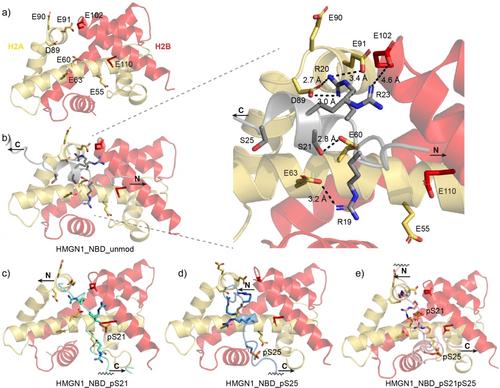
Intrinsically disordered proteins are abundant in the nucleus and are prime sites for posttranslational modifications that modulate transcriptional regulation. Lacking a defined three-dimensional structure, intrinsically disordered proteins populate an ensemble of several conformational states, which are dynamic and often altered by posttranslational modifications, or by binding to interaction partners. Although there is growing appreciation for the role that intrinsically disordered regions have in regulating protein-protein interactions, we still have a poor understanding of how to determine conformational population shifts, their causes under various conditions, and how to represent and model conformational ensembles. Here, we study the effects of serine phosphorylation in the nucleosome-binding domain of an intrinsically disordered protein – HMGN1 – using NMR spectroscopy, circular dichroism and modelling of protein complexes. We show that phosphorylation induces local conformational changes in the peptide backbone and decreases the helical propensity of the nucleosome binding domain. Modelling studies using AlphaFold3 suggest that phosphorylation disrupts the interface between HMGN1 and the nucleosome acidic patch, but that the models over-predict helicity in comparison to experimental data. These studies help us to build a picture of how posttranslational modifications might shift the conformational populations of disordered regions, alter access to histones, and regulate chromatin compaction.
期刊介绍:
ChemBioChem (Impact Factor 2018: 2.641) publishes important breakthroughs across all areas at the interface of chemistry and biology, including the fields of chemical biology, bioorganic chemistry, bioinorganic chemistry, synthetic biology, biocatalysis, bionanotechnology, and biomaterials. It is published on behalf of Chemistry Europe, an association of 16 European chemical societies, and supported by the Asian Chemical Editorial Society (ACES).





 京公网安备 11010802042870号
京ICP备2023020795号-1
京公网安备 11010802042870号
京ICP备2023020795号-1

 分享
分享
 求助内容:
求助内容: 应助结果提醒方式:
 扫码关注我们
