Debodipta Das, Xiaojing Wang, Yu-Chiao Chiu, Hakim Bouamar, Francis E Sharkey, Jorge E Lopera, Zhao Lai, Susan T Weintraub, Xianlin Han, Yi Zou, Hung-I H Chen, Carla R Zeballos Torrez, Xiang Gu, Matyas Cserhati, Joel E Michalek, Glenn A Halff, Yidong Chen, Siyuan Zheng, Francisco G Cigarroa, Lu-Zhe Sun
{"title":"Integrative multi-omics characterization of hepatocellular carcinoma in Hispanic patients.","authors":"Debodipta Das, Xiaojing Wang, Yu-Chiao Chiu, Hakim Bouamar, Francis E Sharkey, Jorge E Lopera, Zhao Lai, Susan T Weintraub, Xianlin Han, Yi Zou, Hung-I H Chen, Carla R Zeballos Torrez, Xiang Gu, Matyas Cserhati, Joel E Michalek, Glenn A Halff, Yidong Chen, Siyuan Zheng, Francisco G Cigarroa, Lu-Zhe Sun","doi":"10.1093/jnci/djae207","DOIUrl":null,"url":null,"abstract":"<p><strong>Background: </strong>The incidence and mortality rates of hepatocellular carcinoma among Hispanic individuals in the United States are much higher than in non-Hispanic White people. We conducted multi-omics analyses to elucidate molecular alterations in hepatocellular carcinoma among Hispanic patients.</p><p><strong>Methods: </strong>Paired tumor and adjacent nontumor samples were collected from 31 Hispanic hepatocellular carcinomas in South Texas for genomic, transcriptomic, proteomic, and metabolomic profiling. Serum lipids were profiled in 40 Hispanic and non-Hispanic patients with or without clinically diagnosed hepatocellular carcinoma.</p><p><strong>Results: </strong>Exome sequencing revealed high mutation frequencies of AXIN2 and CTNNB1 in South Texas Hispanic hepatocellular carcinoma patients, suggesting a predominant activation of the Wnt/β-catenin pathway. TERT promoter mutations were also statistically significantly more frequent in the Hispanic cohort (Fisher exact test, P < .05). Cell cycles and liver function were positively and negatively enriched, respectively, with gene set enrichment analysis. Gene sets representing specific liver metabolic pathways were associated with dysregulation of corresponding metabolites. Negative enrichment of liver adipogenesis and lipid metabolism corroborated with a significant reduction in most lipids in serum samples of hepatocellular carcinoma patients (paired t test, P < .0001). Two hepatocellular carcinoma subtypes from our Hispanic cohort were identified and validated with the Cancer Genome Atlas liver cancer cohort. Patients with better overall survival showed higher activity of immune and angiogenesis signatures and lower activity of liver function-related gene signatures. They also had higher levels of immune checkpoint and immune exhaustion markers.</p><p><strong>Conclusions: </strong>Our study revealed specific molecular features of Hispanic hepatocellular carcinoma and potential biomarkers for therapeutic management. It provides a unique resource for studying Hispanic hepatocellular carcinoma.</p>","PeriodicalId":14809,"journal":{"name":"JNCI Journal of the National Cancer Institute","volume":" ","pages":"1961-1978"},"PeriodicalIF":7.2000,"publicationDate":"2024-12-01","publicationTypes":"Journal Article","fieldsOfStudy":null,"isOpenAccess":false,"openAccessPdf":"https://www.ncbi.nlm.nih.gov/pmc/articles/PMC11630563/pdf/","citationCount":"0","resultStr":null,"platform":"Semanticscholar","paperid":null,"PeriodicalName":"JNCI Journal of the National Cancer Institute","FirstCategoryId":"3","ListUrlMain":"https://doi.org/10.1093/jnci/djae207","RegionNum":1,"RegionCategory":"医学","ArticlePicture":[],"TitleCN":null,"AbstractTextCN":null,"PMCID":null,"EPubDate":"","PubModel":"","JCR":"Q1","JCRName":"ONCOLOGY","Score":null,"Total":0}
引用次数: 0
Abstract
Background: The incidence and mortality rates of hepatocellular carcinoma among Hispanic individuals in the United States are much higher than in non-Hispanic White people. We conducted multi-omics analyses to elucidate molecular alterations in hepatocellular carcinoma among Hispanic patients.
Methods: Paired tumor and adjacent nontumor samples were collected from 31 Hispanic hepatocellular carcinomas in South Texas for genomic, transcriptomic, proteomic, and metabolomic profiling. Serum lipids were profiled in 40 Hispanic and non-Hispanic patients with or without clinically diagnosed hepatocellular carcinoma.
Results: Exome sequencing revealed high mutation frequencies of AXIN2 and CTNNB1 in South Texas Hispanic hepatocellular carcinoma patients, suggesting a predominant activation of the Wnt/β-catenin pathway. TERT promoter mutations were also statistically significantly more frequent in the Hispanic cohort (Fisher exact test, P < .05). Cell cycles and liver function were positively and negatively enriched, respectively, with gene set enrichment analysis. Gene sets representing specific liver metabolic pathways were associated with dysregulation of corresponding metabolites. Negative enrichment of liver adipogenesis and lipid metabolism corroborated with a significant reduction in most lipids in serum samples of hepatocellular carcinoma patients (paired t test, P < .0001). Two hepatocellular carcinoma subtypes from our Hispanic cohort were identified and validated with the Cancer Genome Atlas liver cancer cohort. Patients with better overall survival showed higher activity of immune and angiogenesis signatures and lower activity of liver function-related gene signatures. They also had higher levels of immune checkpoint and immune exhaustion markers.
Conclusions: Our study revealed specific molecular features of Hispanic hepatocellular carcinoma and potential biomarkers for therapeutic management. It provides a unique resource for studying Hispanic hepatocellular carcinoma.
期刊介绍:
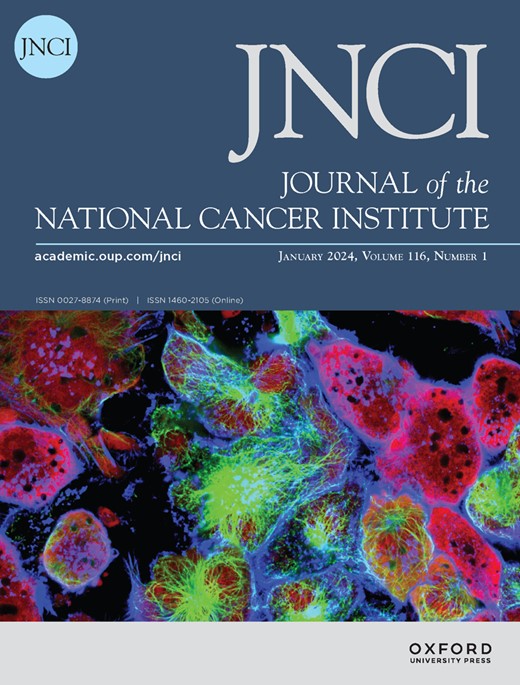
The Journal of the National Cancer Institute is a reputable publication that undergoes a peer-review process. It is available in both print (ISSN: 0027-8874) and online (ISSN: 1460-2105) formats, with 12 issues released annually. The journal's primary aim is to disseminate innovative and important discoveries in the field of cancer research, with specific emphasis on clinical, epidemiologic, behavioral, and health outcomes studies. Authors are encouraged to submit reviews, minireviews, and commentaries. The journal ensures that submitted manuscripts undergo a rigorous and expedited review to publish scientifically and medically significant findings in a timely manner.



 京公网安备 11010802042870号
京ICP备2023020795号-1
京公网安备 11010802042870号
京ICP备2023020795号-1

 分享
分享
 求助内容:
求助内容: 应助结果提醒方式:
 扫码关注我们
