Anna M Senatore, Francesco Mongelli, Federico U Mion, Massimo Lucchelli, Fabio Garofalo
{"title":"Costs of Robotic and Laparoscopic Bariatric Surgery: A Retrospective Propensity Score-matched Analysis.","authors":"Anna M Senatore, Francesco Mongelli, Federico U Mion, Massimo Lucchelli, Fabio Garofalo","doi":"10.1007/s11695-024-07477-x","DOIUrl":null,"url":null,"abstract":"<p><strong>Purpose: </strong>Robotic bariatric surgery has not shown significant advantages compared to laparoscopy, yet costs remain a major concern. The aim of our study was to assess costs of robotic and laparoscopic bariatric surgery.</p><p><strong>Materials and methods: </strong>We retrospectively collected data of all patients who underwent either robotic or laparoscopic bariatric surgery at our institution. We retrieved demographics, clinical characteristics, postoperative data, and costs using a bottom-up approach. The primary endpoint was hospital costs in the robotic and laparoscopic groups. Data was analyzed using a propensity score matching.</p><p><strong>Results: </strong>Out of the total 122 patients enrolled in the study, 42 were subsequently chosen based on propensity scores, with 21 patients allocated to each group. No difference in clinical characteristics and postoperative outcomes were noted. Length of hospital stay was 2.4 ± 0.7 days vs. 2.6 ± 1.1 days (p = 0.520). In the robotic and laparoscopic groups, total costs were USD 16,275 ± 4018 vs. 12,690 ± 2834 (absolute difference USD 3585, 95%CI 1416-5753, p = 0.002), direct costs were USD 5037 ± 1282 vs. 3720 ± 1308 (absolute difference USD 1316, 95% CI 509-2214, p = 0.002), and indirect costs were USD 11,238 ± 3234 vs. 8970 ± 3021 (absolute difference USD 2,268, 95% CI 317-4220, p = 0.024). Subgroup analyses revealed a decreasing trend in the cost difference in patients undergoing primary gastric bypass and revisional surgery.</p><p><strong>Conclusions: </strong>Overall hospital costs were higher in patients operated on with the robotic system than with laparoscopy, yet a clinical advantage has not been demonstrated so far. Subgroup analyses showed lesser disparity in costs among patients undergoing revisional bariatric surgery, where robotics are likely to be more worthwhile.</p>","PeriodicalId":19460,"journal":{"name":"Obesity Surgery","volume":" ","pages":"3694-3702"},"PeriodicalIF":3.1000,"publicationDate":"2024-10-01","publicationTypes":"Journal Article","fieldsOfStudy":null,"isOpenAccess":false,"openAccessPdf":"","citationCount":"0","resultStr":null,"platform":"Semanticscholar","paperid":null,"PeriodicalName":"Obesity Surgery","FirstCategoryId":"3","ListUrlMain":"https://doi.org/10.1007/s11695-024-07477-x","RegionNum":3,"RegionCategory":"医学","ArticlePicture":[],"TitleCN":null,"AbstractTextCN":null,"PMCID":null,"EPubDate":"2024/8/27 0:00:00","PubModel":"Epub","JCR":"Q1","JCRName":"SURGERY","Score":null,"Total":0}
引用次数: 0
Abstract
Purpose: Robotic bariatric surgery has not shown significant advantages compared to laparoscopy, yet costs remain a major concern. The aim of our study was to assess costs of robotic and laparoscopic bariatric surgery.
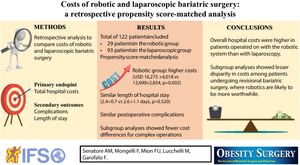
Materials and methods: We retrospectively collected data of all patients who underwent either robotic or laparoscopic bariatric surgery at our institution. We retrieved demographics, clinical characteristics, postoperative data, and costs using a bottom-up approach. The primary endpoint was hospital costs in the robotic and laparoscopic groups. Data was analyzed using a propensity score matching.
Results: Out of the total 122 patients enrolled in the study, 42 were subsequently chosen based on propensity scores, with 21 patients allocated to each group. No difference in clinical characteristics and postoperative outcomes were noted. Length of hospital stay was 2.4 ± 0.7 days vs. 2.6 ± 1.1 days (p = 0.520). In the robotic and laparoscopic groups, total costs were USD 16,275 ± 4018 vs. 12,690 ± 2834 (absolute difference USD 3585, 95%CI 1416-5753, p = 0.002), direct costs were USD 5037 ± 1282 vs. 3720 ± 1308 (absolute difference USD 1316, 95% CI 509-2214, p = 0.002), and indirect costs were USD 11,238 ± 3234 vs. 8970 ± 3021 (absolute difference USD 2,268, 95% CI 317-4220, p = 0.024). Subgroup analyses revealed a decreasing trend in the cost difference in patients undergoing primary gastric bypass and revisional surgery.
Conclusions: Overall hospital costs were higher in patients operated on with the robotic system than with laparoscopy, yet a clinical advantage has not been demonstrated so far. Subgroup analyses showed lesser disparity in costs among patients undergoing revisional bariatric surgery, where robotics are likely to be more worthwhile.
期刊介绍:
Obesity Surgery is the official journal of the International Federation for the Surgery of Obesity and metabolic disorders (IFSO). A journal for bariatric/metabolic surgeons, Obesity Surgery provides an international, interdisciplinary forum for communicating the latest research, surgical and laparoscopic techniques, for treatment of massive obesity and metabolic disorders. Topics covered include original research, clinical reports, current status, guidelines, historical notes, invited commentaries, letters to the editor, medicolegal issues, meeting abstracts, modern surgery/technical innovations, new concepts, reviews, scholarly presentations and opinions.
Obesity Surgery benefits surgeons performing obesity/metabolic surgery, general surgeons and surgical residents, endoscopists, anesthetists, support staff, nurses, dietitians, psychiatrists, psychologists, plastic surgeons, internists including endocrinologists and diabetologists, nutritional scientists, and those dealing with eating disorders.



 京公网安备 11010802042870号
京ICP备2023020795号-1
京公网安备 11010802042870号
京ICP备2023020795号-1

 分享
分享
 求助内容:
求助内容: 应助结果提醒方式:
 扫码关注我们
