{"title":"The number of drones to inseminate a queen with has little potential for optimization of honeybee breeding programs.","authors":"Manuel Du, Richard Bernstein, Andreas Hoppe","doi":"10.1186/s41065-024-00332-0","DOIUrl":null,"url":null,"abstract":"<p><strong>Background: </strong>Mating control is a crucial aspect of honeybee breeding. Instrumental insemination of queens gives the breeder maximum control over the genetic origin of the involved drones. However, in addition to the drones' descent, the breeder's control also extends over the number of drones to use for inseminations. Thus far, this aspect has largely been ignored in attempts to optimize honeybee breeding schemes. The literature provides some comparisons between single drone inseminations (SDI) and multi drone inseminations (MDI) but it is unclear whether the number of drones used in MDI is a relevant parameter for the optimization of honeybee breeding programs.</p><p><strong>Methods: </strong>By computer simulations, we investigated the effect of the number of drones per inseminated queen in breeding programs that relied on best linear unbiased prediction (BLUP) breeding values. We covered a range of 1 to 50 drones per queen and observed the developments of genetic gain and inbreeding over a period of 20 years. Hereby, we focused on insemination schemes that take the drones for one queen from a single colony.</p><p><strong>Results: </strong>SDI strategies led to 5.46% to 14.19% higher genetic gain than MDI at the cost of 6.1% to 30.2% higher inbreeding rates. The number of drones used in MDI settings had only a negligible impact on the results. There was a slight tendency that more drones lead to lower genetic gain and lower inbreeding rates but whenever more than five drones were used for inseminations, no significant differences could be observed.</p><p><strong>Conclusion: </strong>The opportunities to optimize breeding schemes via the number of drones used in inseminations are very limited. SDI can be a viable strategy in situations where breeders are interested in genetically homogeneous offspring or precise pedigree information. However, such strategies have to account for the fact that the semen from a single drone is insufficient to fill a queen's spermatheca, whence SDI queens will not build full-strength colonies. When deciding for MDI, breeders should focus on collecting enough semen for a succesful insemination, regardless of how many drones they need for this purpose.</p>","PeriodicalId":12862,"journal":{"name":"Hereditas","volume":"161 1","pages":"28"},"PeriodicalIF":2.5000,"publicationDate":"2024-08-27","publicationTypes":"Journal Article","fieldsOfStudy":null,"isOpenAccess":false,"openAccessPdf":"https://www.ncbi.nlm.nih.gov/pmc/articles/PMC11348579/pdf/","citationCount":"0","resultStr":null,"platform":"Semanticscholar","paperid":null,"PeriodicalName":"Hereditas","FirstCategoryId":"99","ListUrlMain":"https://doi.org/10.1186/s41065-024-00332-0","RegionNum":3,"RegionCategory":"生物学","ArticlePicture":[],"TitleCN":null,"AbstractTextCN":null,"PMCID":null,"EPubDate":"","PubModel":"","JCR":"","JCRName":"","Score":null,"Total":0}
引用次数: 0
Abstract
Background: Mating control is a crucial aspect of honeybee breeding. Instrumental insemination of queens gives the breeder maximum control over the genetic origin of the involved drones. However, in addition to the drones' descent, the breeder's control also extends over the number of drones to use for inseminations. Thus far, this aspect has largely been ignored in attempts to optimize honeybee breeding schemes. The literature provides some comparisons between single drone inseminations (SDI) and multi drone inseminations (MDI) but it is unclear whether the number of drones used in MDI is a relevant parameter for the optimization of honeybee breeding programs.
Methods: By computer simulations, we investigated the effect of the number of drones per inseminated queen in breeding programs that relied on best linear unbiased prediction (BLUP) breeding values. We covered a range of 1 to 50 drones per queen and observed the developments of genetic gain and inbreeding over a period of 20 years. Hereby, we focused on insemination schemes that take the drones for one queen from a single colony.
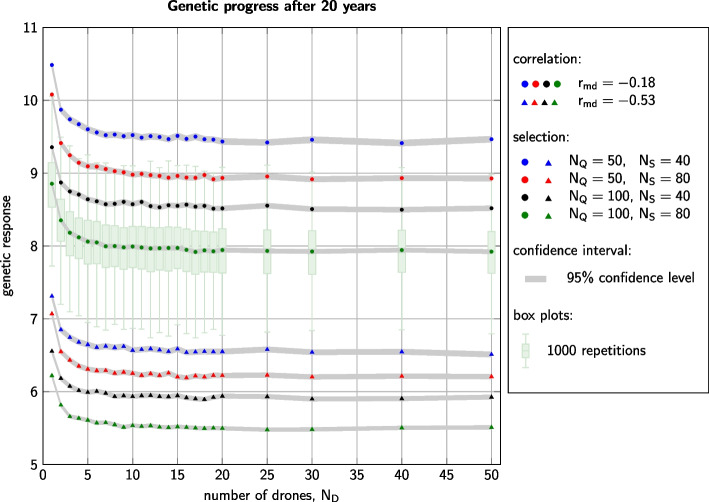
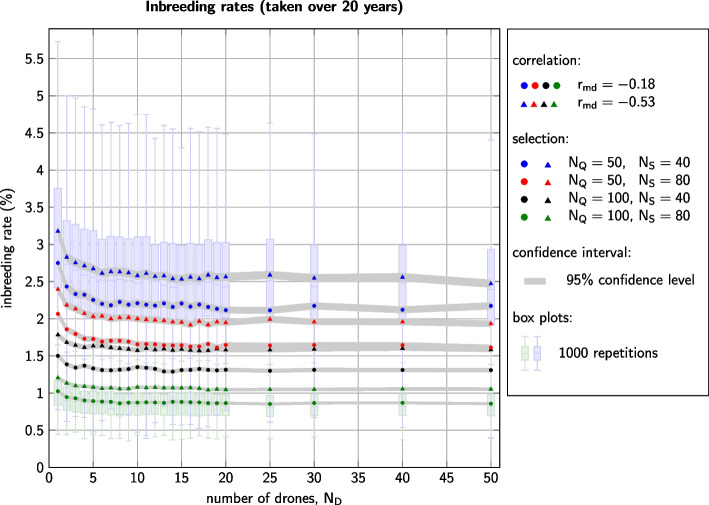
Results: SDI strategies led to 5.46% to 14.19% higher genetic gain than MDI at the cost of 6.1% to 30.2% higher inbreeding rates. The number of drones used in MDI settings had only a negligible impact on the results. There was a slight tendency that more drones lead to lower genetic gain and lower inbreeding rates but whenever more than five drones were used for inseminations, no significant differences could be observed.
Conclusion: The opportunities to optimize breeding schemes via the number of drones used in inseminations are very limited. SDI can be a viable strategy in situations where breeders are interested in genetically homogeneous offspring or precise pedigree information. However, such strategies have to account for the fact that the semen from a single drone is insufficient to fill a queen's spermatheca, whence SDI queens will not build full-strength colonies. When deciding for MDI, breeders should focus on collecting enough semen for a succesful insemination, regardless of how many drones they need for this purpose.
HereditasBiochemistry, Genetics and Molecular Biology-Genetics
CiteScore
3.80
自引率
3.70%
发文量
0
期刊介绍:
For almost a century, Hereditas has published original cutting-edge research and reviews. As the Official journal of the Mendelian Society of Lund, the journal welcomes research from across all areas of genetics and genomics. Topics of interest include human and medical genetics, animal and plant genetics, microbial genetics, agriculture and bioinformatics.



 京公网安备 11010802042870号
京ICP备2023020795号-1
京公网安备 11010802042870号
京ICP备2023020795号-1

 分享
分享
 求助内容:
求助内容: 应助结果提醒方式:
 扫码关注我们
