Matthias Diebold, Katharina A Mayer, Luis Hidalgo, Nicolas Kozakowski, Klemens Budde, Georg A Böhmig
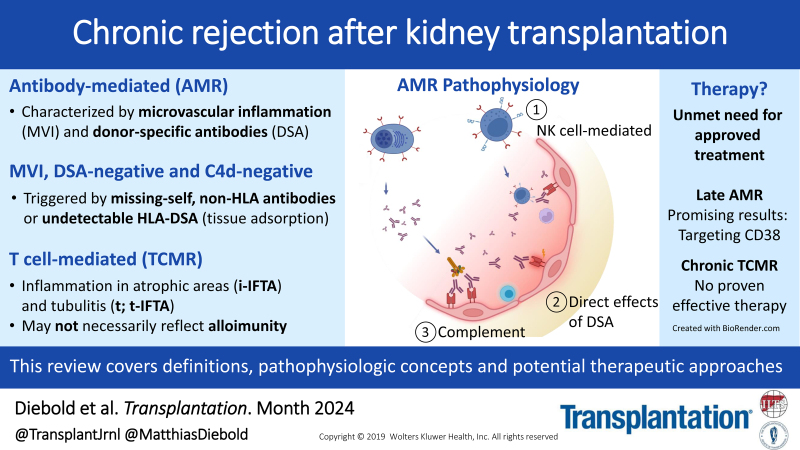
{"title":"Chronic Rejection After Kidney Transplantation.","authors":"Matthias Diebold, Katharina A Mayer, Luis Hidalgo, Nicolas Kozakowski, Klemens Budde, Georg A Böhmig","doi":"10.1097/TP.0000000000005187","DOIUrl":null,"url":null,"abstract":"<p><p>In kidney transplantation, ongoing alloimmune processes-commonly triggered by HLA incompatibilities-can trigger chronic transplant rejection, affecting the microcirculation and the tubulointerstitium. Continuous inflammation may lead to progressive, irreversible graft injury, culminating in graft dysfunction and accelerated transplant failure. Numerous experimental and translational studies have delineated a complex interplay of different immune mechanisms driving rejection, with antibody-mediated rejection (AMR) being an extensively studied rejection variant. In microvascular inflammation, a hallmark lesion of AMR, natural killer (NK) cells have emerged as pivotal effector cells. Their essential role is supported by immunohistologic evidence, bulk and spatial transcriptomics, and functional genetics. Despite significant research efforts, a substantial unmet need for approved rejection therapies persists, with many trials yielding negative outcomes. However, several promising therapies are currently under investigation, including felzartamab, a monoclonal antibody targeting the surface molecule CD38, which is highly expressed in NK cells and antibody-producing plasma cells. In an exploratory phase 2 trial in late AMR, this compound has demonstrated potential in resolving molecular and morphologic rejection activity and injury, predominantly by targeting NK cell effector function. These findings inspire hope for effective treatments and emphasize the necessity of further pivotal trials focusing on chronic transplant rejection.</p>","PeriodicalId":23316,"journal":{"name":"Transplantation","volume":" ","pages":"610-621"},"PeriodicalIF":5.0000,"publicationDate":"2025-04-01","publicationTypes":"Journal Article","fieldsOfStudy":null,"isOpenAccess":false,"openAccessPdf":"https://www.ncbi.nlm.nih.gov/pmc/articles/PMC11927446/pdf/","citationCount":"0","resultStr":null,"platform":"Semanticscholar","paperid":null,"PeriodicalName":"Transplantation","FirstCategoryId":"3","ListUrlMain":"https://doi.org/10.1097/TP.0000000000005187","RegionNum":2,"RegionCategory":"医学","ArticlePicture":[],"TitleCN":null,"AbstractTextCN":null,"PMCID":null,"EPubDate":"2024/8/28 0:00:00","PubModel":"Epub","JCR":"Q1","JCRName":"IMMUNOLOGY","Score":null,"Total":0}
引用次数: 0
Abstract
In kidney transplantation, ongoing alloimmune processes-commonly triggered by HLA incompatibilities-can trigger chronic transplant rejection, affecting the microcirculation and the tubulointerstitium. Continuous inflammation may lead to progressive, irreversible graft injury, culminating in graft dysfunction and accelerated transplant failure. Numerous experimental and translational studies have delineated a complex interplay of different immune mechanisms driving rejection, with antibody-mediated rejection (AMR) being an extensively studied rejection variant. In microvascular inflammation, a hallmark lesion of AMR, natural killer (NK) cells have emerged as pivotal effector cells. Their essential role is supported by immunohistologic evidence, bulk and spatial transcriptomics, and functional genetics. Despite significant research efforts, a substantial unmet need for approved rejection therapies persists, with many trials yielding negative outcomes. However, several promising therapies are currently under investigation, including felzartamab, a monoclonal antibody targeting the surface molecule CD38, which is highly expressed in NK cells and antibody-producing plasma cells. In an exploratory phase 2 trial in late AMR, this compound has demonstrated potential in resolving molecular and morphologic rejection activity and injury, predominantly by targeting NK cell effector function. These findings inspire hope for effective treatments and emphasize the necessity of further pivotal trials focusing on chronic transplant rejection.
在肾移植过程中,持续的异体免疫过程--通常由 HLA 不相容引发--会引发慢性移植排斥反应,影响微循环和肾小管间质。持续的炎症可能导致渐进性、不可逆的移植物损伤,最终导致移植物功能障碍,加速移植失败。大量的实验和转化研究已经勾勒出驱动排斥反应的不同免疫机制之间复杂的相互作用,其中抗体介导的排斥反应(AMR)是被广泛研究的排斥反应变体。微血管炎症是 AMR 的标志性病变,在微血管炎症中,自然杀伤(NK)细胞已成为关键的效应细胞。免疫组织学证据、大量和空间转录组学以及功能遗传学都证明了它们的重要作用。尽管开展了大量的研究工作,但对已获批准的排斥疗法的大量需求仍未得到满足,许多试验都产生了负面结果。不过,目前有几种前景看好的疗法正在研究中,其中包括费尔扎他单抗(felzartamab),这是一种靶向表面分子 CD38 的单克隆抗体,CD38 在 NK 细胞和产生抗体的浆细胞中高度表达。在一项晚期 AMR 的探索性 2 期试验中,这种化合物主要通过靶向 NK 细胞效应功能,在解决分子和形态学排斥活动和损伤方面表现出了潜力。这些发现为有效治疗带来了希望,并强调了进一步开展以慢性移植排斥反应为重点的关键性试验的必要性。
期刊介绍:
The official journal of The Transplantation Society, and the International Liver Transplantation Society, Transplantation is published monthly and is the most cited and influential journal in the field, with more than 25,000 citations per year.
Transplantation has been the trusted source for extensive and timely coverage of the most important advances in transplantation for over 50 years. The Editors and Editorial Board are an international group of research and clinical leaders that includes many pioneers of the field, representing a diverse range of areas of expertise. This capable editorial team provides thoughtful and thorough peer review, and delivers rapid, careful and insightful editorial evaluation of all manuscripts submitted to the journal.
Transplantation is committed to rapid review and publication. The journal remains competitive with a time to first decision of fewer than 21 days. Transplantation was the first in the field to offer CME credit to its peer reviewers for reviews completed.
The journal publishes original research articles in original clinical science and original basic science. Short reports bring attention to research at the forefront of the field. Other areas covered include cell therapy and islet transplantation, immunobiology and genomics, and xenotransplantation.





 京公网安备 11010802042870号
京ICP备2023020795号-1
京公网安备 11010802042870号
京ICP备2023020795号-1

 分享
分享
 求助内容:
求助内容: 应助结果提醒方式:
 扫码关注我们
