Nicholas B Murphy, Marat Slessarev, John Basmaji, Laurie Blackstock, Michael Blaszak, Mayur Brahmania, Jennifer A Chandler, Sonny Dhanani, Matthew Gaulton, Jed A Gross, Andrew Healey, Lorelei Lingard, Mary Ott, Sam D Shemie, Charles Weijer
{"title":"Ethical Issues in Normothermic Regional Perfusion in Controlled Organ Donation After Determination of Death by Circulatory Criteria: A Scoping Review.","authors":"Nicholas B Murphy, Marat Slessarev, John Basmaji, Laurie Blackstock, Michael Blaszak, Mayur Brahmania, Jennifer A Chandler, Sonny Dhanani, Matthew Gaulton, Jed A Gross, Andrew Healey, Lorelei Lingard, Mary Ott, Sam D Shemie, Charles Weijer","doi":"10.1097/TP.0000000000005161","DOIUrl":null,"url":null,"abstract":"<p><p>Normothermic regional perfusion (NRP) is a surgical technique that can improve the quality and number of organs recovered for donation after the determination of death by circulatory criteria. Despite its promise, adoption of NRP has been hindered because of unresolved ethical issues. To inform stakeholders, this scoping review provides an impartial overview of the major ethical controversies surrounding NRP. We undertook this review according to a modified 5-step methodology proposed by Arksey and O'Malley. Publications were retrieved through MEDLINE and Embase. Gray literature was sourced from Canadian organ donation organizations, English-language organ donation organization websites, and through our research networks. Three reviewers independently screened all documents for inclusion, extracted data, and participated in content analysis. Disagreements were resolved through consensus meetings. Seventy-one documents substantively engaging with ethical issues in NRP were included for full-text analysis. We identified 6 major themes encompassing a range of overlapping ethical debates: (1) the compatibility of NRP with the dead donor rule, the injunction that organ recovery cannot cause death, (2) the risk of donor harm posed by NRP, (3) uncertainties regarding consent requirements for NRP, (4) risks to stakeholder trust posed by NRP, (5) the implications of NRP for justice, and (6) NRP's potential to benefits of NRP for stakeholders. We found no agreement on the ethical permissibility of NRP. However, some debates may be resolved through additional empirical study. As decision-makers contemplate the adoption of NRP, it is critical to address the ethical issues facing the technique to ensure stakeholder trust in deceased donation and transplantation systems is preserved.</p>","PeriodicalId":23316,"journal":{"name":"Transplantation","volume":" ","pages":"597-609"},"PeriodicalIF":5.0000,"publicationDate":"2025-04-01","publicationTypes":"Journal Article","fieldsOfStudy":null,"isOpenAccess":false,"openAccessPdf":"https://www.ncbi.nlm.nih.gov/pmc/articles/PMC11927451/pdf/","citationCount":"0","resultStr":null,"platform":"Semanticscholar","paperid":null,"PeriodicalName":"Transplantation","FirstCategoryId":"3","ListUrlMain":"https://doi.org/10.1097/TP.0000000000005161","RegionNum":2,"RegionCategory":"医学","ArticlePicture":[],"TitleCN":null,"AbstractTextCN":null,"PMCID":null,"EPubDate":"2024/8/28 0:00:00","PubModel":"Epub","JCR":"Q1","JCRName":"IMMUNOLOGY","Score":null,"Total":0}
引用次数: 0
Abstract
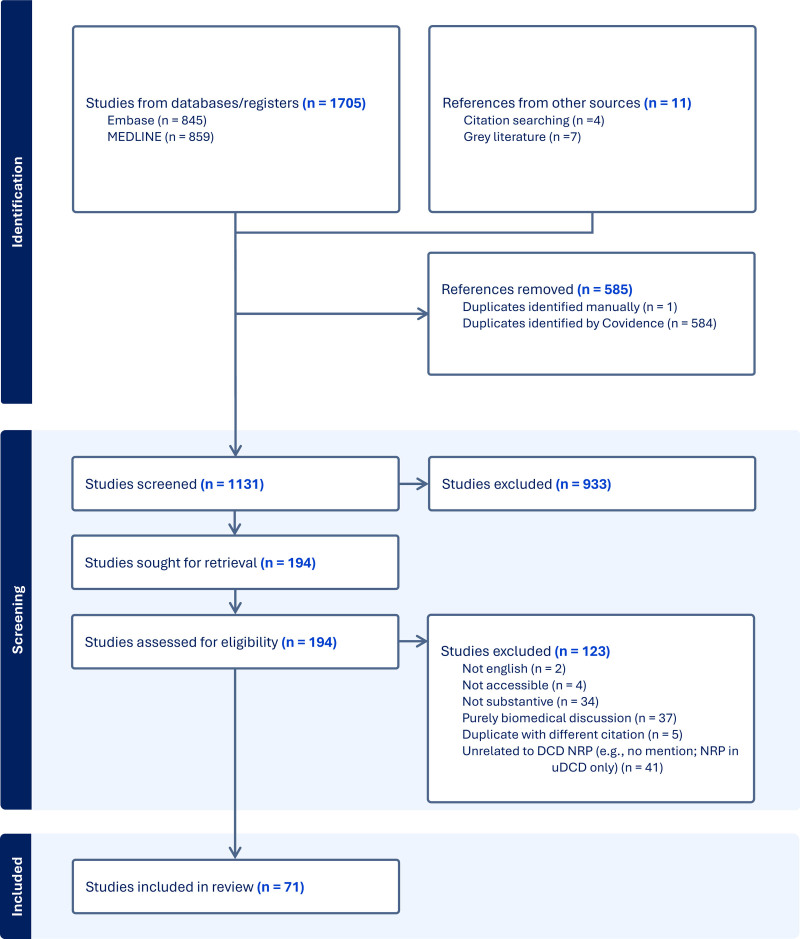
Normothermic regional perfusion (NRP) is a surgical technique that can improve the quality and number of organs recovered for donation after the determination of death by circulatory criteria. Despite its promise, adoption of NRP has been hindered because of unresolved ethical issues. To inform stakeholders, this scoping review provides an impartial overview of the major ethical controversies surrounding NRP. We undertook this review according to a modified 5-step methodology proposed by Arksey and O'Malley. Publications were retrieved through MEDLINE and Embase. Gray literature was sourced from Canadian organ donation organizations, English-language organ donation organization websites, and through our research networks. Three reviewers independently screened all documents for inclusion, extracted data, and participated in content analysis. Disagreements were resolved through consensus meetings. Seventy-one documents substantively engaging with ethical issues in NRP were included for full-text analysis. We identified 6 major themes encompassing a range of overlapping ethical debates: (1) the compatibility of NRP with the dead donor rule, the injunction that organ recovery cannot cause death, (2) the risk of donor harm posed by NRP, (3) uncertainties regarding consent requirements for NRP, (4) risks to stakeholder trust posed by NRP, (5) the implications of NRP for justice, and (6) NRP's potential to benefits of NRP for stakeholders. We found no agreement on the ethical permissibility of NRP. However, some debates may be resolved through additional empirical study. As decision-makers contemplate the adoption of NRP, it is critical to address the ethical issues facing the technique to ensure stakeholder trust in deceased donation and transplantation systems is preserved.
期刊介绍:
The official journal of The Transplantation Society, and the International Liver Transplantation Society, Transplantation is published monthly and is the most cited and influential journal in the field, with more than 25,000 citations per year.
Transplantation has been the trusted source for extensive and timely coverage of the most important advances in transplantation for over 50 years. The Editors and Editorial Board are an international group of research and clinical leaders that includes many pioneers of the field, representing a diverse range of areas of expertise. This capable editorial team provides thoughtful and thorough peer review, and delivers rapid, careful and insightful editorial evaluation of all manuscripts submitted to the journal.
Transplantation is committed to rapid review and publication. The journal remains competitive with a time to first decision of fewer than 21 days. Transplantation was the first in the field to offer CME credit to its peer reviewers for reviews completed.
The journal publishes original research articles in original clinical science and original basic science. Short reports bring attention to research at the forefront of the field. Other areas covered include cell therapy and islet transplantation, immunobiology and genomics, and xenotransplantation.





 京公网安备 11010802042870号
京ICP备2023020795号-1
京公网安备 11010802042870号
京ICP备2023020795号-1

 分享
分享
 求助内容:
求助内容: 应助结果提醒方式:
 扫码关注我们
