Assessing the diagnostic accuracy of postnatal clinical scoring methods and foot length measurement for estimating gestational age and birthweight of newborns in low- and middle-income countries: a systematic review and meta-analysis.
Shiyam Sunder Tikmani, Thomas Mårtensson, Sumaira Khalid, Muhammad Uzair, Qammerulanissa Ali, Anum Rahim, Andreas Mårtensson, Sarah Saleem, Nick Brown
{"title":"Assessing the diagnostic accuracy of postnatal clinical scoring methods and foot length measurement for estimating gestational age and birthweight of newborns in low- and middle-income countries: a systematic review and meta-analysis.","authors":"Shiyam Sunder Tikmani, Thomas Mårtensson, Sumaira Khalid, Muhammad Uzair, Qammerulanissa Ali, Anum Rahim, Andreas Mårtensson, Sarah Saleem, Nick Brown","doi":"10.1136/bmjpo-2024-002717","DOIUrl":null,"url":null,"abstract":"<p><strong>Background: </strong>This study aimed to update systematic reviews and meta-analyses on the diagnostic accuracy of postnatal clinical scoring (PCS) methods and foot length (FL) measurement for assessing gestational age (GA) and birth weight in low-income and middle-income countries (LMICs). In addition, the quality of reference standards, including antenatal ultrasound (A-US), last menstrual period (LMP), PCS and newborn weighing scales, was also evaluated.</p><p><strong>Methods: </strong>Studies from LMICs published between January 2000 and February 2024 were searched, using databases such as PubMed, Web of Science, Cochrane Library, CINAHL and Scopus. Studies that compared PCS and/or FL with LMP and/or A-US to estimate GA or used calibrated newborn weighing scales for birthweight estimation were included. The risk of bias was assessed using the Quality Assessment of Diagnostic Accuracy Studies-II tool and evaluated the quality of the reference standards. When sufficient data were available, pooled estimates were calculated using random-effects models.</p><p><strong>Results: </strong>A total of 50 studies were included. A-US was a reasonable tool for GA assessment if conducted by physicians using fetal biometry and the Hadlock method for GA estimation. LMP was reasonable when women had regular cycles, knew their LMP, were not using contraceptives and LMP data were collected by healthcare providers. When A-US was used as the reference standard, PCS methods estimated GA with a precision of ±2.8 to ±3.2 weeks. FL measurement <7.5 cm showed a pooled sensitivity of 76.2% and specificity of 36.6% for identifying preterm birth. FL measurement ≤7.6 cm had a pooled sensitivity of 78.6% and specificity of 65.7% for identifying low birth weight (LBW). High heterogeneity across studies was observed.</p><p><strong>Conclusion: </strong>This systematic review and meta-analysis highlights significant variability and methodological inconsistencies in using PCS methods and FL measurement for estimating GA and LBW in LMICs. The observed high heterogeneity across studies suggests a cautious interpretation of the results.</p><p><strong>Prospero registration number: </strong>CRD42020209455.</p>","PeriodicalId":9069,"journal":{"name":"BMJ Paediatrics Open","volume":"8 1","pages":""},"PeriodicalIF":2.3000,"publicationDate":"2024-08-30","publicationTypes":"Journal Article","fieldsOfStudy":null,"isOpenAccess":false,"openAccessPdf":"https://www.ncbi.nlm.nih.gov/pmc/articles/PMC11367336/pdf/","citationCount":"0","resultStr":null,"platform":"Semanticscholar","paperid":null,"PeriodicalName":"BMJ Paediatrics Open","FirstCategoryId":"3","ListUrlMain":"https://doi.org/10.1136/bmjpo-2024-002717","RegionNum":4,"RegionCategory":"医学","ArticlePicture":[],"TitleCN":null,"AbstractTextCN":null,"PMCID":null,"EPubDate":"","PubModel":"","JCR":"Q2","JCRName":"PEDIATRICS","Score":null,"Total":0}
引用次数: 0
Abstract
Background: This study aimed to update systematic reviews and meta-analyses on the diagnostic accuracy of postnatal clinical scoring (PCS) methods and foot length (FL) measurement for assessing gestational age (GA) and birth weight in low-income and middle-income countries (LMICs). In addition, the quality of reference standards, including antenatal ultrasound (A-US), last menstrual period (LMP), PCS and newborn weighing scales, was also evaluated.
Methods: Studies from LMICs published between January 2000 and February 2024 were searched, using databases such as PubMed, Web of Science, Cochrane Library, CINAHL and Scopus. Studies that compared PCS and/or FL with LMP and/or A-US to estimate GA or used calibrated newborn weighing scales for birthweight estimation were included. The risk of bias was assessed using the Quality Assessment of Diagnostic Accuracy Studies-II tool and evaluated the quality of the reference standards. When sufficient data were available, pooled estimates were calculated using random-effects models.
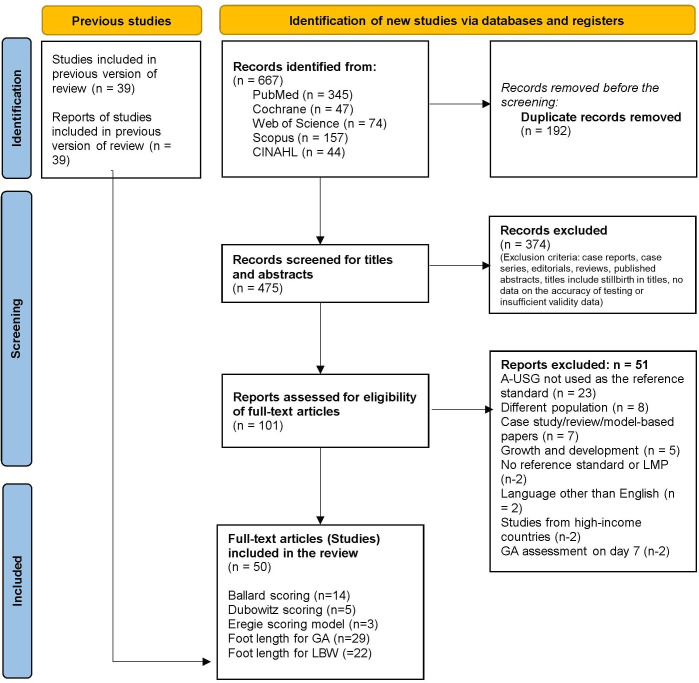
Results: A total of 50 studies were included. A-US was a reasonable tool for GA assessment if conducted by physicians using fetal biometry and the Hadlock method for GA estimation. LMP was reasonable when women had regular cycles, knew their LMP, were not using contraceptives and LMP data were collected by healthcare providers. When A-US was used as the reference standard, PCS methods estimated GA with a precision of ±2.8 to ±3.2 weeks. FL measurement <7.5 cm showed a pooled sensitivity of 76.2% and specificity of 36.6% for identifying preterm birth. FL measurement ≤7.6 cm had a pooled sensitivity of 78.6% and specificity of 65.7% for identifying low birth weight (LBW). High heterogeneity across studies was observed.
Conclusion: This systematic review and meta-analysis highlights significant variability and methodological inconsistencies in using PCS methods and FL measurement for estimating GA and LBW in LMICs. The observed high heterogeneity across studies suggests a cautious interpretation of the results.




 京公网安备 11010802042870号
京ICP备2023020795号-1
京公网安备 11010802042870号
京ICP备2023020795号-1

 分享
分享
 求助内容:
求助内容: 应助结果提醒方式:
 扫码关注我们
