Andrew Vallejo, Matthew W. Lee, Maximilian Klar, Jason D. Wright, Koji Matsuo
{"title":"Assessment of early-death in gynecologic malignancy in the United States","authors":"Andrew Vallejo, Matthew W. Lee, Maximilian Klar, Jason D. Wright, Koji Matsuo","doi":"10.1002/ijgo.15890","DOIUrl":null,"url":null,"abstract":"<p>Early death following the diagnosis of malignancy, even if expected, regardless of the etiology from patient-, disease-, and healthcare-related reasons, may pose a grave emotional and psychological impact to the patient's family.<span><sup>1, 2</sup></span> Prior investigations on early death in gynecologic malignancies were limited, but available data showed a wide range of early-death rates across ovarian, uterine, cervical, vulvar, and vaginal cancers.<span><sup>3</sup></span> Yet, these statistics of gynecologic cancers in relation to other malignancies were understudied, especially as stratified by gender. The objective of this study was to describe early death in patients with gynecologic malignancy who received care at the Commission-on-Cancer facilities in the United States.</p><p>This retrospective cohort study examined the National Cancer Database, a nationwide tumor registry collaboratory mechanism between the American Cancer Society and the American College of Surgeons.<span><sup>4</sup></span> Their data-capturing mechanism collects more than 70% of new incident cancer cases in each year in the United States.</p><p>The study population was 12 805 885 patients from 27 gender-stratified malignancy groups diagnosed from 2004 to 2019 who had follow-up of at least 2 months after the diagnosis: (i) 1 173 955 patients with five gynecologic malignancies (uterus [<i>n</i> = 639 591], tubo-ovary [<i>n</i> = 285 452], cervix [<i>n</i> = 156 616], vulva [<i>n</i> = 75 514], and vagina [<i>n</i> = 15 496]); (ii) 7 107 174 female patients with 11 non-gynecologic malignancies (breast, lung, colo-rectum, central nervous system, bladder, kidney, pancreas, liver, lymphoma, leukemia, and myeloma); and (iii) 4 524 756 male patients with 11 non-gynecologic malignancies.</p><p>Early death, defined as mortality within 2 months from the date of cancer diagnosis,<span><sup>1, 2</sup></span> was described based on malignancy type. Sensitivity analyses included race and ethnicity specific evaluations. The University of Southern California institutional review boards deemed this study exempt as it included only publicly available, deidentified data (registration no. UP-23-00221).</p><p>Across the 27 gender-stratified malignancy groups, early-death rates ranged from 0.7% for female breast cancer to 22.7% for male pancreatic cancer with the median early-death rate of 6.4% for female colorectal cancer (ranked 14th of 27 groups; Figure 1). There were six malignancy groups in which the early-death rates exceeded 15%: 22.7% for male pancreatic cancer, 21.8% for female pancreatic cancer, 19.4% for male liver cancer, 18.0% for male lung cancer, 17.4% for female liver cancer, 16.1% for female leukemia, and 15.0% for male leukemia (Figure 1).</p><p>All five gynecologic malignancies had early-death rates of lower than the median of early-death rate rank (6.4% for female colorectal cancer, 14th of 27 groups), including 6.2% for tubo-ovarian cancer (ranked 15th), 2.8% for vaginal cancer (ranked 22nd), 2.0% for cervical cancer (ranked 23rd), 1.5% for uterine cancer (ranked 24th), and 1.1% for vulvar cancer (ranked 26th; Figure 1).</p><p>These statistics were consistent when stratified for race and ethnicity, except for non-Hispanic black patients with tubo-ovarian cancer in which the early-death rate was 8.5% and ranked 10th highest among 27 genders-stratified malignancy groups and higher than other racial and ethnic groups (6.2% for non-Hispanic White [ranked 15th], 4.5% for Hispanic [ranked 15th], 3.5% for Asian [ranked 15th], and 3.4% for Native American [ranked 19th]) (Figures S1–S5).</p><p>The results of current real-world data across the Commission-on-Cancer facilities suggest that patients with gynecologic malignancy had overall lower rates of early death following diagnosis compared with non-gynecologic malignancies, with the exception of non-Hispanic black patients with tubo-ovarian cancer.</p><p>Key limitations included lack of data on cause of death, patient-related factors including comorbidity, performance status, and living-will, tumor-related factors, including extent of malignancy and anti-cancer treatment, and healthcare-related factors, including access to care and hospital quality for cancer care. Together with the results of prior investigations,<span><sup>3</sup></span> further studies to assess early death in this patient group are necessary, including early death as a quality indicator in oncologic care.<span><sup>5</sup></span></p><p>Conceptualization: KM, JDW; data curation: MWL; formal analysis: KM; funding acquisition: KM; investigation: all authors; methodology: KM; project administration: MWL, KM; resources: MK, JDW; software: KM, MWL; supervision: KM, MK, JDW; validation: KM; visualization: KM; writing—original draft: AV, KM; writing—review and editing: all authors.</p><p>Ensign Endowment for Gynecologic Cancer Research (KM). The funder had no role in the design and conduct of the study; collection, management, analysis, and interpretation of the data; preparation, review, or approval of the manuscript; and decision to submit the manuscript for publication.</p><p>All conflicts of interest were unrelated to the work: consultation, Cooper Surgical, AstraZeneca, Immunogen, and KLS Martin (MK); research grant, Merck, royalties, UpToDate, honoraria, American College of Obstetricians and Gynecologists (JDW). The remaining authors have no conflicts of interest.</p>","PeriodicalId":14164,"journal":{"name":"International Journal of Gynecology & Obstetrics","volume":"168 2","pages":"838-840"},"PeriodicalIF":2.4000,"publicationDate":"2024-09-02","publicationTypes":"Journal Article","fieldsOfStudy":null,"isOpenAccess":false,"openAccessPdf":"https://www.ncbi.nlm.nih.gov/pmc/articles/PMC11726126/pdf/","citationCount":"0","resultStr":null,"platform":"Semanticscholar","paperid":null,"PeriodicalName":"International Journal of Gynecology & Obstetrics","FirstCategoryId":"3","ListUrlMain":"https://obgyn.onlinelibrary.wiley.com/doi/10.1002/ijgo.15890","RegionNum":3,"RegionCategory":"医学","ArticlePicture":[],"TitleCN":null,"AbstractTextCN":null,"PMCID":null,"EPubDate":"","PubModel":"","JCR":"Q2","JCRName":"OBSTETRICS & GYNECOLOGY","Score":null,"Total":0}
引用次数: 0
Abstract
Early death following the diagnosis of malignancy, even if expected, regardless of the etiology from patient-, disease-, and healthcare-related reasons, may pose a grave emotional and psychological impact to the patient's family.1, 2 Prior investigations on early death in gynecologic malignancies were limited, but available data showed a wide range of early-death rates across ovarian, uterine, cervical, vulvar, and vaginal cancers.3 Yet, these statistics of gynecologic cancers in relation to other malignancies were understudied, especially as stratified by gender. The objective of this study was to describe early death in patients with gynecologic malignancy who received care at the Commission-on-Cancer facilities in the United States.
This retrospective cohort study examined the National Cancer Database, a nationwide tumor registry collaboratory mechanism between the American Cancer Society and the American College of Surgeons.4 Their data-capturing mechanism collects more than 70% of new incident cancer cases in each year in the United States.
The study population was 12 805 885 patients from 27 gender-stratified malignancy groups diagnosed from 2004 to 2019 who had follow-up of at least 2 months after the diagnosis: (i) 1 173 955 patients with five gynecologic malignancies (uterus [n = 639 591], tubo-ovary [n = 285 452], cervix [n = 156 616], vulva [n = 75 514], and vagina [n = 15 496]); (ii) 7 107 174 female patients with 11 non-gynecologic malignancies (breast, lung, colo-rectum, central nervous system, bladder, kidney, pancreas, liver, lymphoma, leukemia, and myeloma); and (iii) 4 524 756 male patients with 11 non-gynecologic malignancies.
Early death, defined as mortality within 2 months from the date of cancer diagnosis,1, 2 was described based on malignancy type. Sensitivity analyses included race and ethnicity specific evaluations. The University of Southern California institutional review boards deemed this study exempt as it included only publicly available, deidentified data (registration no. UP-23-00221).
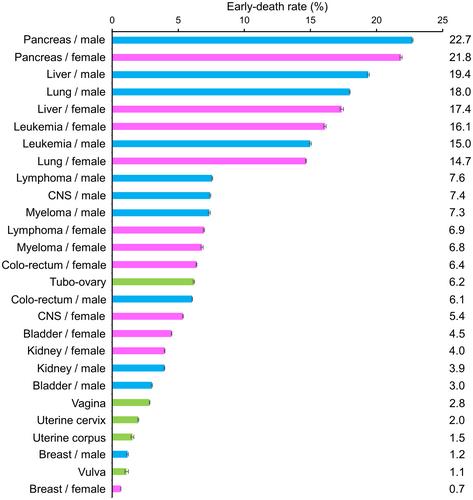
Across the 27 gender-stratified malignancy groups, early-death rates ranged from 0.7% for female breast cancer to 22.7% for male pancreatic cancer with the median early-death rate of 6.4% for female colorectal cancer (ranked 14th of 27 groups; Figure 1). There were six malignancy groups in which the early-death rates exceeded 15%: 22.7% for male pancreatic cancer, 21.8% for female pancreatic cancer, 19.4% for male liver cancer, 18.0% for male lung cancer, 17.4% for female liver cancer, 16.1% for female leukemia, and 15.0% for male leukemia (Figure 1).
All five gynecologic malignancies had early-death rates of lower than the median of early-death rate rank (6.4% for female colorectal cancer, 14th of 27 groups), including 6.2% for tubo-ovarian cancer (ranked 15th), 2.8% for vaginal cancer (ranked 22nd), 2.0% for cervical cancer (ranked 23rd), 1.5% for uterine cancer (ranked 24th), and 1.1% for vulvar cancer (ranked 26th; Figure 1).
These statistics were consistent when stratified for race and ethnicity, except for non-Hispanic black patients with tubo-ovarian cancer in which the early-death rate was 8.5% and ranked 10th highest among 27 genders-stratified malignancy groups and higher than other racial and ethnic groups (6.2% for non-Hispanic White [ranked 15th], 4.5% for Hispanic [ranked 15th], 3.5% for Asian [ranked 15th], and 3.4% for Native American [ranked 19th]) (Figures S1–S5).
The results of current real-world data across the Commission-on-Cancer facilities suggest that patients with gynecologic malignancy had overall lower rates of early death following diagnosis compared with non-gynecologic malignancies, with the exception of non-Hispanic black patients with tubo-ovarian cancer.
Key limitations included lack of data on cause of death, patient-related factors including comorbidity, performance status, and living-will, tumor-related factors, including extent of malignancy and anti-cancer treatment, and healthcare-related factors, including access to care and hospital quality for cancer care. Together with the results of prior investigations,3 further studies to assess early death in this patient group are necessary, including early death as a quality indicator in oncologic care.5
Conceptualization: KM, JDW; data curation: MWL; formal analysis: KM; funding acquisition: KM; investigation: all authors; methodology: KM; project administration: MWL, KM; resources: MK, JDW; software: KM, MWL; supervision: KM, MK, JDW; validation: KM; visualization: KM; writing—original draft: AV, KM; writing—review and editing: all authors.
Ensign Endowment for Gynecologic Cancer Research (KM). The funder had no role in the design and conduct of the study; collection, management, analysis, and interpretation of the data; preparation, review, or approval of the manuscript; and decision to submit the manuscript for publication.
All conflicts of interest were unrelated to the work: consultation, Cooper Surgical, AstraZeneca, Immunogen, and KLS Martin (MK); research grant, Merck, royalties, UpToDate, honoraria, American College of Obstetricians and Gynecologists (JDW). The remaining authors have no conflicts of interest.
期刊介绍:
The International Journal of Gynecology & Obstetrics publishes articles on all aspects of basic and clinical research in the fields of obstetrics and gynecology and related subjects, with emphasis on matters of worldwide interest.





 京公网安备 11010802042870号
京ICP备2023020795号-1
京公网安备 11010802042870号
京ICP备2023020795号-1

 分享
分享

 求助内容:
求助内容: 应助结果提醒方式:
 扫码关注我们
