{"title":"Trends in Mental Disorders in Children and Adolescents Receiving Treatment in the State Mental Health System","authors":"Ramin Mojtabai MD, PhD, MPH , Mark Olfson MD, MPH","doi":"10.1016/j.jaac.2024.08.008","DOIUrl":null,"url":null,"abstract":"<div><h3>Objective</h3><div>To examine recent trends in clinical diagnoses of children and adolescents receiving treatment in publicly funded mental health treatment services in the United States.</div></div><div><h3>Method</h3><div>Data on children and adolescents (≤17 years) receiving treatment from publicly funded mental health treatment services recorded in Mental Health Client-Level Data 2013-2021 (total number of records = 13,684,154) were used to examine temporal trends in the proportion of different child and adolescent psychiatric disorders. Trends were examined overall and in age, sex, racial/ethnic, and service strata focusing on community-based programs.</div></div><div><h3>Results</h3><div>The analyses revealed increases in the proportion of anxiety disorders from 9.6% in 2013 to 19.2% in 2021 (adjusted odds ratio [AOR] 2.17, 95% CI 1.85-2.55, <em>p</em> < .001), trauma- and stressor-related disorders from 22.7% to 27.4% (AOR 1.31, 95% CI 1.09-1.57, <em>p</em> = .004), and depressive disorders from 13.4% to 17.0% (AOR 1.20, 95% CI 1.03-1.41, <em>p</em> = .04). During this same period, the proportion of bipolar disorders declined almost 8-fold from 10.0% to 1.3% (AOR 0.07, 95% CI 0.06-0.09, <em>p</em> < .001). The proportion of conduct disorder and oppositional defiant disorder also declined from 9.7% to 4.4% (AOR 0.42, 95% CI 0.32-0.55, <em>p</em> < .001) and from 11.1% to 7.8% (AOR 0.79, 95% CI 0.65-0.98, <em>p</em> = .03), respectively. Trends varied across sex, age, and racial/ethnic strata.</div></div><div><h3>Conclusion</h3><div>The composition of childhood psychiatric diagnoses in patients within publicly funded mental health treatment settings changed over the past decade. While some of the trends may reflect changes in diagnostic practices of clinicians, increases in anxiety and depressive disorders parallel trends in the prevalence of these conditions in the general population and highlight a growing need for identifying and treating these conditions in this age group.</div></div><div><h3>Plain language summary</h3><div>Utilizing the records of services for children and adolescents (≤17 years) receiving treatment from publicly funded mental health treatment services that recorded in Mental Health Client-Level Data (n∼13.5 million), the authors found increases in the proportion of anxiety disorders, trauma- and stressor-related disorders, and depressive disorders between 2013 to 2021. During this same period, the proportion of bipolar disorders, conduct disorder, and oppositional defiant disorder declined. While some of these trends may reflect changes in diagnostic practices of clinicians, increases in anxiety and depressive disorders parallel trends in the prevalence of these conditions in the general population. Results highlight the need for identifying and treating pediatric depression, anxiety, and trauma-related disorders.</div></div>","PeriodicalId":17186,"journal":{"name":"Journal of the American Academy of Child and Adolescent Psychiatry","volume":"64 8","pages":"Pages 906-920"},"PeriodicalIF":9.5000,"publicationDate":"2024-08-28","publicationTypes":"Journal Article","fieldsOfStudy":null,"isOpenAccess":false,"openAccessPdf":"","citationCount":"0","resultStr":null,"platform":"Semanticscholar","paperid":null,"PeriodicalName":"Journal of the American Academy of Child and Adolescent Psychiatry","FirstCategoryId":"3","ListUrlMain":"https://www.sciencedirect.com/science/article/pii/S0890856724013571","RegionNum":1,"RegionCategory":"医学","ArticlePicture":[],"TitleCN":null,"AbstractTextCN":null,"PMCID":null,"EPubDate":"","PubModel":"","JCR":"Q1","JCRName":"PEDIATRICS","Score":null,"Total":0}
引用次数: 0
Abstract
Objective
To examine recent trends in clinical diagnoses of children and adolescents receiving treatment in publicly funded mental health treatment services in the United States.
Method
Data on children and adolescents (≤17 years) receiving treatment from publicly funded mental health treatment services recorded in Mental Health Client-Level Data 2013-2021 (total number of records = 13,684,154) were used to examine temporal trends in the proportion of different child and adolescent psychiatric disorders. Trends were examined overall and in age, sex, racial/ethnic, and service strata focusing on community-based programs.
Results
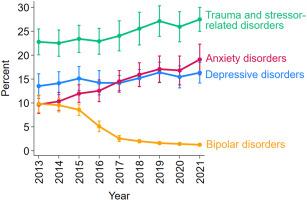
The analyses revealed increases in the proportion of anxiety disorders from 9.6% in 2013 to 19.2% in 2021 (adjusted odds ratio [AOR] 2.17, 95% CI 1.85-2.55, p < .001), trauma- and stressor-related disorders from 22.7% to 27.4% (AOR 1.31, 95% CI 1.09-1.57, p = .004), and depressive disorders from 13.4% to 17.0% (AOR 1.20, 95% CI 1.03-1.41, p = .04). During this same period, the proportion of bipolar disorders declined almost 8-fold from 10.0% to 1.3% (AOR 0.07, 95% CI 0.06-0.09, p < .001). The proportion of conduct disorder and oppositional defiant disorder also declined from 9.7% to 4.4% (AOR 0.42, 95% CI 0.32-0.55, p < .001) and from 11.1% to 7.8% (AOR 0.79, 95% CI 0.65-0.98, p = .03), respectively. Trends varied across sex, age, and racial/ethnic strata.
Conclusion
The composition of childhood psychiatric diagnoses in patients within publicly funded mental health treatment settings changed over the past decade. While some of the trends may reflect changes in diagnostic practices of clinicians, increases in anxiety and depressive disorders parallel trends in the prevalence of these conditions in the general population and highlight a growing need for identifying and treating these conditions in this age group.
Plain language summary
Utilizing the records of services for children and adolescents (≤17 years) receiving treatment from publicly funded mental health treatment services that recorded in Mental Health Client-Level Data (n∼13.5 million), the authors found increases in the proportion of anxiety disorders, trauma- and stressor-related disorders, and depressive disorders between 2013 to 2021. During this same period, the proportion of bipolar disorders, conduct disorder, and oppositional defiant disorder declined. While some of these trends may reflect changes in diagnostic practices of clinicians, increases in anxiety and depressive disorders parallel trends in the prevalence of these conditions in the general population. Results highlight the need for identifying and treating pediatric depression, anxiety, and trauma-related disorders.
期刊介绍:
The Journal of the American Academy of Child & Adolescent Psychiatry (JAACAP) is dedicated to advancing the field of child and adolescent psychiatry through the publication of original research and papers of theoretical, scientific, and clinical significance. Our primary focus is on the mental health of children, adolescents, and families.
We welcome unpublished manuscripts that explore various perspectives, ranging from genetic, epidemiological, neurobiological, and psychopathological research, to cognitive, behavioral, psychodynamic, and other psychotherapeutic investigations. We also encourage submissions that delve into parent-child, interpersonal, and family research, as well as clinical and empirical studies conducted in inpatient, outpatient, consultation-liaison, and school-based settings.
In addition to publishing research, we aim to promote the well-being of children and families by featuring scholarly papers on topics such as health policy, legislation, advocacy, culture, society, and service provision in relation to mental health.
At JAACAP, we strive to foster collaboration and dialogue among researchers, clinicians, and policy-makers in order to enhance our understanding and approach to child and adolescent mental health.



 京公网安备 11010802042870号
京ICP备2023020795号-1
京公网安备 11010802042870号
京ICP备2023020795号-1

 分享
分享
 求助内容:
求助内容: 应助结果提醒方式:
 扫码关注我们
