Wen-Qiang He, Hannah Catherine Moore, Jessica E Miller, David P Burgner, Olivia Swann, Samantha J Lain, Natasha Nassar
{"title":"Impact of early childhood infection on child development and school performance: a population-based study.","authors":"Wen-Qiang He, Hannah Catherine Moore, Jessica E Miller, David P Burgner, Olivia Swann, Samantha J Lain, Natasha Nassar","doi":"10.1136/jech-2024-222040","DOIUrl":null,"url":null,"abstract":"<p><strong>Background: </strong>Childhood infection might be associated with adverse child development and neurocognitive outcomes, but the results have been inconsistent.</p><p><strong>Methods: </strong>Two population-based record-linkage cohorts of all singleton children born at term in New South Wales, Australia, from 2001 to 2014, were set up and followed up to 2019 for developmental outcome (N=276 454) and school performance (N=644 291). The primary outcome was developmentally high risk (DHR) at age 4-6 years and numeracy and reading below the national minimum standard at age 7-9 years. Cox regression was used to assess the association of childhood infection ascertained from hospital records with each outcome adjusting for maternal, birth and child characteristics, and sensitivity analyses were conducted assessing E-values and sibling analysis for discordant exposure.</p><p><strong>Results: </strong>A higher proportion of children with an infection-related hospitalisation were DHR (10.9% vs 8.7%) and had numeracy (3.7% vs 2.7%) and reading results (4.3% vs 3.1%) below the national minimum standard, compared with those without infection-related hospitalisation. In the multivariable analysis, children with infection-related hospitalisation were more likely to be DHR (adjusted HR 1.12, 95% CI 1.08 to 1.15) and have numeracy (adjusted HR 1.22, 95% CI 1.18 to 1.26) and reading results (adjusted HR 1.16, 95% CI 1.12 to 1.20) below the national minimum standard. However, these results may be impacted by unmeasured confounding, based on E-values of 1.48-1.74, and minimal association with education outcome was found in the sibling analysis.</p><p><strong>Conclusions: </strong>Infection-related hospitalisation was modestly associated with adverse child development and school performance, but the association may be explained by shared familial factors, particularly in those with most socioeconomic disadvantages.</p>","PeriodicalId":54839,"journal":{"name":"Journal of Epidemiology and Community Health","volume":" ","pages":"27-35"},"PeriodicalIF":3.7000,"publicationDate":"2024-12-10","publicationTypes":"Journal Article","fieldsOfStudy":null,"isOpenAccess":false,"openAccessPdf":"https://www.ncbi.nlm.nih.gov/pmc/articles/PMC11671983/pdf/","citationCount":"0","resultStr":null,"platform":"Semanticscholar","paperid":null,"PeriodicalName":"Journal of Epidemiology and Community Health","FirstCategoryId":"3","ListUrlMain":"https://doi.org/10.1136/jech-2024-222040","RegionNum":2,"RegionCategory":"医学","ArticlePicture":[],"TitleCN":null,"AbstractTextCN":null,"PMCID":null,"EPubDate":"","PubModel":"","JCR":"Q1","JCRName":"PUBLIC, ENVIRONMENTAL & OCCUPATIONAL HEALTH","Score":null,"Total":0}
引用次数: 0
Abstract
Background: Childhood infection might be associated with adverse child development and neurocognitive outcomes, but the results have been inconsistent.
Methods: Two population-based record-linkage cohorts of all singleton children born at term in New South Wales, Australia, from 2001 to 2014, were set up and followed up to 2019 for developmental outcome (N=276 454) and school performance (N=644 291). The primary outcome was developmentally high risk (DHR) at age 4-6 years and numeracy and reading below the national minimum standard at age 7-9 years. Cox regression was used to assess the association of childhood infection ascertained from hospital records with each outcome adjusting for maternal, birth and child characteristics, and sensitivity analyses were conducted assessing E-values and sibling analysis for discordant exposure.
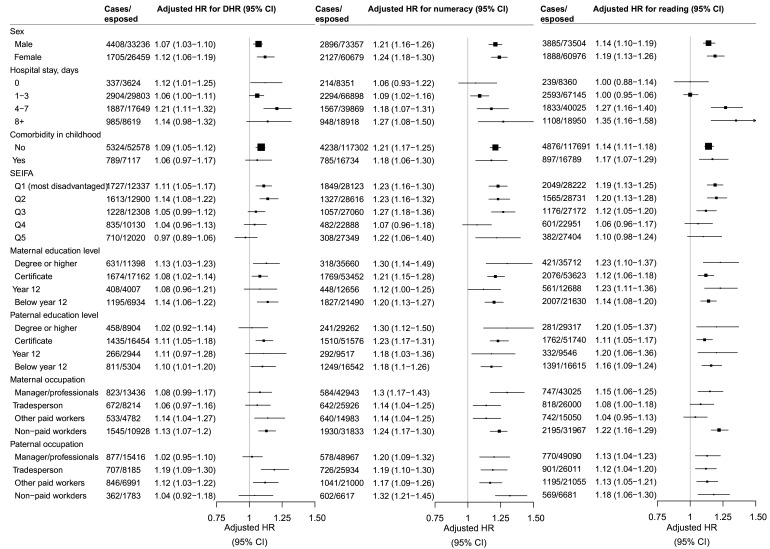
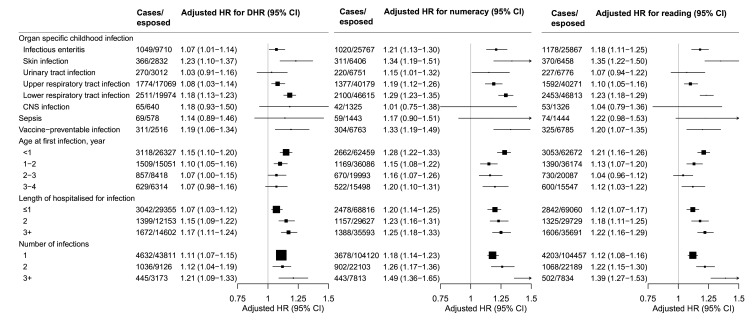
Results: A higher proportion of children with an infection-related hospitalisation were DHR (10.9% vs 8.7%) and had numeracy (3.7% vs 2.7%) and reading results (4.3% vs 3.1%) below the national minimum standard, compared with those without infection-related hospitalisation. In the multivariable analysis, children with infection-related hospitalisation were more likely to be DHR (adjusted HR 1.12, 95% CI 1.08 to 1.15) and have numeracy (adjusted HR 1.22, 95% CI 1.18 to 1.26) and reading results (adjusted HR 1.16, 95% CI 1.12 to 1.20) below the national minimum standard. However, these results may be impacted by unmeasured confounding, based on E-values of 1.48-1.74, and minimal association with education outcome was found in the sibling analysis.
Conclusions: Infection-related hospitalisation was modestly associated with adverse child development and school performance, but the association may be explained by shared familial factors, particularly in those with most socioeconomic disadvantages.
期刊介绍:
The Journal of Epidemiology and Community Health is a leading international journal devoted to publication of original research and reviews covering applied, methodological and theoretical issues with emphasis on studies using multidisciplinary or integrative approaches. The journal aims to improve epidemiological knowledge and ultimately health worldwide.



 京公网安备 11010802042870号
京ICP备2023020795号-1
京公网安备 11010802042870号
京ICP备2023020795号-1

 分享
分享
 求助内容:
求助内容: 应助结果提醒方式:
 扫码关注我们
