{"title":"The brain-heart-immune axis: a vago-centric framework for predicting and enhancing resilient recovery in older surgery patients.","authors":"Leah Acker, Kevin Xu, J P Ginsberg","doi":"10.1186/s42234-024-00155-4","DOIUrl":null,"url":null,"abstract":"<p><p>Nearly all geriatric surgical complications are studied in the context of a single organ system, e.g., cardiac complications and the heart; delirium and the brain; infections and the immune system. Yet, we know that advanced age, physiological stress, and infection all increase sympathetic and decrease parasympathetic nervous system function. Parasympathetic function is mediated through the vagus nerve, which connects the heart, brain, and immune system to form, what we have termed, the brain-heart-immune axis. We hypothesize that this brain-heart-immune axis plays a critical role in surgical recovery among older adults. In particular, we hypothesize that the brain-heart-immune axis plays a critical role in the most common surgical complication among older adults: postoperative delirium. Further, we present heart rate variability as a measure that may eventually become a multi-system vital sign evaluating brain-heart-immune axis function. Finally, we suggest the brain-heart-immune axis as a potential interventional target for bio-electronic neuro-immune modulation to enhance resilient surgical recovery among older adults.</p>","PeriodicalId":72363,"journal":{"name":"Bioelectronic medicine","volume":"10 1","pages":"21"},"PeriodicalIF":0.0000,"publicationDate":"2024-09-02","publicationTypes":"Journal Article","fieldsOfStudy":null,"isOpenAccess":false,"openAccessPdf":"https://www.ncbi.nlm.nih.gov/pmc/articles/PMC11367755/pdf/","citationCount":"0","resultStr":null,"platform":"Semanticscholar","paperid":null,"PeriodicalName":"Bioelectronic medicine","FirstCategoryId":"1085","ListUrlMain":"https://doi.org/10.1186/s42234-024-00155-4","RegionNum":0,"RegionCategory":null,"ArticlePicture":[],"TitleCN":null,"AbstractTextCN":null,"PMCID":null,"EPubDate":"","PubModel":"","JCR":"","JCRName":"","Score":null,"Total":0}
引用次数: 0
Abstract
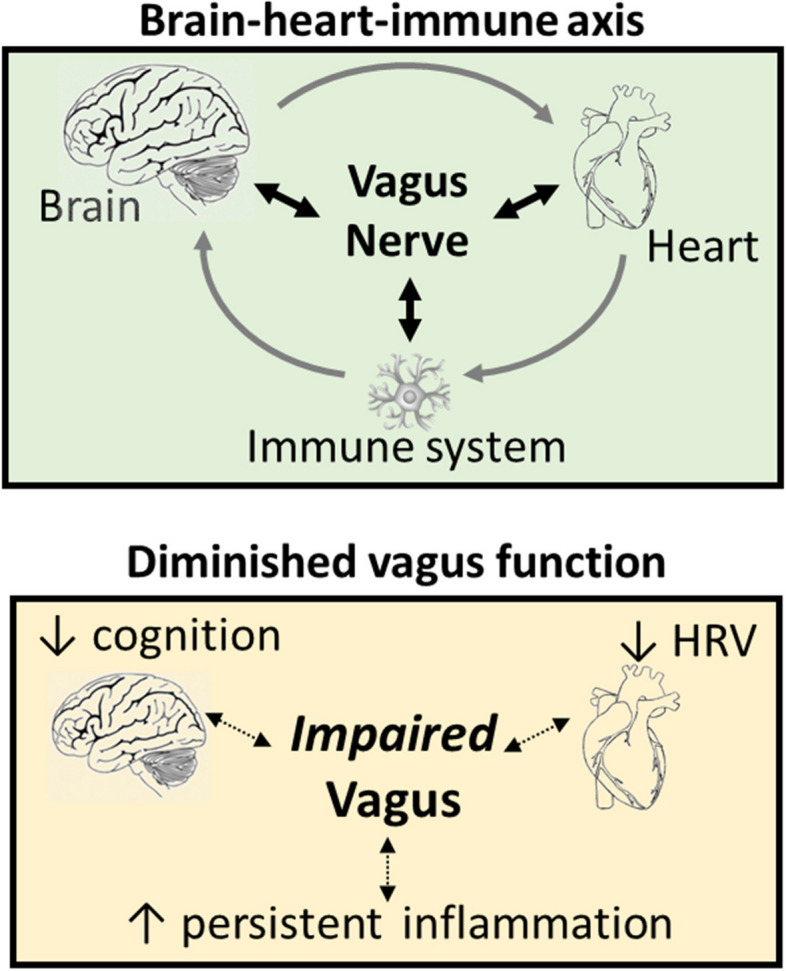
Nearly all geriatric surgical complications are studied in the context of a single organ system, e.g., cardiac complications and the heart; delirium and the brain; infections and the immune system. Yet, we know that advanced age, physiological stress, and infection all increase sympathetic and decrease parasympathetic nervous system function. Parasympathetic function is mediated through the vagus nerve, which connects the heart, brain, and immune system to form, what we have termed, the brain-heart-immune axis. We hypothesize that this brain-heart-immune axis plays a critical role in surgical recovery among older adults. In particular, we hypothesize that the brain-heart-immune axis plays a critical role in the most common surgical complication among older adults: postoperative delirium. Further, we present heart rate variability as a measure that may eventually become a multi-system vital sign evaluating brain-heart-immune axis function. Finally, we suggest the brain-heart-immune axis as a potential interventional target for bio-electronic neuro-immune modulation to enhance resilient surgical recovery among older adults.



 京公网安备 11010802042870号
京ICP备2023020795号-1
京公网安备 11010802042870号
京ICP备2023020795号-1

 分享
分享

 求助内容:
求助内容: 应助结果提醒方式:
 扫码关注我们
