{"title":"Internal structure of <i>Mycoplasma mobile</i> gliding machinery analyzed by negative staining electron tomography.","authors":"Minoru Fukushima, Takuma Toyonaga, Yuhei O Tahara, Daisuke Nakane, Makoto Miyata","doi":"10.2142/biophysico.bppb-v21.0015","DOIUrl":null,"url":null,"abstract":"<p><p><i>Mycoplasma mobile</i> is a parasitic bacterium that forms gliding machinery on the cell pole and glides on a solid surface in the direction of the cell pole. The gliding machinery consists of both internal and surface structures. The internal structure is divided into a bell at the front and chain structure extending from the bell. In this study, the internal structures prepared under several conditions were analyzed using negative-staining electron microscopy and electron tomography. The chains were constructed by linked motors containing two complexes similar to ATP synthase. A cylindrical spacer with a maximum diameter of 6 nm and a height of 13 nm, and anonymous linkers with a diameter of 0.9-8.3 nm and length of 14.7±6.9 nm were found between motors. The bell is bowl-shaped and features a honeycomb surface with a periodicity of 8.4 nm. The chains of the motor are connected to the rim of the bell through a wedge-shaped structure. These structures may play roles in the assembly and cooperation of gliding machinery units.</p>","PeriodicalId":101323,"journal":{"name":"Biophysics and physicobiology","volume":"21 2","pages":"e210015"},"PeriodicalIF":1.6000,"publicationDate":"2024-05-28","publicationTypes":"Journal Article","fieldsOfStudy":null,"isOpenAccess":false,"openAccessPdf":"https://www.ncbi.nlm.nih.gov/pmc/articles/PMC11347822/pdf/","citationCount":"0","resultStr":null,"platform":"Semanticscholar","paperid":null,"PeriodicalName":"Biophysics and physicobiology","FirstCategoryId":"1085","ListUrlMain":"https://doi.org/10.2142/biophysico.bppb-v21.0015","RegionNum":0,"RegionCategory":null,"ArticlePicture":[],"TitleCN":null,"AbstractTextCN":null,"PMCID":null,"EPubDate":"2024/1/1 0:00:00","PubModel":"eCollection","JCR":"Q4","JCRName":"BIOPHYSICS","Score":null,"Total":0}
引用次数: 0
Abstract
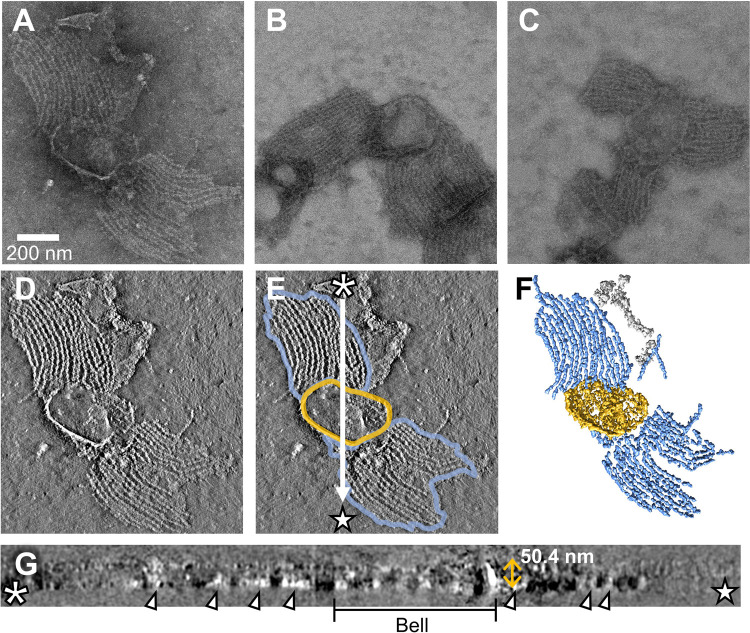
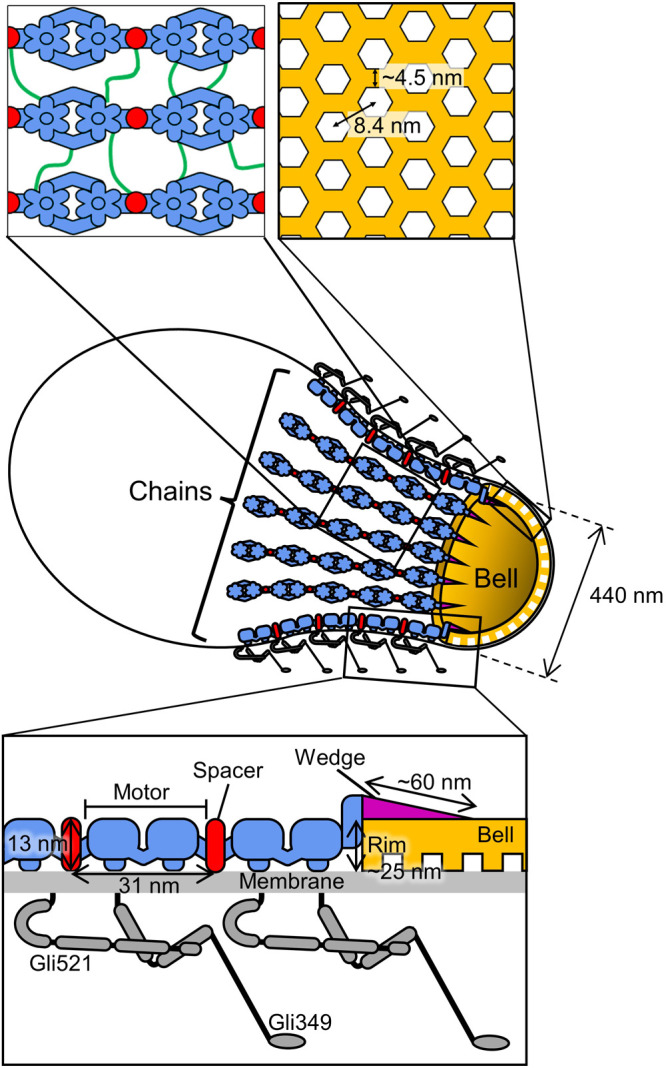
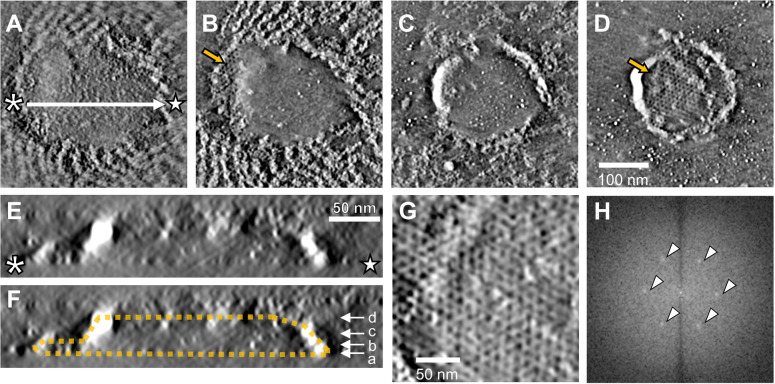
Mycoplasma mobile is a parasitic bacterium that forms gliding machinery on the cell pole and glides on a solid surface in the direction of the cell pole. The gliding machinery consists of both internal and surface structures. The internal structure is divided into a bell at the front and chain structure extending from the bell. In this study, the internal structures prepared under several conditions were analyzed using negative-staining electron microscopy and electron tomography. The chains were constructed by linked motors containing two complexes similar to ATP synthase. A cylindrical spacer with a maximum diameter of 6 nm and a height of 13 nm, and anonymous linkers with a diameter of 0.9-8.3 nm and length of 14.7±6.9 nm were found between motors. The bell is bowl-shaped and features a honeycomb surface with a periodicity of 8.4 nm. The chains of the motor are connected to the rim of the bell through a wedge-shaped structure. These structures may play roles in the assembly and cooperation of gliding machinery units.



 京公网安备 11010802042870号
京ICP备2023020795号-1
京公网安备 11010802042870号
京ICP备2023020795号-1

 分享
分享

 求助内容:
求助内容: 应助结果提醒方式:
 扫码关注我们
