Haoze Li, Shan Jiang, Shan He, Yingbing Zhang, Ye Chen, Li Wang, Jianping Yang
{"title":"Accelerated Solar-Driven Polyolefin Degradation via Self-Activated Hydroxy-Rich ZnIn<sub>2</sub>S<sub>4</sub>.","authors":"Haoze Li, Shan Jiang, Shan He, Yingbing Zhang, Ye Chen, Li Wang, Jianping Yang","doi":"10.1021/acs.nanolett.4c03067","DOIUrl":null,"url":null,"abstract":"<p><p>Degradation of polyolefin (PE) plastic by a traditional chemical method requires a high pressure and a high temperature but generates complex products. Here, sulfur vacancy-rich ZnIn<sub>2</sub>S<sub>4</sub> and hydroxy-rich ZnIn<sub>2</sub>S<sub>4</sub> were rationally fabricated to realize photocatalytic degradation of PE in an aqueous solution under mild conditions. The results reveal that the optimized photocatalyst could degrade PE into CO<sub>2</sub> and CO, and PE had a weight loss of 84.5% after reaction for 60 h. Systematic experiments confirm that the synergetic effect of hydroxyl groups and S vacancies contributes to improve the photocatalytic degradation properties of plastic wastes. In-depth investigation illustrates that the active radicals attack (h<sup>+</sup> and •OH) weak spots (C-H and C-C bonds) of the PE chain to form CO<sub>2</sub>, which is further selectively photoreduced to CO. Multimodule synergistic tandem catalysis can further improve the utilization value of plastic wastes; for example, product CO<sub>2</sub>/CO in the plastic degradation process can be converted in situ into HCOOH by coupling with electrocatalytic technology.</p>","PeriodicalId":53,"journal":{"name":"Nano Letters","volume":" ","pages":"11624-11631"},"PeriodicalIF":9.1000,"publicationDate":"2024-09-18","publicationTypes":"Journal Article","fieldsOfStudy":null,"isOpenAccess":false,"openAccessPdf":"","citationCount":"0","resultStr":null,"platform":"Semanticscholar","paperid":null,"PeriodicalName":"Nano Letters","FirstCategoryId":"88","ListUrlMain":"https://doi.org/10.1021/acs.nanolett.4c03067","RegionNum":1,"RegionCategory":"材料科学","ArticlePicture":[],"TitleCN":null,"AbstractTextCN":null,"PMCID":null,"EPubDate":"2024/9/3 0:00:00","PubModel":"Epub","JCR":"Q1","JCRName":"CHEMISTRY, MULTIDISCIPLINARY","Score":null,"Total":0}
引用次数: 0
Abstract
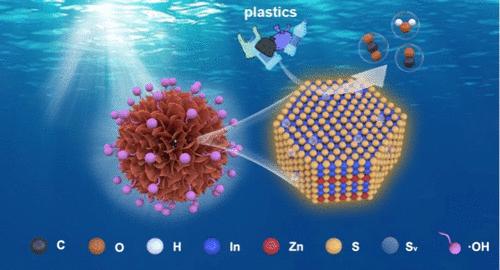
Degradation of polyolefin (PE) plastic by a traditional chemical method requires a high pressure and a high temperature but generates complex products. Here, sulfur vacancy-rich ZnIn2S4 and hydroxy-rich ZnIn2S4 were rationally fabricated to realize photocatalytic degradation of PE in an aqueous solution under mild conditions. The results reveal that the optimized photocatalyst could degrade PE into CO2 and CO, and PE had a weight loss of 84.5% after reaction for 60 h. Systematic experiments confirm that the synergetic effect of hydroxyl groups and S vacancies contributes to improve the photocatalytic degradation properties of plastic wastes. In-depth investigation illustrates that the active radicals attack (h+ and •OH) weak spots (C-H and C-C bonds) of the PE chain to form CO2, which is further selectively photoreduced to CO. Multimodule synergistic tandem catalysis can further improve the utilization value of plastic wastes; for example, product CO2/CO in the plastic degradation process can be converted in situ into HCOOH by coupling with electrocatalytic technology.
期刊介绍:
Nano Letters serves as a dynamic platform for promptly disseminating original results in fundamental, applied, and emerging research across all facets of nanoscience and nanotechnology. A pivotal criterion for inclusion within Nano Letters is the convergence of at least two different areas or disciplines, ensuring a rich interdisciplinary scope. The journal is dedicated to fostering exploration in diverse areas, including:
- Experimental and theoretical findings on physical, chemical, and biological phenomena at the nanoscale
- Synthesis, characterization, and processing of organic, inorganic, polymer, and hybrid nanomaterials through physical, chemical, and biological methodologies
- Modeling and simulation of synthetic, assembly, and interaction processes
- Realization of integrated nanostructures and nano-engineered devices exhibiting advanced performance
- Applications of nanoscale materials in living and environmental systems
Nano Letters is committed to advancing and showcasing groundbreaking research that intersects various domains, fostering innovation and collaboration in the ever-evolving field of nanoscience and nanotechnology.



 京公网安备 11010802042870号
京ICP备2023020795号-1
京公网安备 11010802042870号
京ICP备2023020795号-1

 分享
分享
 求助内容:
求助内容: 应助结果提醒方式:
 扫码关注我们
