Phu N. Tran, Sattvic Ray, Linnea Lemma, Yunrui Li, Reef Sweeney, Aparna Baskaran, Zvonimir Dogic, Pengyu Hong and Michael F. Hagan
{"title":"Deep-learning optical flow for measuring velocity fields from experimental data†‡","authors":"Phu N. Tran, Sattvic Ray, Linnea Lemma, Yunrui Li, Reef Sweeney, Aparna Baskaran, Zvonimir Dogic, Pengyu Hong and Michael F. Hagan","doi":"10.1039/D4SM00483C","DOIUrl":null,"url":null,"abstract":"<p >Deep learning-based optical flow (DLOF) extracts features in adjacent video frames with deep convolutional neural networks. It uses those features to estimate the inter-frame motions of objects. We evaluate the ability of optical flow to quantify the spontaneous flows of microtubule (MT)-based active nematics under different labeling conditions, and compare its performance to particle image velocimetry (PIV). We obtain flow velocity ground truths either by performing semi-automated particle tracking on samples with sparsely labeled filaments, or from passive tracer beads. DLOF produces more accurate velocity fields than PIV for densely labeled samples. PIV cannot reliably distinguish contrast variations at high densities, particularly along the nematic director. DLOF overcomes this limitation. For sparsely labeled samples, DLOF and PIV produce comparable results, but DLOF gives higher-resolution fields. Our work establishes DLOF as a versatile tool for measuring fluid flows in a broad class of active, soft, and biophysical systems.</p>","PeriodicalId":103,"journal":{"name":"Soft Matter","volume":" 36","pages":" 7246-7257"},"PeriodicalIF":2.8000,"publicationDate":"2024-08-23","publicationTypes":"Journal Article","fieldsOfStudy":null,"isOpenAccess":false,"openAccessPdf":"https://pubs.rsc.org/en/content/articlepdf/2024/sm/d4sm00483c?page=search","citationCount":"0","resultStr":null,"platform":"Semanticscholar","paperid":null,"PeriodicalName":"Soft Matter","FirstCategoryId":"92","ListUrlMain":"https://pubs.rsc.org/en/content/articlelanding/2024/sm/d4sm00483c","RegionNum":3,"RegionCategory":"化学","ArticlePicture":[],"TitleCN":null,"AbstractTextCN":null,"PMCID":null,"EPubDate":"","PubModel":"","JCR":"Q3","JCRName":"CHEMISTRY, PHYSICAL","Score":null,"Total":0}
引用次数: 0
Abstract
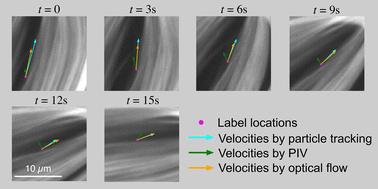
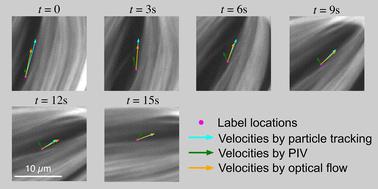
Deep learning-based optical flow (DLOF) extracts features in adjacent video frames with deep convolutional neural networks. It uses those features to estimate the inter-frame motions of objects. We evaluate the ability of optical flow to quantify the spontaneous flows of microtubule (MT)-based active nematics under different labeling conditions, and compare its performance to particle image velocimetry (PIV). We obtain flow velocity ground truths either by performing semi-automated particle tracking on samples with sparsely labeled filaments, or from passive tracer beads. DLOF produces more accurate velocity fields than PIV for densely labeled samples. PIV cannot reliably distinguish contrast variations at high densities, particularly along the nematic director. DLOF overcomes this limitation. For sparsely labeled samples, DLOF and PIV produce comparable results, but DLOF gives higher-resolution fields. Our work establishes DLOF as a versatile tool for measuring fluid flows in a broad class of active, soft, and biophysical systems.
期刊介绍:
Soft Matter is an international journal published by the Royal Society of Chemistry using Engineering-Materials Science: A Synthesis as its research focus. It publishes original research articles, review articles, and synthesis articles related to this field, reporting the latest discoveries in the relevant theoretical, practical, and applied disciplines in a timely manner, and aims to promote the rapid exchange of scientific information in this subject area. The journal is an open access journal. The journal is an open access journal and has not been placed on the alert list in the last three years.




 京公网安备 11010802042870号
京ICP备2023020795号-1
京公网安备 11010802042870号
京ICP备2023020795号-1

 分享
分享
 求助内容:
求助内容: 应助结果提醒方式:
 扫码关注我们
