Ngoc A. Nguyen, Deborah Y. Liu and Daniel V. Krogstad
{"title":"Impact of water and oleic acid on glycerol monooleate phase transition and bi-continuous structure formation in white oil†","authors":"Ngoc A. Nguyen, Deborah Y. Liu and Daniel V. Krogstad","doi":"10.1039/D4SM00809J","DOIUrl":null,"url":null,"abstract":"<p >Production of biofuels from biological feedstocks, such as soybean oil, is an important piece of the transition to renewable energy sources. Processes have been developed to co-refine these feedstocks with traditional feedstocks, however, the high concentration of polar functional groups in biofeedstocks can cause a wide range of intermediate chemical reactions and interactions. An improved understanding of the interactions of biofeedstocks and their degradation products is needed to continue to expand the usage of biofeedstocks in fuel production. In this study, the equilibrium structures of glycerol monooleate (GMO), a common intermediate product of biofeedstock processing, in white mineral oil at a wide range of compositions, temperatures, and additional byproduct concentrations (water and/or oleic acid) were characterized using small angle X-ray scattering (SAXS). It was determined that GMO can exist as crystalline aggregates in white oil or as reverse micelles depending on the concentration and temperature. The critical micelle temperature increases significantly with increasing GMO concentration but remains relatively stable with increasing water or fatty acid concentration. Fitting of the SAXS data revealed that for many compositions, the GMO formed roughly spherical reverse micelles, however, at high water concentrations (∼1 wt%), the GMO formed elongated reverse micelles. Additionally, when >1 wt% oleic acid was added to the system, bi-continuous structures were stabilized rather than discreet reverse micelles. These results help increase our understanding of the structural behavior of biofeedstock intermediate products at concentrations and temperatures relevant to biofuel production and can enable processers to design systems and products that can either leverage or prevent these interactions for improved processing performance.</p>","PeriodicalId":103,"journal":{"name":"Soft Matter","volume":" 36","pages":" 7237-7245"},"PeriodicalIF":2.8000,"publicationDate":"2024-08-30","publicationTypes":"Journal Article","fieldsOfStudy":null,"isOpenAccess":false,"openAccessPdf":"","citationCount":"0","resultStr":null,"platform":"Semanticscholar","paperid":null,"PeriodicalName":"Soft Matter","FirstCategoryId":"92","ListUrlMain":"https://pubs.rsc.org/en/content/articlelanding/2024/sm/d4sm00809j","RegionNum":3,"RegionCategory":"化学","ArticlePicture":[],"TitleCN":null,"AbstractTextCN":null,"PMCID":null,"EPubDate":"","PubModel":"","JCR":"Q3","JCRName":"CHEMISTRY, PHYSICAL","Score":null,"Total":0}
引用次数: 0
Abstract
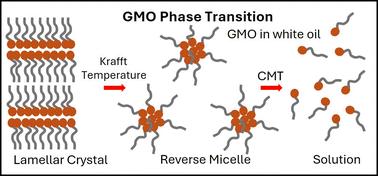
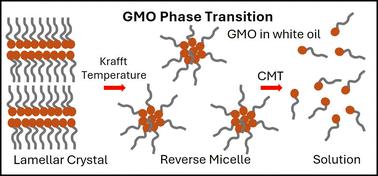
Production of biofuels from biological feedstocks, such as soybean oil, is an important piece of the transition to renewable energy sources. Processes have been developed to co-refine these feedstocks with traditional feedstocks, however, the high concentration of polar functional groups in biofeedstocks can cause a wide range of intermediate chemical reactions and interactions. An improved understanding of the interactions of biofeedstocks and their degradation products is needed to continue to expand the usage of biofeedstocks in fuel production. In this study, the equilibrium structures of glycerol monooleate (GMO), a common intermediate product of biofeedstock processing, in white mineral oil at a wide range of compositions, temperatures, and additional byproduct concentrations (water and/or oleic acid) were characterized using small angle X-ray scattering (SAXS). It was determined that GMO can exist as crystalline aggregates in white oil or as reverse micelles depending on the concentration and temperature. The critical micelle temperature increases significantly with increasing GMO concentration but remains relatively stable with increasing water or fatty acid concentration. Fitting of the SAXS data revealed that for many compositions, the GMO formed roughly spherical reverse micelles, however, at high water concentrations (∼1 wt%), the GMO formed elongated reverse micelles. Additionally, when >1 wt% oleic acid was added to the system, bi-continuous structures were stabilized rather than discreet reverse micelles. These results help increase our understanding of the structural behavior of biofeedstock intermediate products at concentrations and temperatures relevant to biofuel production and can enable processers to design systems and products that can either leverage or prevent these interactions for improved processing performance.
期刊介绍:
Soft Matter is an international journal published by the Royal Society of Chemistry using Engineering-Materials Science: A Synthesis as its research focus. It publishes original research articles, review articles, and synthesis articles related to this field, reporting the latest discoveries in the relevant theoretical, practical, and applied disciplines in a timely manner, and aims to promote the rapid exchange of scientific information in this subject area. The journal is an open access journal. The journal is an open access journal and has not been placed on the alert list in the last three years.



 京公网安备 11010802042870号
京ICP备2023020795号-1
京公网安备 11010802042870号
京ICP备2023020795号-1

 分享
分享
 求助内容:
求助内容: 应助结果提醒方式:
 扫码关注我们
