Allison L. Chau, Kseniia M. Karnaukh, Ian Maskiewicz, Javier Read de Alaniz and Angela A. Pitenis
{"title":"Photoresponsive hydrogel friction†","authors":"Allison L. Chau, Kseniia M. Karnaukh, Ian Maskiewicz, Javier Read de Alaniz and Angela A. Pitenis","doi":"10.1039/D4SM00677A","DOIUrl":null,"url":null,"abstract":"<p >Photoresponsive hydrogels are an emerging class of stimuli-responsive materials that exhibit changes in physical or chemical properties in response to light. Previous investigations have leveraged photothermal mechanisms to achieve reversible changes in hydrogel friction, although few have focused on photochemical means. To date, the tribological properties of photoswitchable hydrogels (<em>e.g.</em>, friction and lubrication) have remained underexplored. In this work, we incorporated photoresponsive methoxy-spiropyran-methacrylate monomers (methoxy-SP-MA) into a hydrogel network to form a copolymerized system of poly(<em>N</em>-isopropylacrylamide-<em>co</em>-2-acrylamido-2-methylpropane sulfonic acid-<em>co</em>-methoxy-spiropyran-methacrylate) (p(NIPAAm-<em>co</em>-AMPS-<em>co</em>-SP)). We demonstrated repeatable photoresponsive changes to swelling, friction, and stiffness over three light cycles. Our findings suggest that volume changes driven by the decreased hydrophilicity of the methoxy-SP-MA upon light irradiation are responsible for differences in the mechanical and tribological properties of our photoresponsive hydrogels. Our results could inform future designs of photoswitchable hydrogels for applications ranging from biomedical applications to soft robotics.</p>","PeriodicalId":103,"journal":{"name":"Soft Matter","volume":" 36","pages":" 7227-7236"},"PeriodicalIF":2.8000,"publicationDate":"2024-08-29","publicationTypes":"Journal Article","fieldsOfStudy":null,"isOpenAccess":false,"openAccessPdf":"https://pubs.rsc.org/en/content/articlepdf/2024/sm/d4sm00677a?page=search","citationCount":"0","resultStr":null,"platform":"Semanticscholar","paperid":null,"PeriodicalName":"Soft Matter","FirstCategoryId":"92","ListUrlMain":"https://pubs.rsc.org/en/content/articlelanding/2024/sm/d4sm00677a","RegionNum":3,"RegionCategory":"化学","ArticlePicture":[],"TitleCN":null,"AbstractTextCN":null,"PMCID":null,"EPubDate":"","PubModel":"","JCR":"Q3","JCRName":"CHEMISTRY, PHYSICAL","Score":null,"Total":0}
引用次数: 0
Abstract
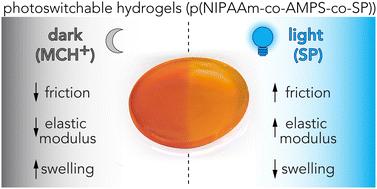
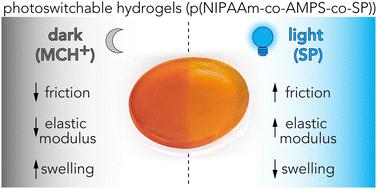
Photoresponsive hydrogels are an emerging class of stimuli-responsive materials that exhibit changes in physical or chemical properties in response to light. Previous investigations have leveraged photothermal mechanisms to achieve reversible changes in hydrogel friction, although few have focused on photochemical means. To date, the tribological properties of photoswitchable hydrogels (e.g., friction and lubrication) have remained underexplored. In this work, we incorporated photoresponsive methoxy-spiropyran-methacrylate monomers (methoxy-SP-MA) into a hydrogel network to form a copolymerized system of poly(N-isopropylacrylamide-co-2-acrylamido-2-methylpropane sulfonic acid-co-methoxy-spiropyran-methacrylate) (p(NIPAAm-co-AMPS-co-SP)). We demonstrated repeatable photoresponsive changes to swelling, friction, and stiffness over three light cycles. Our findings suggest that volume changes driven by the decreased hydrophilicity of the methoxy-SP-MA upon light irradiation are responsible for differences in the mechanical and tribological properties of our photoresponsive hydrogels. Our results could inform future designs of photoswitchable hydrogels for applications ranging from biomedical applications to soft robotics.
期刊介绍:
Soft Matter is an international journal published by the Royal Society of Chemistry using Engineering-Materials Science: A Synthesis as its research focus. It publishes original research articles, review articles, and synthesis articles related to this field, reporting the latest discoveries in the relevant theoretical, practical, and applied disciplines in a timely manner, and aims to promote the rapid exchange of scientific information in this subject area. The journal is an open access journal. The journal is an open access journal and has not been placed on the alert list in the last three years.



 京公网安备 11010802042870号
京ICP备2023020795号-1
京公网安备 11010802042870号
京ICP备2023020795号-1

 分享
分享
 求助内容:
求助内容: 应助结果提醒方式:
 扫码关注我们
