Nadjib Kihal, Marie-Jeanne Archambault, Margaryta Babych, Ali Nazemi and Steve Bourgault
{"title":"Probing the molecular determinants of the activation of toll-like receptor 2/6 by amyloid nanostructures through directed peptide self-assembly†","authors":"Nadjib Kihal, Marie-Jeanne Archambault, Margaryta Babych, Ali Nazemi and Steve Bourgault","doi":"10.1039/D4SM00638K","DOIUrl":null,"url":null,"abstract":"<p >Amyloid fibrils are proteinaceous nanostructures known for their ability to activate the innate immune system, which has been recently exploited for their use as self-adjuvanted antigen delivery systems for vaccines. Among mechanisms of immunostimulation, the activation of the heterodimeric toll-like receptor 2/6 (TLR2/TLR6) by the cross-β-sheet quaternary conformation appears important. Nonetheless, the lack of control over the process of self-assembly and the polydispersity of the resulting supramolecular architectures make it challenging to elucidate the molecular basis of TLR2/TLR6 engagement by amyloid assemblies. In this context, we harnessed the effects of N- and C-terminal modifications of a short 10-mer β-peptide derived from the islet amyloid polypeptide (I<small><sub>10</sub></small>) to investigate the relationships between the morphology and physicochemical properties of amyloid assemblies and their TLR2/TLR6 activity. Chemical substitutions at the N- and C-termini of the I<small><sub>10</sub></small> peptide, including addition of charged residues at the N-terminus and α-amidation of C-terminus, allowed the controlled formation of a diversity of architectures, including belt-like filaments, rigid nanorods as well as flat and twisted fibrils. These fully cytocompatible peptide nanostructures showed different potencies to activate TLR2/TLR6, which correlated with the charge exposed on the surface. These results further demonstrate the potent modulatory effect of N- and C-terminal electrostatic capping on the self-assembly of short synthetic β-peptides. This study also indicates that self-assembly into cross-β-sheet nanostructures is essential for the activation of the TLR2/TLR6 by amyloidogenic peptides, albeit the structural requirements of the engagement of this promiscuous immune receptor by the nanostructures remain challenging to precisely untangle.</p>","PeriodicalId":103,"journal":{"name":"Soft Matter","volume":" 39","pages":" 7821-7831"},"PeriodicalIF":2.8000,"publicationDate":"2024-08-28","publicationTypes":"Journal Article","fieldsOfStudy":null,"isOpenAccess":false,"openAccessPdf":"","citationCount":"0","resultStr":null,"platform":"Semanticscholar","paperid":null,"PeriodicalName":"Soft Matter","FirstCategoryId":"92","ListUrlMain":"https://pubs.rsc.org/en/content/articlelanding/2024/sm/d4sm00638k","RegionNum":3,"RegionCategory":"化学","ArticlePicture":[],"TitleCN":null,"AbstractTextCN":null,"PMCID":null,"EPubDate":"","PubModel":"","JCR":"Q3","JCRName":"CHEMISTRY, PHYSICAL","Score":null,"Total":0}
引用次数: 0
Abstract
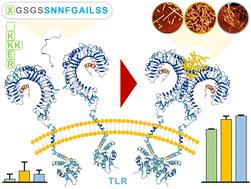
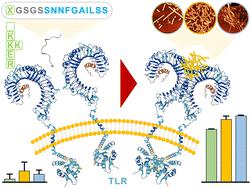
Amyloid fibrils are proteinaceous nanostructures known for their ability to activate the innate immune system, which has been recently exploited for their use as self-adjuvanted antigen delivery systems for vaccines. Among mechanisms of immunostimulation, the activation of the heterodimeric toll-like receptor 2/6 (TLR2/TLR6) by the cross-β-sheet quaternary conformation appears important. Nonetheless, the lack of control over the process of self-assembly and the polydispersity of the resulting supramolecular architectures make it challenging to elucidate the molecular basis of TLR2/TLR6 engagement by amyloid assemblies. In this context, we harnessed the effects of N- and C-terminal modifications of a short 10-mer β-peptide derived from the islet amyloid polypeptide (I10) to investigate the relationships between the morphology and physicochemical properties of amyloid assemblies and their TLR2/TLR6 activity. Chemical substitutions at the N- and C-termini of the I10 peptide, including addition of charged residues at the N-terminus and α-amidation of C-terminus, allowed the controlled formation of a diversity of architectures, including belt-like filaments, rigid nanorods as well as flat and twisted fibrils. These fully cytocompatible peptide nanostructures showed different potencies to activate TLR2/TLR6, which correlated with the charge exposed on the surface. These results further demonstrate the potent modulatory effect of N- and C-terminal electrostatic capping on the self-assembly of short synthetic β-peptides. This study also indicates that self-assembly into cross-β-sheet nanostructures is essential for the activation of the TLR2/TLR6 by amyloidogenic peptides, albeit the structural requirements of the engagement of this promiscuous immune receptor by the nanostructures remain challenging to precisely untangle.
淀粉样纤维是一种蛋白质纳米结构,以其激活先天性免疫系统的能力而闻名,最近已被用作疫苗的自佐剂抗原递送系统。在免疫刺激机制中,交叉β片四元构象对异源二聚体收费样受体 2/6(TLR2/TLR6)的激活似乎很重要。尽管如此,由于缺乏对自组装过程的控制,以及由此产生的超分子结构的多分散性,要阐明淀粉样组装体参与 TLR2/TLR6 的分子基础具有挑战性。在这种情况下,我们利用源自胰岛淀粉样多肽(I10)的短 10 聚体 β 肽的 N 端和 C 端修饰效应,研究了淀粉样集合体的形态和理化性质与其 TLR2/TLR6 活性之间的关系。在 I10 肽的 N 端和 C 端进行化学取代,包括在 N 端添加带电残基和在 C 端进行 α-酰胺化,可控制形成多种结构,包括带状细丝、刚性纳米棒以及扁平和扭曲的纤维。这些完全细胞兼容的多肽纳米结构显示出不同的激活 TLR2/TLR6 的效力,这与表面暴露的电荷有关。这些结果进一步证明了 N 端和 C 端静电封端对短合成 β 肽自组装的强效调节作用。这项研究还表明,自组装成交叉β片状纳米结构对于淀粉样蛋白肽激活TLR2/TLR6至关重要,尽管纳米结构与这种杂交免疫受体接触的结构要求仍难以精确解开。
期刊介绍:
Soft Matter is an international journal published by the Royal Society of Chemistry using Engineering-Materials Science: A Synthesis as its research focus. It publishes original research articles, review articles, and synthesis articles related to this field, reporting the latest discoveries in the relevant theoretical, practical, and applied disciplines in a timely manner, and aims to promote the rapid exchange of scientific information in this subject area. The journal is an open access journal. The journal is an open access journal and has not been placed on the alert list in the last three years.




 京公网安备 11010802042870号
京ICP备2023020795号-1
京公网安备 11010802042870号
京ICP备2023020795号-1

 分享
分享
 求助内容:
求助内容: 应助结果提醒方式:
 扫码关注我们
