{"title":"Benchtop IR Imaging of Live Cells: Monitoring the Total Mass of Biomolecules in Single Cells.","authors":"Yow-Ren Chang, Seong-Min Kim, Young Jong Lee","doi":"10.1021/acs.analchem.4c02108","DOIUrl":null,"url":null,"abstract":"<p><p>Absolute quantity imaging of biomolecules on a single cell level is critical for measurement assurance in biosciences and bioindustries. While infrared (IR) transmission microscopy is a powerful label-free imaging modality capable of chemical quantification, its applicability to hydrated biological samples remains challenging due to the strong IR absorption by water. Traditional IR imaging of hydrated cells relies on powerful light sources, such as synchrotrons, to mitigate the light absorption by water. However, we overcome this challenge by applying a solvent absorption compensation (SAC) technique to a home-built benchtop IR microscope based on an external-cavity quantum cascade laser. SAC-IR microscopy adjusts the incident light using a pair of polarizers to precompensate the IR absorption by water while retaining the full dynamic range. Integrating the IR absorbance over a cell yields the total mass of biomolecules per cell. We monitor the total mass of the biomolecules of live fibroblast cells over 12 h, demonstrating promise for advancing our understanding of the biomolecular processes occurring in live cells on the single-cell level.</p>","PeriodicalId":27,"journal":{"name":"Analytical Chemistry","volume":" ","pages":"14783-14790"},"PeriodicalIF":6.7000,"publicationDate":"2024-09-17","publicationTypes":"Journal Article","fieldsOfStudy":null,"isOpenAccess":false,"openAccessPdf":"https://www.ncbi.nlm.nih.gov/pmc/articles/PMC11431153/pdf/","citationCount":"0","resultStr":null,"platform":"Semanticscholar","paperid":null,"PeriodicalName":"Analytical Chemistry","FirstCategoryId":"92","ListUrlMain":"https://doi.org/10.1021/acs.analchem.4c02108","RegionNum":1,"RegionCategory":"化学","ArticlePicture":[],"TitleCN":null,"AbstractTextCN":null,"PMCID":null,"EPubDate":"2024/9/4 0:00:00","PubModel":"Epub","JCR":"Q1","JCRName":"CHEMISTRY, ANALYTICAL","Score":null,"Total":0}
引用次数: 0
Abstract
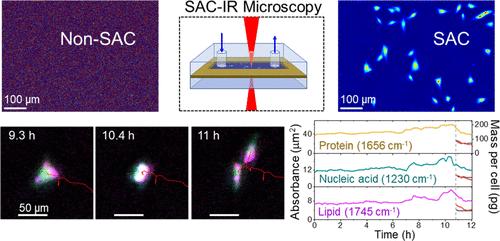
Absolute quantity imaging of biomolecules on a single cell level is critical for measurement assurance in biosciences and bioindustries. While infrared (IR) transmission microscopy is a powerful label-free imaging modality capable of chemical quantification, its applicability to hydrated biological samples remains challenging due to the strong IR absorption by water. Traditional IR imaging of hydrated cells relies on powerful light sources, such as synchrotrons, to mitigate the light absorption by water. However, we overcome this challenge by applying a solvent absorption compensation (SAC) technique to a home-built benchtop IR microscope based on an external-cavity quantum cascade laser. SAC-IR microscopy adjusts the incident light using a pair of polarizers to precompensate the IR absorption by water while retaining the full dynamic range. Integrating the IR absorbance over a cell yields the total mass of biomolecules per cell. We monitor the total mass of the biomolecules of live fibroblast cells over 12 h, demonstrating promise for advancing our understanding of the biomolecular processes occurring in live cells on the single-cell level.
期刊介绍:
Analytical Chemistry, a peer-reviewed research journal, focuses on disseminating new and original knowledge across all branches of analytical chemistry. Fundamental articles may explore general principles of chemical measurement science and need not directly address existing or potential analytical methodology. They can be entirely theoretical or report experimental results. Contributions may cover various phases of analytical operations, including sampling, bioanalysis, electrochemistry, mass spectrometry, microscale and nanoscale systems, environmental analysis, separations, spectroscopy, chemical reactions and selectivity, instrumentation, imaging, surface analysis, and data processing. Papers discussing known analytical methods should present a significant, original application of the method, a notable improvement, or results on an important analyte.



 京公网安备 11010802042870号
京ICP备2023020795号-1
京公网安备 11010802042870号
京ICP备2023020795号-1

 分享
分享
 求助内容:
求助内容: 应助结果提醒方式:
 扫码关注我们
