{"title":"Income and education level trajectories and changes in the daily consumption of vegetables after thirteen years of follow-up: the Pró-Saúde Study.","authors":"Talita Lelis Berti, Diana Barbosa Cunha, Rosely Sichieri, Joana Maia Brandão, Eduardo Faerstein","doi":"10.1590/1980-549720240043","DOIUrl":null,"url":null,"abstract":"<p><strong>Objective: </strong>This study aimed to examine whether education level and income trajectories influence vegetable consumption changes over 13 years among civil servants at different campuses of a university in the state of Rio de Janeiro, Brazil.</p><p><strong>Methods: </strong>Vegetable intake frequency (daily and non-daily consumption), income (per capita), and education level (maintenance of low schooling/ upward mobility/maintenance of high schooling) were assessed at baseline (1999) and in the fourth wave (2011-12) of the Pró-Saúde (Pro-Health) cohort study. A total of 2,381 participants were analyzed. The association between educational and income trajectories and variation in vegetable consumption was assessed via crude and age-adjusted generalized linear models, stratified by sex.</p><p><strong>Results: </strong>Men in upward educational mobility showed a 0.5% increase in vegetable consumption (p=0.01), while women in this group demonstrated a 2.5% increase (p=0.05). Adjusted models showed that women who reduced their income had a lower likelihood of consuming vegetables (odds ratio [OR] 0.93; 95% confidence interval [CI] 0.89-0.97).</p><p><strong>Conclusions: </strong>The findings highlight the influence of social inequalities on vegetable consumption in adults.</p>","PeriodicalId":74697,"journal":{"name":"Revista brasileira de epidemiologia = Brazilian journal of epidemiology","volume":"27 ","pages":"e240043"},"PeriodicalIF":2.0000,"publicationDate":"2024-08-30","publicationTypes":"Journal Article","fieldsOfStudy":null,"isOpenAccess":false,"openAccessPdf":"https://www.ncbi.nlm.nih.gov/pmc/articles/PMC11383517/pdf/","citationCount":"0","resultStr":null,"platform":"Semanticscholar","paperid":null,"PeriodicalName":"Revista brasileira de epidemiologia = Brazilian journal of epidemiology","FirstCategoryId":"1085","ListUrlMain":"https://doi.org/10.1590/1980-549720240043","RegionNum":0,"RegionCategory":null,"ArticlePicture":[],"TitleCN":null,"AbstractTextCN":null,"PMCID":null,"EPubDate":"2024/1/1 0:00:00","PubModel":"eCollection","JCR":"","JCRName":"","Score":null,"Total":0}
引用次数: 0
Abstract
Objective: This study aimed to examine whether education level and income trajectories influence vegetable consumption changes over 13 years among civil servants at different campuses of a university in the state of Rio de Janeiro, Brazil.
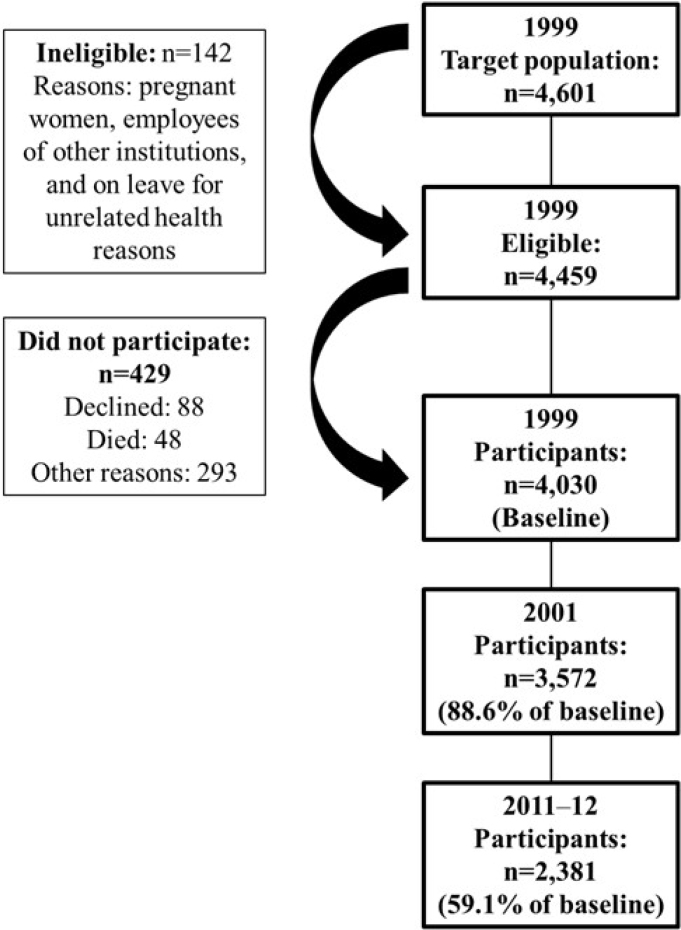
Methods: Vegetable intake frequency (daily and non-daily consumption), income (per capita), and education level (maintenance of low schooling/ upward mobility/maintenance of high schooling) were assessed at baseline (1999) and in the fourth wave (2011-12) of the Pró-Saúde (Pro-Health) cohort study. A total of 2,381 participants were analyzed. The association between educational and income trajectories and variation in vegetable consumption was assessed via crude and age-adjusted generalized linear models, stratified by sex.
Results: Men in upward educational mobility showed a 0.5% increase in vegetable consumption (p=0.01), while women in this group demonstrated a 2.5% increase (p=0.05). Adjusted models showed that women who reduced their income had a lower likelihood of consuming vegetables (odds ratio [OR] 0.93; 95% confidence interval [CI] 0.89-0.97).
Conclusions: The findings highlight the influence of social inequalities on vegetable consumption in adults.




 京公网安备 11010802042870号
京ICP备2023020795号-1
京公网安备 11010802042870号
京ICP备2023020795号-1

 分享
分享

 求助内容:
求助内容: 应助结果提醒方式:
 扫码关注我们
