Yifan Xu, Zhiyu Chen, Jiaqi Wang, Bai Li, Jiangnan Li, Zijian He, Prof. Lei Li, Lei Gao, Prof. Songbai Han, Prof. Juncao Bian, Prof. Jinlong Zhu, Prof. Liping Wang, Prof. Yusheng Zhao, Prof. Qiang Xu, Prof. Ruo Zhao
{"title":"Design of Quasi-Metal–Organic Frameworks for Solid Polymer Electrolytes Enabling an Ultra-Stable Interface with Li Metal Anode","authors":"Yifan Xu, Zhiyu Chen, Jiaqi Wang, Bai Li, Jiangnan Li, Zijian He, Prof. Lei Li, Lei Gao, Prof. Songbai Han, Prof. Juncao Bian, Prof. Jinlong Zhu, Prof. Liping Wang, Prof. Yusheng Zhao, Prof. Qiang Xu, Prof. Ruo Zhao","doi":"10.1002/anie.202416170","DOIUrl":null,"url":null,"abstract":"<p>Solid polymer electrolytes (SPEs) are crucial in the development of lithium metal batteries. Recently, metal–organic frameworks (MOFs) with open metal sites (OMSs) have shown promise as solid fillers to improve the performance of SPEs. However, the number of OMS-containing MOFs is quite limited, comprising less than 5% of the total MOFs. When considering yield, cost, and processability, the commonly used OMS-containing MOFs are no more than 10 types, causing great limitations. Herein, we reported a simple and universal methodology that converted OMS-free MOFs to OMS-rich quasi-MOFs for developing high-performance SPEs, and explored the underlying mechanism. The “OMS-polymer” and “OMS-ion” interactions were investigated in detail to elucidate the role of quasi-MOFs on battery performance. It was found that quasi-MOFs, functioning as ion sieves, can effectively regulate ion migration, thus promoting uniform Li deposition and enabling an ultra-stable interface. As a result, the Li symmetric cell stably ran over 3000 h at 0.3 mA cm<sup>−2</sup>, while the full cell retained 85 % of its initial capacity after 1500 cycles at 1.0 C. Finally, universal testing was performed using other MOFs, confirming the generalizability and effectiveness of our design concept.</p>","PeriodicalId":125,"journal":{"name":"Angewandte Chemie International Edition","volume":"64 4","pages":""},"PeriodicalIF":16.9000,"publicationDate":"2024-09-05","publicationTypes":"Journal Article","fieldsOfStudy":null,"isOpenAccess":false,"openAccessPdf":"","citationCount":"0","resultStr":null,"platform":"Semanticscholar","paperid":null,"PeriodicalName":"Angewandte Chemie International Edition","FirstCategoryId":"92","ListUrlMain":"https://onlinelibrary.wiley.com/doi/10.1002/anie.202416170","RegionNum":1,"RegionCategory":"化学","ArticlePicture":[],"TitleCN":null,"AbstractTextCN":null,"PMCID":null,"EPubDate":"","PubModel":"","JCR":"Q1","JCRName":"CHEMISTRY, MULTIDISCIPLINARY","Score":null,"Total":0}
引用次数: 0
Abstract
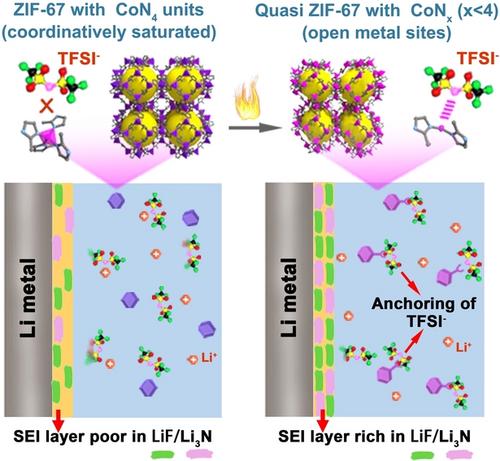
Solid polymer electrolytes (SPEs) are crucial in the development of lithium metal batteries. Recently, metal–organic frameworks (MOFs) with open metal sites (OMSs) have shown promise as solid fillers to improve the performance of SPEs. However, the number of OMS-containing MOFs is quite limited, comprising less than 5% of the total MOFs. When considering yield, cost, and processability, the commonly used OMS-containing MOFs are no more than 10 types, causing great limitations. Herein, we reported a simple and universal methodology that converted OMS-free MOFs to OMS-rich quasi-MOFs for developing high-performance SPEs, and explored the underlying mechanism. The “OMS-polymer” and “OMS-ion” interactions were investigated in detail to elucidate the role of quasi-MOFs on battery performance. It was found that quasi-MOFs, functioning as ion sieves, can effectively regulate ion migration, thus promoting uniform Li deposition and enabling an ultra-stable interface. As a result, the Li symmetric cell stably ran over 3000 h at 0.3 mA cm−2, while the full cell retained 85 % of its initial capacity after 1500 cycles at 1.0 C. Finally, universal testing was performed using other MOFs, confirming the generalizability and effectiveness of our design concept.
期刊介绍:
Angewandte Chemie, a journal of the German Chemical Society (GDCh), maintains a leading position among scholarly journals in general chemistry with an impressive Impact Factor of 16.6 (2022 Journal Citation Reports, Clarivate, 2023). Published weekly in a reader-friendly format, it features new articles almost every day. Established in 1887, Angewandte Chemie is a prominent chemistry journal, offering a dynamic blend of Review-type articles, Highlights, Communications, and Research Articles on a weekly basis, making it unique in the field.



 京公网安备 11010802042870号
京ICP备2023020795号-1
京公网安备 11010802042870号
京ICP备2023020795号-1

 分享
分享
 求助内容:
求助内容: 应助结果提醒方式:
 扫码关注我们
