Arshad Hussain, Mostafa M. Mohamed, Muhammad Omer Aijaz, Mohammad Rezaul Karim, Atif Saeed Alzahrani, Md. Abdul Aziz
{"title":"Advanced PEI/PAN Membrane to Suppress Zinc Dendrite Growth in Zinc Metal Batteries","authors":"Arshad Hussain, Mostafa M. Mohamed, Muhammad Omer Aijaz, Mohammad Rezaul Karim, Atif Saeed Alzahrani, Md. Abdul Aziz","doi":"10.1002/asia.202400828","DOIUrl":null,"url":null,"abstract":"<p>Aqueous zinc-ion batteries (AZIBs) are a potential new technology in energy storage due to their high energy density, affordability, and environmental friendliness. The development of AZIBs is still hampered by unchecked zinc dendrite formation during cycling, which results in an unstable interface, a short cycling life, and a considerable capacity decline with security issues. Herein, we demonstrate a novel nanofiber membrane based on polyetherimide-polyacrylonitrile (PEI/PAN) polymer via electrospinning method with entangled nanofibers for AZIBs applications. The as-fabricated PEI/PAN membrane has a homogeneous, tortuous, and linked porous structure, high porosity, and superior electrolyte wettability. The resulting PEI/PAN membrane exhibits a decent thermal stability of 200 °C and a strong ionic conductivity of up to 5.3×10<sup>−4</sup> S cm<sup>−1</sup>. This membrane gives Zn/Zn symmetric cells an ultralong cycle life of more than 250 hours at 3 mA cm<sup>−2</sup>. In the meantime, the MnO<sub>2</sub>/Zn cell outperforms commercial filter paper regarding cycle stability and rate performance. This work demonstrates the design of a straightforward technique to fabricate advanced nanofiber membranes for AZIBs to modify Zn<sup>2+</sup> deposition behavior and improve Zn dendrite resistance.</p>","PeriodicalId":145,"journal":{"name":"Chemistry - An Asian Journal","volume":"19 23","pages":""},"PeriodicalIF":3.3000,"publicationDate":"2024-09-04","publicationTypes":"Journal Article","fieldsOfStudy":null,"isOpenAccess":false,"openAccessPdf":"","citationCount":"0","resultStr":null,"platform":"Semanticscholar","paperid":null,"PeriodicalName":"Chemistry - An Asian Journal","FirstCategoryId":"1","ListUrlMain":"https://aces.onlinelibrary.wiley.com/doi/10.1002/asia.202400828","RegionNum":3,"RegionCategory":"化学","ArticlePicture":[],"TitleCN":null,"AbstractTextCN":null,"PMCID":null,"EPubDate":"","PubModel":"","JCR":"Q2","JCRName":"CHEMISTRY, MULTIDISCIPLINARY","Score":null,"Total":0}
引用次数: 0
Abstract
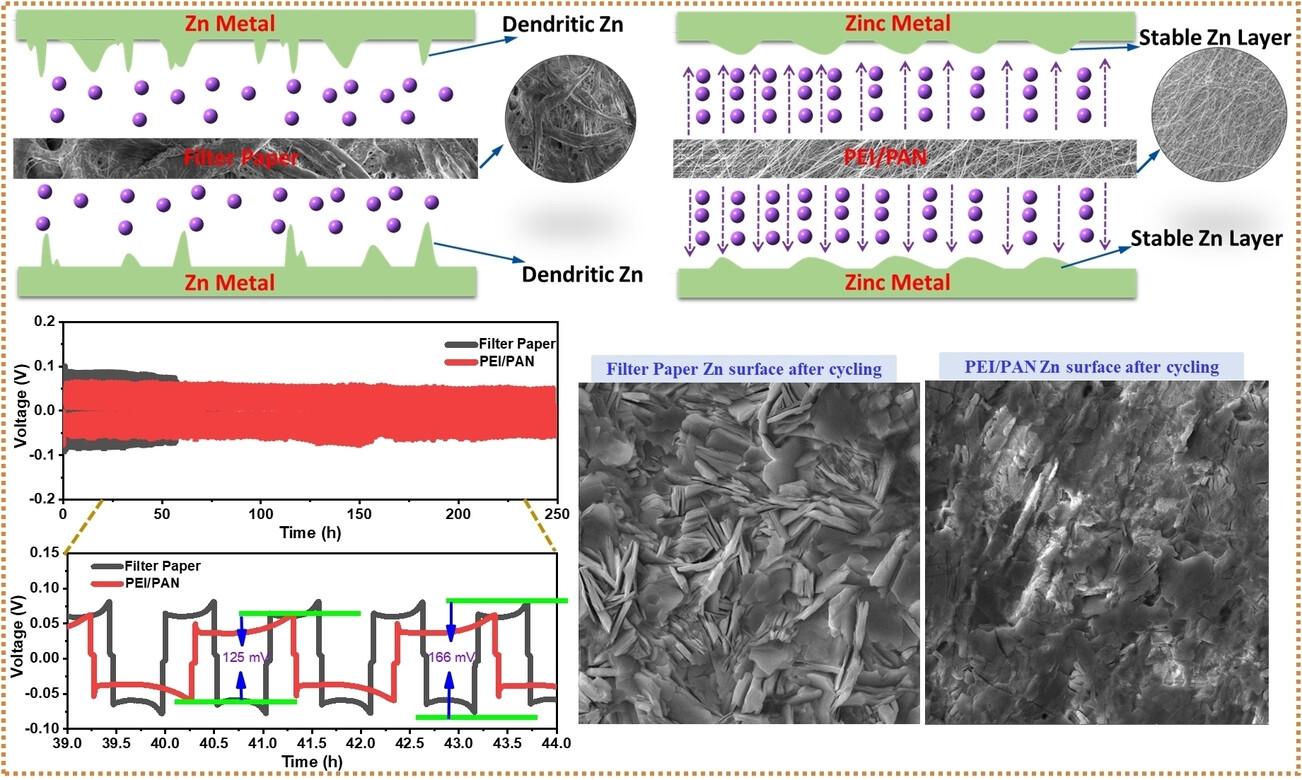
Aqueous zinc-ion batteries (AZIBs) are a potential new technology in energy storage due to their high energy density, affordability, and environmental friendliness. The development of AZIBs is still hampered by unchecked zinc dendrite formation during cycling, which results in an unstable interface, a short cycling life, and a considerable capacity decline with security issues. Herein, we demonstrate a novel nanofiber membrane based on polyetherimide-polyacrylonitrile (PEI/PAN) polymer via electrospinning method with entangled nanofibers for AZIBs applications. The as-fabricated PEI/PAN membrane has a homogeneous, tortuous, and linked porous structure, high porosity, and superior electrolyte wettability. The resulting PEI/PAN membrane exhibits a decent thermal stability of 200 °C and a strong ionic conductivity of up to 5.3×10⁻⁴ S cm−1. This membrane gives Zn/Zn symmetric cells an ultralong cycle life of more than 250 hours at 3 mA cm−2. In the meantime, the MnO2/Zn cell outperforms commercial filter paper regarding cycle stability and rate performance. This work demonstrates the design of a straightforward technique to fabricate advanced nanofiber membranes for AZIBs to modify Zn2+ deposition behavior and improve Zn dendrite resistance.
期刊介绍:
Chemistry—An Asian Journal is an international high-impact journal for chemistry in its broadest sense. The journal covers all aspects of chemistry from biochemistry through organic and inorganic chemistry to physical chemistry, including interdisciplinary topics.
Chemistry—An Asian Journal publishes Full Papers, Communications, and Focus Reviews.
A professional editorial team headed by Dr. Theresa Kueckmann and an Editorial Board (headed by Professor Susumu Kitagawa) ensure the highest quality of the peer-review process, the contents and the production of the journal.
Chemistry—An Asian Journal is published on behalf of the Asian Chemical Editorial Society (ACES), an association of numerous Asian chemical societies, and supported by the Gesellschaft Deutscher Chemiker (GDCh, German Chemical Society), ChemPubSoc Europe, and the Federation of Asian Chemical Societies (FACS).




 京公网安备 11010802042870号
京ICP备2023020795号-1
京公网安备 11010802042870号
京ICP备2023020795号-1

 分享
分享
 求助内容:
求助内容: 应助结果提醒方式:
 扫码关注我们
