L Ferrão, M Morini, W A González-Lopéz, V Gallego, A Felip, L Pérez, J F Asturiano
{"title":"Effects of cold seawater pre-treatments on induction of early sexual maturation and sperm production in European eel (Anguilla anguilla).","authors":"L Ferrão, M Morini, W A González-Lopéz, V Gallego, A Felip, L Pérez, J F Asturiano","doi":"10.1007/s10695-024-01402-w","DOIUrl":null,"url":null,"abstract":"<p><p>To induce sexual maturation in captivity, eels rely on hormonal treatments, but this process is costly and time-consuming. As an alternative, different types of conditioning, also referred as pre-treatment, have been assessed to ease hormonal treatment response. Recent studies have shown that migrating eels experience a wide range of temperatures, varying from 12 °C at night to as low as to 8 °C during the day. Therefore, this study evaluates the effects of low-temperature (10 °C) seawater pre-treatments of different durations (2 and 4 weeks) on male eel reproduction. The eye, gonadosomatic and hepatosomatic indexes from control (without thermic seawater pre-treatment) and pre-treated fish were measured. Blood and testis samples were also collected for sex steroid and histology analysis, respectively. Eels pre-treated for 2 weeks demonstrated increased progestin levels, comparing with the control group. Eels pre-treated for 4 weeks showed significantly higher gonadosomatic index and elevated androgens and estradiol levels in comparison with the remaining groups. In eels pre-treated for 2 and 4 weeks, there was an increase in the proportion of spermatogonia type B cells compared to undifferentiated spermatogonia type A, a differentiation process that was not observed in the control group. Cold seawater pre-treatment induced early sexual maturation, including steroid production, which consequently stimulated biometric changes and increased spermatogonia differentiation. Following the pre-treatments, eels started receiving standard hormonal treatment (with recombinant human chorionic gonadotropin at 20 °C). Pre-treated males started to spermiate earlier than the control group. In some treatment weeks, pre-treated individuals registered higher values of sperm density, motility, and kinetic parameters. Moreover, an economic evaluation was carried out relating the investment made in terms of hormone injections with the volume of high-quality sperm obtained from each experimental group. The low temperature pre-treatments demonstrated their economic effectiveness in terms of hormone treatment profitability, increasing the production of high-quality sperm in the European eel. Thus, this in vivo study suggests that cold seawater pre-treatment may increase sensitivity to the hormone applied during standard maturation treatment.</p>","PeriodicalId":12274,"journal":{"name":"Fish Physiology and Biochemistry","volume":" ","pages":"2489-2503"},"PeriodicalIF":2.5000,"publicationDate":"2024-12-01","publicationTypes":"Journal Article","fieldsOfStudy":null,"isOpenAccess":false,"openAccessPdf":"https://www.ncbi.nlm.nih.gov/pmc/articles/PMC11573872/pdf/","citationCount":"0","resultStr":null,"platform":"Semanticscholar","paperid":null,"PeriodicalName":"Fish Physiology and Biochemistry","FirstCategoryId":"97","ListUrlMain":"https://doi.org/10.1007/s10695-024-01402-w","RegionNum":3,"RegionCategory":"农林科学","ArticlePicture":[],"TitleCN":null,"AbstractTextCN":null,"PMCID":null,"EPubDate":"2024/9/5 0:00:00","PubModel":"Epub","JCR":"Q3","JCRName":"BIOCHEMISTRY & MOLECULAR BIOLOGY","Score":null,"Total":0}
引用次数: 0
Abstract
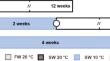
To induce sexual maturation in captivity, eels rely on hormonal treatments, but this process is costly and time-consuming. As an alternative, different types of conditioning, also referred as pre-treatment, have been assessed to ease hormonal treatment response. Recent studies have shown that migrating eels experience a wide range of temperatures, varying from 12 °C at night to as low as to 8 °C during the day. Therefore, this study evaluates the effects of low-temperature (10 °C) seawater pre-treatments of different durations (2 and 4 weeks) on male eel reproduction. The eye, gonadosomatic and hepatosomatic indexes from control (without thermic seawater pre-treatment) and pre-treated fish were measured. Blood and testis samples were also collected for sex steroid and histology analysis, respectively. Eels pre-treated for 2 weeks demonstrated increased progestin levels, comparing with the control group. Eels pre-treated for 4 weeks showed significantly higher gonadosomatic index and elevated androgens and estradiol levels in comparison with the remaining groups. In eels pre-treated for 2 and 4 weeks, there was an increase in the proportion of spermatogonia type B cells compared to undifferentiated spermatogonia type A, a differentiation process that was not observed in the control group. Cold seawater pre-treatment induced early sexual maturation, including steroid production, which consequently stimulated biometric changes and increased spermatogonia differentiation. Following the pre-treatments, eels started receiving standard hormonal treatment (with recombinant human chorionic gonadotropin at 20 °C). Pre-treated males started to spermiate earlier than the control group. In some treatment weeks, pre-treated individuals registered higher values of sperm density, motility, and kinetic parameters. Moreover, an economic evaluation was carried out relating the investment made in terms of hormone injections with the volume of high-quality sperm obtained from each experimental group. The low temperature pre-treatments demonstrated their economic effectiveness in terms of hormone treatment profitability, increasing the production of high-quality sperm in the European eel. Thus, this in vivo study suggests that cold seawater pre-treatment may increase sensitivity to the hormone applied during standard maturation treatment.
期刊介绍:
Fish Physiology and Biochemistry is an international journal publishing original research papers in all aspects of the physiology and biochemistry of fishes. Coverage includes experimental work in such topics as biochemistry of organisms, organs, tissues and cells; structure of organs, tissues, cells and organelles related to their function; nutritional, osmotic, ionic, respiratory and excretory homeostasis; nerve and muscle physiology; endocrinology; reproductive physiology; energetics; biochemical and physiological effects of toxicants; molecular biology and biotechnology and more.



 京公网安备 11010802042870号
京ICP备2023020795号-1
京公网安备 11010802042870号
京ICP备2023020795号-1

 分享
分享
 求助内容:
求助内容: 应助结果提醒方式:
 扫码关注我们
