Mark T. Mills MBChB, MSc, Peter Calvert MBChB, Richard Snowdon MD, Saagar Mahida PhD, Johan Waktare MD, Zoltan Borbas PhD, Reza Ashrafi MBBS, Derick Todd MD, Simon Modi MD, Vishal Luther PhD, Dhiraj Gupta MD
{"title":"Suture-based techniques versus manual compression for femoral venous haemostasis after electrophysiology procedures","authors":"Mark T. Mills MBChB, MSc, Peter Calvert MBChB, Richard Snowdon MD, Saagar Mahida PhD, Johan Waktare MD, Zoltan Borbas PhD, Reza Ashrafi MBBS, Derick Todd MD, Simon Modi MD, Vishal Luther PhD, Dhiraj Gupta MD","doi":"10.1111/jce.16417","DOIUrl":null,"url":null,"abstract":"<div>\n \n \n <section>\n \n <h3> Background and aims</h3>\n \n <p>Methods for femoral venous haemostasis following electrophysiology (EP) procedures include manual compression (MC) and suture-based techniques such as a figure-of-eight suture secured with a hand-tied knot (Fo8<sub>HT</sub>) or a modified figure-of-eight suture secured with a 3-way stopcock (Fo8<sub>MOD</sub>). We hypothesised that short-term bleeding outcomes using the Fo8<sub>MOD</sub> approach would be superior to MC. We additionally compared outcomes between Fo8<sub>MOD</sub> and Fo8<sub>HT</sub> approaches.</p>\n </section>\n \n <section>\n \n <h3> Methods</h3>\n \n <p>We studied consecutive patients undergoing EP procedures at our institution between March and December 2023. Patients were categorised into three haemostasis groups: MC, Fo8<sub>HT</sub> and Fo8<sub>MOD</sub>. Access site complications were classified as major (requiring intervention or blood transfusion, delaying discharge or resulting in death) or minor (bleeding/haematoma requiring additional compression).</p>\n </section>\n \n <section>\n \n <h3> Results</h3>\n \n <p>1089 patients were included: MC 718 (65.9%); Fo8<sub>HT</sub> 105 (9.6%); Fo8<sub>MOD</sub> 266 (24.4%). Procedures were most commonly for atrial fibrillation (52.4%), atrial flutter (10.9%), and atrioventricular nodal re-entrant tachycardia (10.1%). In patients receiving periprocedural anticoagulation (865, 79.4%), Fo8<sub>MOD</sub> associated with fewer complications than MC or Fo8<sub>HT</sub> (major: MC 2.2%, Fo8<sub>HT</sub> 6.0%, Fo8<sub>MOD</sub> 0.8%, <i>p</i> = .01; minor: MC 16.5%, Fo8<sub>HT</sub> 12.0%, Fo8<sub>MOD</sub> 7.4%, <i>p</i> = .002). In patients not receiving periprocedural anticoagulation, complications did not differ between haemostasis methods (total major and minor complications 5.8%, <i>p</i> = .729 for between groups rates). On multivariable logistic regression, Fo8<sub>MOD</sub> was associated with a significantly lower risk of access site complications (OR 0.29 [95% CI 0.17–0.48], <i>p</i> < .001), whilst intraprocedural heparinisation (OR 5.25 [2.88–9.69], <i>p</i> < .001) and larger maximal sheath size (OR 1.06 [1.00–1.11], <i>p</i> = .04) were associated with a higher risk of complications.</p>\n </section>\n \n <section>\n \n <h3> Conclusion</h3>\n \n <p>Femoral haemostasis with Fo8<sub>MOD</sub> associates with fewer access site complications than MC and Fo8<sub>HT</sub> following EP procedures that need periprocedural anticoagulation.</p>\n </section>\n </div>","PeriodicalId":15178,"journal":{"name":"Journal of Cardiovascular Electrophysiology","volume":"35 11","pages":"2119-2127"},"PeriodicalIF":2.6000,"publicationDate":"2024-09-04","publicationTypes":"Journal Article","fieldsOfStudy":null,"isOpenAccess":false,"openAccessPdf":"https://onlinelibrary.wiley.com/doi/epdf/10.1111/jce.16417","citationCount":"0","resultStr":null,"platform":"Semanticscholar","paperid":null,"PeriodicalName":"Journal of Cardiovascular Electrophysiology","FirstCategoryId":"3","ListUrlMain":"https://onlinelibrary.wiley.com/doi/10.1111/jce.16417","RegionNum":3,"RegionCategory":"医学","ArticlePicture":[],"TitleCN":null,"AbstractTextCN":null,"PMCID":null,"EPubDate":"","PubModel":"","JCR":"Q2","JCRName":"CARDIAC & CARDIOVASCULAR SYSTEMS","Score":null,"Total":0}
引用次数: 0
Abstract
Background and aims
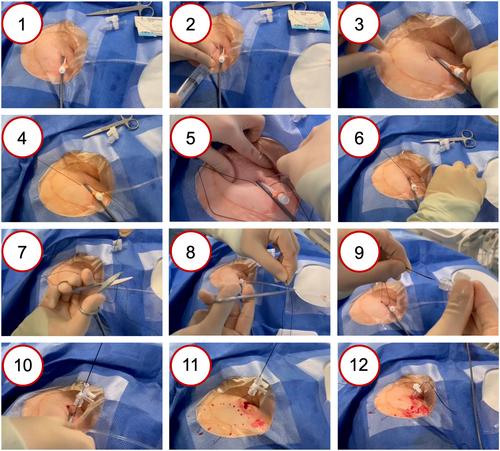
Methods for femoral venous haemostasis following electrophysiology (EP) procedures include manual compression (MC) and suture-based techniques such as a figure-of-eight suture secured with a hand-tied knot (Fo8HT) or a modified figure-of-eight suture secured with a 3-way stopcock (Fo8MOD). We hypothesised that short-term bleeding outcomes using the Fo8MOD approach would be superior to MC. We additionally compared outcomes between Fo8MOD and Fo8HT approaches.
Methods
We studied consecutive patients undergoing EP procedures at our institution between March and December 2023. Patients were categorised into three haemostasis groups: MC, Fo8HT and Fo8MOD. Access site complications were classified as major (requiring intervention or blood transfusion, delaying discharge or resulting in death) or minor (bleeding/haematoma requiring additional compression).
Results
1089 patients were included: MC 718 (65.9%); Fo8HT 105 (9.6%); Fo8MOD 266 (24.4%). Procedures were most commonly for atrial fibrillation (52.4%), atrial flutter (10.9%), and atrioventricular nodal re-entrant tachycardia (10.1%). In patients receiving periprocedural anticoagulation (865, 79.4%), Fo8MOD associated with fewer complications than MC or Fo8HT (major: MC 2.2%, Fo8HT 6.0%, Fo8MOD 0.8%, p = .01; minor: MC 16.5%, Fo8HT 12.0%, Fo8MOD 7.4%, p = .002). In patients not receiving periprocedural anticoagulation, complications did not differ between haemostasis methods (total major and minor complications 5.8%, p = .729 for between groups rates). On multivariable logistic regression, Fo8MOD was associated with a significantly lower risk of access site complications (OR 0.29 [95% CI 0.17–0.48], p < .001), whilst intraprocedural heparinisation (OR 5.25 [2.88–9.69], p < .001) and larger maximal sheath size (OR 1.06 [1.00–1.11], p = .04) were associated with a higher risk of complications.
Conclusion
Femoral haemostasis with Fo8MOD associates with fewer access site complications than MC and Fo8HT following EP procedures that need periprocedural anticoagulation.
期刊介绍:
Journal of Cardiovascular Electrophysiology (JCE) keeps its readership well informed of the latest developments in the study and management of arrhythmic disorders. Edited by Bradley P. Knight, M.D., and a distinguished international editorial board, JCE is the leading journal devoted to the study of the electrophysiology of the heart.