Zhengyun Ling, Haoqian Zhang, Jian Zhao, Pengchao Wang, Ziyan An, Shuwei Xiao, Yanfeng Sun, Weijun Fu
{"title":"Electrostimulation-Based Decellularized Matrix Bladder Patch Promotes Bladder Repair in Rats.","authors":"Zhengyun Ling, Haoqian Zhang, Jian Zhao, Pengchao Wang, Ziyan An, Shuwei Xiao, Yanfeng Sun, Weijun Fu","doi":"10.1021/acsbiomaterials.4c00961","DOIUrl":null,"url":null,"abstract":"<p><p>Bladder tissue engineering offers significant potential for repairing defects resulting from congenital and acquired conditions. However, the effectiveness of engineered grafts is often constrained by insufficient vascularization and neural regeneration. This study utilized four primary biomaterials─gelatin methacryloyl (GelMA), chitin nanocrystals (ChiNC), titanium carbide (MXene), and adipose-derived stem cells (ADSC)─to formulate two types of bioinks, GCM0.2 and GCM0.2-ADSC, in specified proportions. These bioinks were 3D printed onto bladder acellular matrix (BAM) patches to create BAM-GCM0.2 and BAM-GCM0.2-ADSC patches. The BAM-GCM0.2-ADSC patches underwent electrical stimulation to yield GCM0.2-ADSC-ES bladder patches. Employed for the repair of rat bladder defects, these patches were evaluated against a Control group, which underwent partial cystectomy followed by direct suturing. Our findings indicate that the inclusion of ADSC and electrical stimulation significantly enhances the regeneration of rat bladder smooth muscle (from [24.052 ± 2.782] % to [57.380 ± 4.017] %), blood vessels (from [5.326 ± 0.703] % to [12.723 ± 1.440] %), and nerves (from [0.227 ± 0.017] % to [1.369 ± 0.218] %). This research underscores the superior bladder repair capabilities of the GCM0.2-ADSC-ES patch and opens new pathways for bladder defect repair.</p>","PeriodicalId":8,"journal":{"name":"ACS Biomaterials Science & Engineering","volume":" ","pages":"6498-6508"},"PeriodicalIF":5.5000,"publicationDate":"2024-10-14","publicationTypes":"Journal Article","fieldsOfStudy":null,"isOpenAccess":false,"openAccessPdf":"","citationCount":"0","resultStr":null,"platform":"Semanticscholar","paperid":null,"PeriodicalName":"ACS Biomaterials Science & Engineering","FirstCategoryId":"5","ListUrlMain":"https://doi.org/10.1021/acsbiomaterials.4c00961","RegionNum":2,"RegionCategory":"医学","ArticlePicture":[],"TitleCN":null,"AbstractTextCN":null,"PMCID":null,"EPubDate":"2024/9/6 0:00:00","PubModel":"Epub","JCR":"Q2","JCRName":"MATERIALS SCIENCE, BIOMATERIALS","Score":null,"Total":0}
引用次数: 0
Abstract
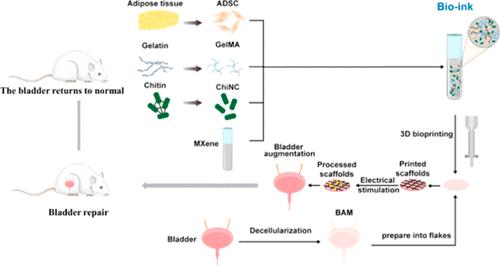
Bladder tissue engineering offers significant potential for repairing defects resulting from congenital and acquired conditions. However, the effectiveness of engineered grafts is often constrained by insufficient vascularization and neural regeneration. This study utilized four primary biomaterials─gelatin methacryloyl (GelMA), chitin nanocrystals (ChiNC), titanium carbide (MXene), and adipose-derived stem cells (ADSC)─to formulate two types of bioinks, GCM0.2 and GCM0.2-ADSC, in specified proportions. These bioinks were 3D printed onto bladder acellular matrix (BAM) patches to create BAM-GCM0.2 and BAM-GCM0.2-ADSC patches. The BAM-GCM0.2-ADSC patches underwent electrical stimulation to yield GCM0.2-ADSC-ES bladder patches. Employed for the repair of rat bladder defects, these patches were evaluated against a Control group, which underwent partial cystectomy followed by direct suturing. Our findings indicate that the inclusion of ADSC and electrical stimulation significantly enhances the regeneration of rat bladder smooth muscle (from [24.052 ± 2.782] % to [57.380 ± 4.017] %), blood vessels (from [5.326 ± 0.703] % to [12.723 ± 1.440] %), and nerves (from [0.227 ± 0.017] % to [1.369 ± 0.218] %). This research underscores the superior bladder repair capabilities of the GCM0.2-ADSC-ES patch and opens new pathways for bladder defect repair.
期刊介绍:
ACS Biomaterials Science & Engineering is the leading journal in the field of biomaterials, serving as an international forum for publishing cutting-edge research and innovative ideas on a broad range of topics:
Applications and Health – implantable tissues and devices, prosthesis, health risks, toxicology
Bio-interactions and Bio-compatibility – material-biology interactions, chemical/morphological/structural communication, mechanobiology, signaling and biological responses, immuno-engineering, calcification, coatings, corrosion and degradation of biomaterials and devices, biophysical regulation of cell functions
Characterization, Synthesis, and Modification – new biomaterials, bioinspired and biomimetic approaches to biomaterials, exploiting structural hierarchy and architectural control, combinatorial strategies for biomaterials discovery, genetic biomaterials design, synthetic biology, new composite systems, bionics, polymer synthesis
Controlled Release and Delivery Systems – biomaterial-based drug and gene delivery, bio-responsive delivery of regulatory molecules, pharmaceutical engineering
Healthcare Advances – clinical translation, regulatory issues, patient safety, emerging trends
Imaging and Diagnostics – imaging agents and probes, theranostics, biosensors, monitoring
Manufacturing and Technology – 3D printing, inks, organ-on-a-chip, bioreactor/perfusion systems, microdevices, BioMEMS, optics and electronics interfaces with biomaterials, systems integration
Modeling and Informatics Tools – scaling methods to guide biomaterial design, predictive algorithms for structure-function, biomechanics, integrating bioinformatics with biomaterials discovery, metabolomics in the context of biomaterials
Tissue Engineering and Regenerative Medicine – basic and applied studies, cell therapies, scaffolds, vascularization, bioartificial organs, transplantation and functionality, cellular agriculture



 京公网安备 11010802042870号
京ICP备2023020795号-1
京公网安备 11010802042870号
京ICP备2023020795号-1

 分享
分享
 求助内容:
求助内容: 应助结果提醒方式:
 扫码关注我们
