Joo Kyung Kim, Wandi Zhu, Chunhong Dong, Lai Wei, Yao Ma, Timothy Denning, Sang-Moo Kang and Bao-Zhong Wang
{"title":"Double-layered protein nanoparticles conjugated with truncated flagellin induce improved mucosal and systemic immune responses in mice†","authors":"Joo Kyung Kim, Wandi Zhu, Chunhong Dong, Lai Wei, Yao Ma, Timothy Denning, Sang-Moo Kang and Bao-Zhong Wang","doi":"10.1039/D4NH00287C","DOIUrl":null,"url":null,"abstract":"<p >Influenza viral infection poses a severe risk to global public health. Considering the suboptimal protection provided by current influenza vaccines against circulating influenza A viruses, it is imperative to develop novel vaccine formulations to combat respiratory infections. Here, we report the development of an intranasally-administered, self-adjuvanted double-layered protein nanoparticle consisting of influenza nucleoprotein (NP) cores coated with hemagglutinin (HA) and a truncated form of bacterial flagellin (tFliC). Intranasal vaccination of these nanoparticles notably amplified both antigen-specific humoral and cellular immune responses in the systematic compartments. Elevated antigen-specific IgA and IgG levels in mucosal washes, along with increased lung-resident memory B cell populations, were observed in the respiratory system of the immunized mice. Furthermore, intranasal vaccination of tFliC-adjuvanted nanoparticles enhanced survival rates against homologous and heterologous H3N2 viral challenges. Intriguingly, mucosal slow delivery of the prime dose (by splitting the dose into 5 applications over 8 days) significantly enhanced germinal center reactions and effector T-cell populations in lung draining lymph nodes, therefore promoting the protective efficacy against heterologous influenza viral challenges compared to single-prime immunization. These findings highlight the potential of intranasal immunization with tFliC-adjuvanted protein nanoparticles to bolster mucosal and systemic immune responses, with a slow-delivery strategy offering a promising approach for combating influenza epidemics.</p>","PeriodicalId":93,"journal":{"name":"Nanoscale Horizons","volume":" 11","pages":" 2016-2030"},"PeriodicalIF":6.6000,"publicationDate":"2024-09-06","publicationTypes":"Journal Article","fieldsOfStudy":null,"isOpenAccess":false,"openAccessPdf":"https://pubs.rsc.org/en/content/articlepdf/2024/nh/d4nh00287c?page=search","citationCount":"0","resultStr":null,"platform":"Semanticscholar","paperid":null,"PeriodicalName":"Nanoscale Horizons","FirstCategoryId":"88","ListUrlMain":"https://pubs.rsc.org/en/content/articlelanding/2024/nh/d4nh00287c","RegionNum":2,"RegionCategory":"材料科学","ArticlePicture":[],"TitleCN":null,"AbstractTextCN":null,"PMCID":null,"EPubDate":"","PubModel":"","JCR":"Q1","JCRName":"CHEMISTRY, PHYSICAL","Score":null,"Total":0}
引用次数: 0
Abstract
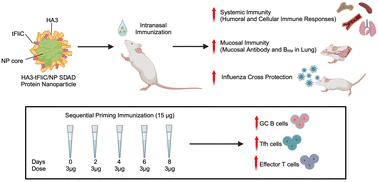
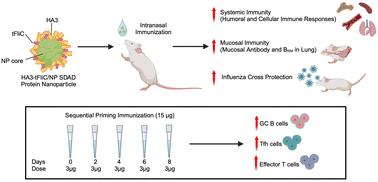
Influenza viral infection poses a severe risk to global public health. Considering the suboptimal protection provided by current influenza vaccines against circulating influenza A viruses, it is imperative to develop novel vaccine formulations to combat respiratory infections. Here, we report the development of an intranasally-administered, self-adjuvanted double-layered protein nanoparticle consisting of influenza nucleoprotein (NP) cores coated with hemagglutinin (HA) and a truncated form of bacterial flagellin (tFliC). Intranasal vaccination of these nanoparticles notably amplified both antigen-specific humoral and cellular immune responses in the systematic compartments. Elevated antigen-specific IgA and IgG levels in mucosal washes, along with increased lung-resident memory B cell populations, were observed in the respiratory system of the immunized mice. Furthermore, intranasal vaccination of tFliC-adjuvanted nanoparticles enhanced survival rates against homologous and heterologous H3N2 viral challenges. Intriguingly, mucosal slow delivery of the prime dose (by splitting the dose into 5 applications over 8 days) significantly enhanced germinal center reactions and effector T-cell populations in lung draining lymph nodes, therefore promoting the protective efficacy against heterologous influenza viral challenges compared to single-prime immunization. These findings highlight the potential of intranasal immunization with tFliC-adjuvanted protein nanoparticles to bolster mucosal and systemic immune responses, with a slow-delivery strategy offering a promising approach for combating influenza epidemics.
流感病毒感染对全球公共卫生构成严重威胁。考虑到目前的流感疫苗对流行性甲型流感病毒的保护效果不佳,开发新型疫苗制剂以对抗呼吸道感染势在必行。在此,我们报告了一种鼻内给药的自佐剂双层蛋白纳米粒子的开发情况,该粒子由涂有血凝素(HA)和截短型细菌鞭毛蛋白(tFliC)的流感核蛋白(NP)核心组成。鼻腔内接种这些纳米颗粒可显著增强系统分区的抗原特异性体液免疫和细胞免疫反应。在免疫小鼠的呼吸系统中观察到,粘膜清洗液中的抗原特异性 IgA 和 IgG 水平升高,肺驻留记忆 B 细胞群增加。此外,tFliC 佐剂纳米粒子鼻内接种提高了小鼠在同源和异源 H3N2 病毒挑战下的存活率。耐人寻味的是,与单次免疫相比,粘膜慢速给药(在8天内分5次给药)可显著增强生殖中心反应和肺引流淋巴结中的效应T细胞群,从而提高对异源流感病毒挑战的保护效力。这些研究结果突显了tFliC佐剂蛋白纳米粒子鼻内免疫在增强粘膜和全身免疫反应方面的潜力,而缓慢给药策略则为抗击流感流行提供了一种前景广阔的方法。
期刊介绍:
Nanoscale Horizons stands out as a premier journal for publishing exceptionally high-quality and innovative nanoscience and nanotechnology. The emphasis lies on original research that introduces a new concept or a novel perspective (a conceptual advance), prioritizing this over reporting technological improvements. Nevertheless, outstanding articles showcasing truly groundbreaking developments, including record-breaking performance, may also find a place in the journal. Published work must be of substantial general interest to our broad and diverse readership across the nanoscience and nanotechnology community.



 京公网安备 11010802042870号
京ICP备2023020795号-1
京公网安备 11010802042870号
京ICP备2023020795号-1

 分享
分享
 求助内容:
求助内容: 应助结果提醒方式:
 扫码关注我们
