{"title":"Two-dimensional (2D) quasi-living crystallization-driven self-assembly of polyethylene-b-hyperbranched polyglycidol diblock copolymers in solution†","authors":"Xiaowen Si, Chenxi Jiang, Yu Hu and Jingshan Mu","doi":"10.1039/D4SM00845F","DOIUrl":null,"url":null,"abstract":"<p >This paper presents a systematic investigation of the crystalline nucleation, micellization, two-dimensional (2D) growth of polyethylene-<em>b</em>-hyperbranched polyglycidol (PE-<em>b-hb</em>PG) copolymers in solutions during cooling and isothermal crystallization. As a result, lozenge-shaped monolayer or multilayer lamellar crystals were prepared by optimizing the “self-nucleation” conditions. The effect of crystallization temperatures (<em>T</em><small><sub>c</sub></small>), critical micelle temperature (CMT), selective solvents, and the topology of block copolymers (BCPs) on the growth of 2D lozenge-shaped crystals is extensively explored using TEM, AFM and <em>in situ</em> DLS techniques. The results demonstrate that the formation of a perfect lozenge-shaped monolayer crystal is contingent upon the relationship between CMT and <em>T</em><small><sub>c</sub></small> of the BCPs (CMT < <em>T</em><small><sub>c</sub></small>), as well as the isothermal crystallization temperature <em>T</em><small><sub>iso</sub></small> (CMT < <em>T</em><small><sub>iso</sub></small> < <em>T</em><small><sub>c</sub></small>). This significant finding provides a feasibility programme for the preparation of 2D lamellar crystals using the “self-nucleation” approach from an alternative viewpoint of the corona topology.</p>","PeriodicalId":103,"journal":{"name":"Soft Matter","volume":" 36","pages":" 7258-7269"},"PeriodicalIF":2.8000,"publicationDate":"2024-08-28","publicationTypes":"Journal Article","fieldsOfStudy":null,"isOpenAccess":false,"openAccessPdf":"","citationCount":"0","resultStr":null,"platform":"Semanticscholar","paperid":null,"PeriodicalName":"Soft Matter","FirstCategoryId":"92","ListUrlMain":"https://pubs.rsc.org/en/content/articlelanding/2024/sm/d4sm00845f","RegionNum":3,"RegionCategory":"化学","ArticlePicture":[],"TitleCN":null,"AbstractTextCN":null,"PMCID":null,"EPubDate":"","PubModel":"","JCR":"Q3","JCRName":"CHEMISTRY, PHYSICAL","Score":null,"Total":0}
引用次数: 0
Abstract
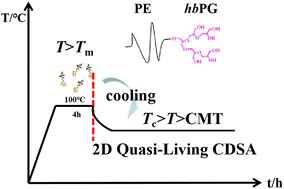
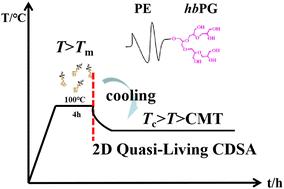
This paper presents a systematic investigation of the crystalline nucleation, micellization, two-dimensional (2D) growth of polyethylene-b-hyperbranched polyglycidol (PE-b-hbPG) copolymers in solutions during cooling and isothermal crystallization. As a result, lozenge-shaped monolayer or multilayer lamellar crystals were prepared by optimizing the “self-nucleation” conditions. The effect of crystallization temperatures (Tc), critical micelle temperature (CMT), selective solvents, and the topology of block copolymers (BCPs) on the growth of 2D lozenge-shaped crystals is extensively explored using TEM, AFM and in situ DLS techniques. The results demonstrate that the formation of a perfect lozenge-shaped monolayer crystal is contingent upon the relationship between CMT and Tc of the BCPs (CMT < Tc), as well as the isothermal crystallization temperature Tiso (CMT < Tiso < Tc). This significant finding provides a feasibility programme for the preparation of 2D lamellar crystals using the “self-nucleation” approach from an alternative viewpoint of the corona topology.
期刊介绍:
Soft Matter is an international journal published by the Royal Society of Chemistry using Engineering-Materials Science: A Synthesis as its research focus. It publishes original research articles, review articles, and synthesis articles related to this field, reporting the latest discoveries in the relevant theoretical, practical, and applied disciplines in a timely manner, and aims to promote the rapid exchange of scientific information in this subject area. The journal is an open access journal. The journal is an open access journal and has not been placed on the alert list in the last three years.



 京公网安备 11010802042870号
京ICP备2023020795号-1
京公网安备 11010802042870号
京ICP备2023020795号-1

 分享
分享
 求助内容:
求助内容: 应助结果提醒方式:
 扫码关注我们
