William Franklin Peacock, Karina Melissa Soto-Ruiz, Allan S Jaffe, Brian R Tiffany, Simon A Mahler, Brian W Patterson, Alan H B Wu, Robert Christenson
{"title":"A rapid noninvasive wearable device for assessing cardiac troponin I level.","authors":"William Franklin Peacock, Karina Melissa Soto-Ruiz, Allan S Jaffe, Brian R Tiffany, Simon A Mahler, Brian W Patterson, Alan H B Wu, Robert Christenson","doi":"10.15441/ceem.24.294","DOIUrl":null,"url":null,"abstract":"<p><strong>Objective: </strong>Chest pain, a common emergency department presentation, requires rapid evaluation. The current gold standard of care is serial troponin measurements from blood draws along with an electrocardiogram and clinical presentation. However, an optical technology-based noninvasive wearable device, the Infrasensor, which can rapidly and transcutaneously assesses cardiac troponin I (cTnI), was recently developed. We aimed to perform a pilot study to evaluate the performance of the Infrasensor in cTnI defined cohorts.</p><p><strong>Methods: </strong>This was a 10-hospital prospective observational study in healthy US subjects with a normal cTnI level and in patients with an elevated local cTnI level. Healthy subjects as determined by a negative questionnaire and bloodwork underwent 3-minute Infrasensor measurement and levels of high-sensitivity cTnI (hs-cTnI), n-terminal pro-B-type natriuretic peptide (NTproBNP), creatinine, and glycosylated hemoglobin (HbA1c) were evaluated from blood. Patients with elevated cTnI had the same Infrasensor and blood sample measurements. Using a fivefold cross-validation technique, cTnI-based binary classification models that did and did not include age were trained on 80% and validated on 20% of the dataset (n=168; elevated hs-cTnI equally partitioned into five nearly equally-sized subsets ).</p><p><strong>Results: </strong>Of 840 patients, 727 (87.5%) had normal (nonelevated) cTnI levels while the remaining 113 had elevated cTnI. Median age was 61 years (interquartile range, 52-71 years) for the elevated cohort and 48 years (interquartile range, 32-57 years) for the nonelevated. Overall, 416 (50.5%) were female, with 33 of 113 (29.2%) in the elevated cohort and 383 of 727 (52.7%) in the nonelevated cohort. Overall, the sensitivity, specificity, negative and positive predictive values of the Infrasensor for identifying elevated cTnI were 0.90, 0.70, 0.98 and 0.48, respectively, with a C-statistic of 0.90 (95% confidence interval, 0.89-0.99).</p><p><strong>Conclusion: </strong>The Infrasensor accurately identifies elevated cTnI within 3 minutes of application.</p>","PeriodicalId":10325,"journal":{"name":"Clinical and Experimental Emergency Medicine","volume":" ","pages":"251-258"},"PeriodicalIF":2.3000,"publicationDate":"2025-09-01","publicationTypes":"Journal Article","fieldsOfStudy":null,"isOpenAccess":false,"openAccessPdf":"https://www.ncbi.nlm.nih.gov/pmc/articles/PMC12541513/pdf/","citationCount":"0","resultStr":null,"platform":"Semanticscholar","paperid":null,"PeriodicalName":"Clinical and Experimental Emergency Medicine","FirstCategoryId":"1085","ListUrlMain":"https://doi.org/10.15441/ceem.24.294","RegionNum":0,"RegionCategory":null,"ArticlePicture":[],"TitleCN":null,"AbstractTextCN":null,"PMCID":null,"EPubDate":"2024/9/6 0:00:00","PubModel":"Epub","JCR":"Q2","JCRName":"EMERGENCY MEDICINE","Score":null,"Total":0}
引用次数: 0
Abstract
Objective: Chest pain, a common emergency department presentation, requires rapid evaluation. The current gold standard of care is serial troponin measurements from blood draws along with an electrocardiogram and clinical presentation. However, an optical technology-based noninvasive wearable device, the Infrasensor, which can rapidly and transcutaneously assesses cardiac troponin I (cTnI), was recently developed. We aimed to perform a pilot study to evaluate the performance of the Infrasensor in cTnI defined cohorts.
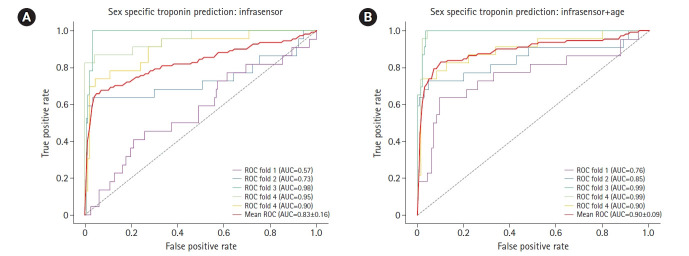
Methods: This was a 10-hospital prospective observational study in healthy US subjects with a normal cTnI level and in patients with an elevated local cTnI level. Healthy subjects as determined by a negative questionnaire and bloodwork underwent 3-minute Infrasensor measurement and levels of high-sensitivity cTnI (hs-cTnI), n-terminal pro-B-type natriuretic peptide (NTproBNP), creatinine, and glycosylated hemoglobin (HbA1c) were evaluated from blood. Patients with elevated cTnI had the same Infrasensor and blood sample measurements. Using a fivefold cross-validation technique, cTnI-based binary classification models that did and did not include age were trained on 80% and validated on 20% of the dataset (n=168; elevated hs-cTnI equally partitioned into five nearly equally-sized subsets ).
Results: Of 840 patients, 727 (87.5%) had normal (nonelevated) cTnI levels while the remaining 113 had elevated cTnI. Median age was 61 years (interquartile range, 52-71 years) for the elevated cohort and 48 years (interquartile range, 32-57 years) for the nonelevated. Overall, 416 (50.5%) were female, with 33 of 113 (29.2%) in the elevated cohort and 383 of 727 (52.7%) in the nonelevated cohort. Overall, the sensitivity, specificity, negative and positive predictive values of the Infrasensor for identifying elevated cTnI were 0.90, 0.70, 0.98 and 0.48, respectively, with a C-statistic of 0.90 (95% confidence interval, 0.89-0.99).
Conclusion: The Infrasensor accurately identifies elevated cTnI within 3 minutes of application.






 京公网安备 11010802042870号
京ICP备2023020795号-1
京公网安备 11010802042870号
京ICP备2023020795号-1

 分享
分享
 求助内容:
求助内容: 应助结果提醒方式:
 扫码关注我们
