{"title":"Lipophilic fluorescent products as a potential biomarker of oxidative stress: A link between central (brain) and peripheral (blood).","authors":"Sepideh Tarbali, Masoomeh Dadkhah, Hakimeh Saadati","doi":"10.4103/jrms.jrms_671_23","DOIUrl":null,"url":null,"abstract":"<p><p>Oxidative stress plays a key role in brain damage because of the sensitivity of brain tissue to oxidative damage. Biomarkers with easy measurement can be a candidate for reflecting the oxidative stress issue in humans. For this reason, we need to focus on specific metabolic products of the brain. End products of free radical reactions such as malondialdehydes form fluorescent products known as lipophilic fluorescent products (LFPs). The distinctive feature of LFPs is their autofluorescent properties. LFPs are detectable in the brain and cerebrospinal fluid. Furthermore, because of the diffusion into the bloodstream, these lipophilic molecules can be detected in the blood. Accumulations of these compounds produce more reactive oxygen species and increase the sensitivity of cells to oxidative damage. Hence, LFPs can be considered a danger signal for neurons and can be introduced as a strong index of oxidative damage both in the central and in the peripheral.</p>","PeriodicalId":50062,"journal":{"name":"Journal of Research in Medical Sciences","volume":"29 ","pages":"38"},"PeriodicalIF":1.7000,"publicationDate":"2024-07-12","publicationTypes":"Journal Article","fieldsOfStudy":null,"isOpenAccess":false,"openAccessPdf":"https://www.ncbi.nlm.nih.gov/pmc/articles/PMC11376719/pdf/","citationCount":"0","resultStr":null,"platform":"Semanticscholar","paperid":null,"PeriodicalName":"Journal of Research in Medical Sciences","FirstCategoryId":"3","ListUrlMain":"https://doi.org/10.4103/jrms.jrms_671_23","RegionNum":4,"RegionCategory":"医学","ArticlePicture":[],"TitleCN":null,"AbstractTextCN":null,"PMCID":null,"EPubDate":"2024/1/1 0:00:00","PubModel":"eCollection","JCR":"Q2","JCRName":"MEDICINE, GENERAL & INTERNAL","Score":null,"Total":0}
引用次数: 0
Abstract
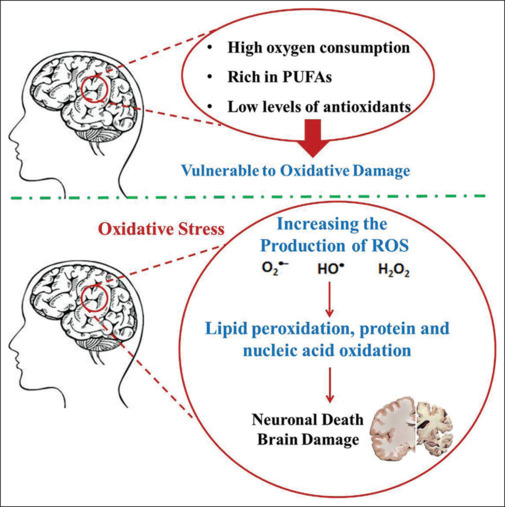
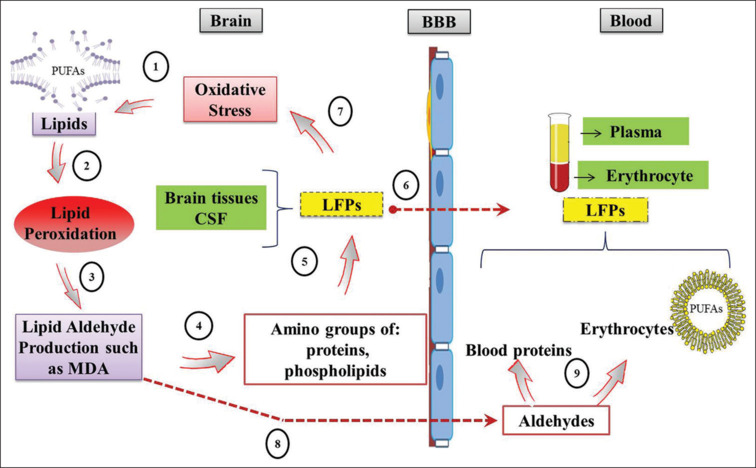
Oxidative stress plays a key role in brain damage because of the sensitivity of brain tissue to oxidative damage. Biomarkers with easy measurement can be a candidate for reflecting the oxidative stress issue in humans. For this reason, we need to focus on specific metabolic products of the brain. End products of free radical reactions such as malondialdehydes form fluorescent products known as lipophilic fluorescent products (LFPs). The distinctive feature of LFPs is their autofluorescent properties. LFPs are detectable in the brain and cerebrospinal fluid. Furthermore, because of the diffusion into the bloodstream, these lipophilic molecules can be detected in the blood. Accumulations of these compounds produce more reactive oxygen species and increase the sensitivity of cells to oxidative damage. Hence, LFPs can be considered a danger signal for neurons and can be introduced as a strong index of oxidative damage both in the central and in the peripheral.
期刊介绍:
Journal of Research in Medical Sciences, a publication of Isfahan University of Medical Sciences, is a peer-reviewed online continuous journal with print on demand compilation of issues published. The journal’s full text is available online at http://www.jmsjournal.net. The journal allows free access (Open Access) to its contents and permits authors to self-archive final accepted version of the articles on any OAI-compliant institutional / subject-based repository.




 京公网安备 11010802042870号
京ICP备2023020795号-1
京公网安备 11010802042870号
京ICP备2023020795号-1

 分享
分享
 求助内容:
求助内容: 应助结果提醒方式:
 扫码关注我们
