Miloš Auersvald , Michal Šiman , Petr Vozka , Petr Straka
{"title":"Quantitative determination of olefins in pyrolysis oils from waste plastics and tires using selective adsorption by Ag–SiO2 followed by GC×GC-FID","authors":"Miloš Auersvald , Michal Šiman , Petr Vozka , Petr Straka","doi":"10.1016/j.talanta.2024.126792","DOIUrl":null,"url":null,"abstract":"<div><p>Determination of olefins in pyrolysis oils from waste plastics and tires is crucial for optimizing the pyrolysis process and especially for the further advanced valorization of these oils in terms of the circular economy. Identifying olefins, even using high-resolution techniques like GC×GC, is challenging without TOF-MS, which allows modification of the ionization step. Currently, the only method for determining olefins in plastic pyrolysis oils is GC-VUV, recently standardized as ASTM D8519. However, TOF-MS and VUV are not affordable instruments for many research teams working on plastics recycling. This paper introduces a simple method for the selective micro-scale adsorption of olefins over AgNO<sub>3</sub>/SiO<sub>2</sub>, followed by the GC×GC-FID analysis. Olefins are determined indirectly from the loss of chromatographic area in respective hydrocarbon groups before and after removal. Only 50 μL sample and 15 min of sample separation are needed. Our method was extensively validated and provides a reliable determination of olefin content in a wide range of pyrolysis oils from plastics and tires and their products after mild hydrotreatment. It is affordable to all researchers and industrial companies working on plastics recycling by thermochemical processes as it does not require an MS detector.</p></div>","PeriodicalId":435,"journal":{"name":"Talanta","volume":"281 ","pages":"Article 126792"},"PeriodicalIF":6.1000,"publicationDate":"2024-08-30","publicationTypes":"Journal Article","fieldsOfStudy":null,"isOpenAccess":false,"openAccessPdf":"https://www.sciencedirect.com/science/article/pii/S0039914024011718/pdfft?md5=8b466a17210cfafe36426d21d78dd6a8&pid=1-s2.0-S0039914024011718-main.pdf","citationCount":"0","resultStr":null,"platform":"Semanticscholar","paperid":null,"PeriodicalName":"Talanta","FirstCategoryId":"92","ListUrlMain":"https://www.sciencedirect.com/science/article/pii/S0039914024011718","RegionNum":1,"RegionCategory":"化学","ArticlePicture":[],"TitleCN":null,"AbstractTextCN":null,"PMCID":null,"EPubDate":"","PubModel":"","JCR":"Q1","JCRName":"CHEMISTRY, ANALYTICAL","Score":null,"Total":0}
引用次数: 0
Abstract
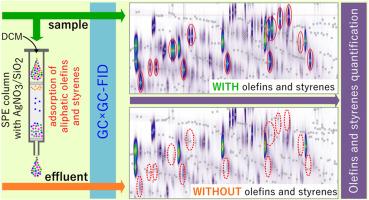
Determination of olefins in pyrolysis oils from waste plastics and tires is crucial for optimizing the pyrolysis process and especially for the further advanced valorization of these oils in terms of the circular economy. Identifying olefins, even using high-resolution techniques like GC×GC, is challenging without TOF-MS, which allows modification of the ionization step. Currently, the only method for determining olefins in plastic pyrolysis oils is GC-VUV, recently standardized as ASTM D8519. However, TOF-MS and VUV are not affordable instruments for many research teams working on plastics recycling. This paper introduces a simple method for the selective micro-scale adsorption of olefins over AgNO3/SiO2, followed by the GC×GC-FID analysis. Olefins are determined indirectly from the loss of chromatographic area in respective hydrocarbon groups before and after removal. Only 50 μL sample and 15 min of sample separation are needed. Our method was extensively validated and provides a reliable determination of olefin content in a wide range of pyrolysis oils from plastics and tires and their products after mild hydrotreatment. It is affordable to all researchers and industrial companies working on plastics recycling by thermochemical processes as it does not require an MS detector.
期刊介绍:
Talanta provides a forum for the publication of original research papers, short communications, and critical reviews in all branches of pure and applied analytical chemistry. Papers are evaluated based on established guidelines, including the fundamental nature of the study, scientific novelty, substantial improvement or advantage over existing technology or methods, and demonstrated analytical applicability. Original research papers on fundamental studies, and on novel sensor and instrumentation developments, are encouraged. Novel or improved applications in areas such as clinical and biological chemistry, environmental analysis, geochemistry, materials science and engineering, and analytical platforms for omics development are welcome.
Analytical performance of methods should be determined, including interference and matrix effects, and methods should be validated by comparison with a standard method, or analysis of a certified reference material. Simple spiking recoveries may not be sufficient. The developed method should especially comprise information on selectivity, sensitivity, detection limits, accuracy, and reliability. However, applying official validation or robustness studies to a routine method or technique does not necessarily constitute novelty. Proper statistical treatment of the data should be provided. Relevant literature should be cited, including related publications by the authors, and authors should discuss how their proposed methodology compares with previously reported methods.



 京公网安备 11010802042870号
京ICP备2023020795号-1
京公网安备 11010802042870号
京ICP备2023020795号-1

 分享
分享
 求助内容:
求助内容: 应助结果提醒方式:
 扫码关注我们
