{"title":"A survey of intraocular lens preferences of UK refractive surgeons for cataract surgery and refractive lens exchange.","authors":"Jamil Kabbani, Liam Price, Radhika Patel, Nizar Din, Mukhtar Bizrah","doi":"10.1186/s12886-024-03639-8","DOIUrl":null,"url":null,"abstract":"<p><strong>Background: </strong>To explore intraocular lens (IOL) preferences of United Kingdom-based (UK) refractive surgeons in cataract and refractive lens exchange (RLE) surgery.</p><p><strong>Methods: </strong>An online survey on IOL preferences (and reasons for their choice) in cataract and RLE surgery was distributed. It also enquired about implementing mini-monovision with extended depth of field (EDoF) IOLs, about utilising IOL mix-and-match (different IOL types in each eye), and at what level of corneal astigmatism they prefer toric lenses.</p><p><strong>Results: </strong>Following an 81.6% response rate, thirty responses were analysed; median years of refractive surgery experience was 12.5. The most popular IOL choices for cataract surgery were EDoF lenses (30%), monofocals (20%), and trifocals (20%). The most cited reason for each was better overall visual outcomes (88.9%), fewer unwanted symptoms (66.7%) and best spectacle independence (66.7%), respectively. For RLE, EDoF remained most popular (36.7%), followed by trifocals (30%), and multifocals (16.7%) with the same reasons for choice cited above. Mini-monovision with EDoF lenses was well-regarded (83% recommend for most/select patients), unlike utilising IOL mix-and-match (60% did not recommend). 40% prefer toric IOLs for astigmatism of 1 dioptre (D) or higher, whilst 30% opt for them at < 1D.</p><p><strong>Conclusions: </strong>Experienced UK refractive surgeons prefer newer IOLs with enhanced optics; ≥50% of respondents favoured either EDoF or trifocals for a 'typical' cataract or RLE patient. Notably, respondents have a low corneal astigmatism threshold for toric lenses. Mini-monovision with EDoF IOLs was well-regarded, whilst mix-and-match of different IOL types was less recommended.</p>","PeriodicalId":9058,"journal":{"name":"BMC Ophthalmology","volume":"24 1","pages":"397"},"PeriodicalIF":1.7000,"publicationDate":"2024-09-06","publicationTypes":"Journal Article","fieldsOfStudy":null,"isOpenAccess":false,"openAccessPdf":"https://www.ncbi.nlm.nih.gov/pmc/articles/PMC11378387/pdf/","citationCount":"0","resultStr":null,"platform":"Semanticscholar","paperid":null,"PeriodicalName":"BMC Ophthalmology","FirstCategoryId":"3","ListUrlMain":"https://doi.org/10.1186/s12886-024-03639-8","RegionNum":4,"RegionCategory":"医学","ArticlePicture":[],"TitleCN":null,"AbstractTextCN":null,"PMCID":null,"EPubDate":"","PubModel":"","JCR":"Q3","JCRName":"OPHTHALMOLOGY","Score":null,"Total":0}
引用次数: 0
Abstract
Background: To explore intraocular lens (IOL) preferences of United Kingdom-based (UK) refractive surgeons in cataract and refractive lens exchange (RLE) surgery.
Methods: An online survey on IOL preferences (and reasons for their choice) in cataract and RLE surgery was distributed. It also enquired about implementing mini-monovision with extended depth of field (EDoF) IOLs, about utilising IOL mix-and-match (different IOL types in each eye), and at what level of corneal astigmatism they prefer toric lenses.
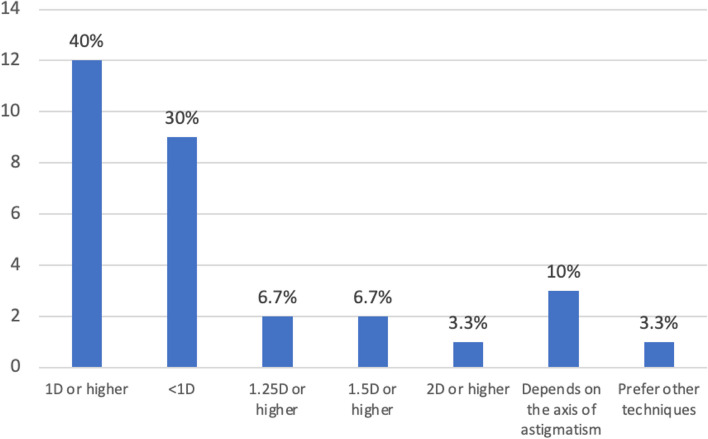
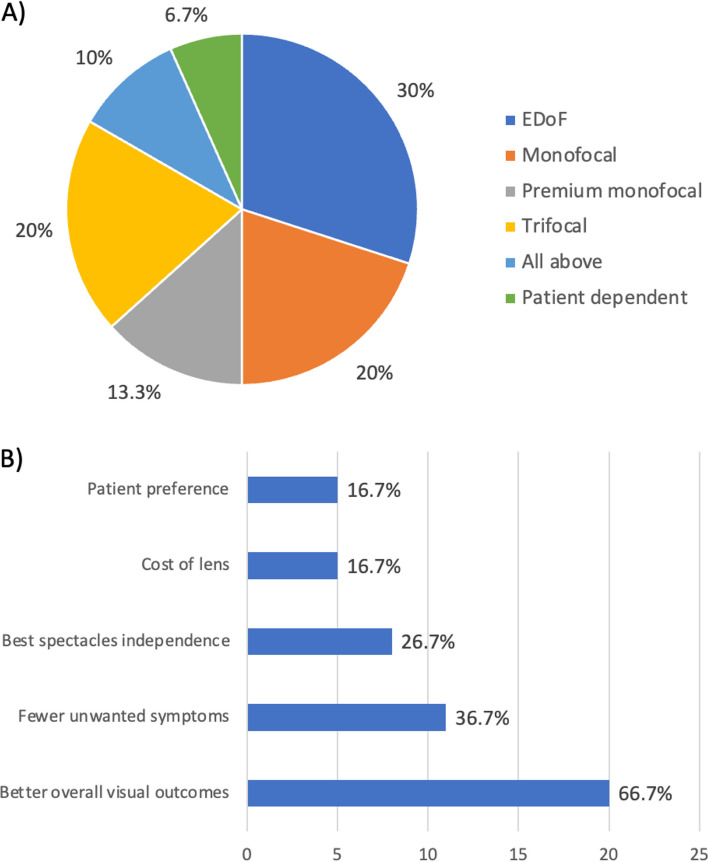
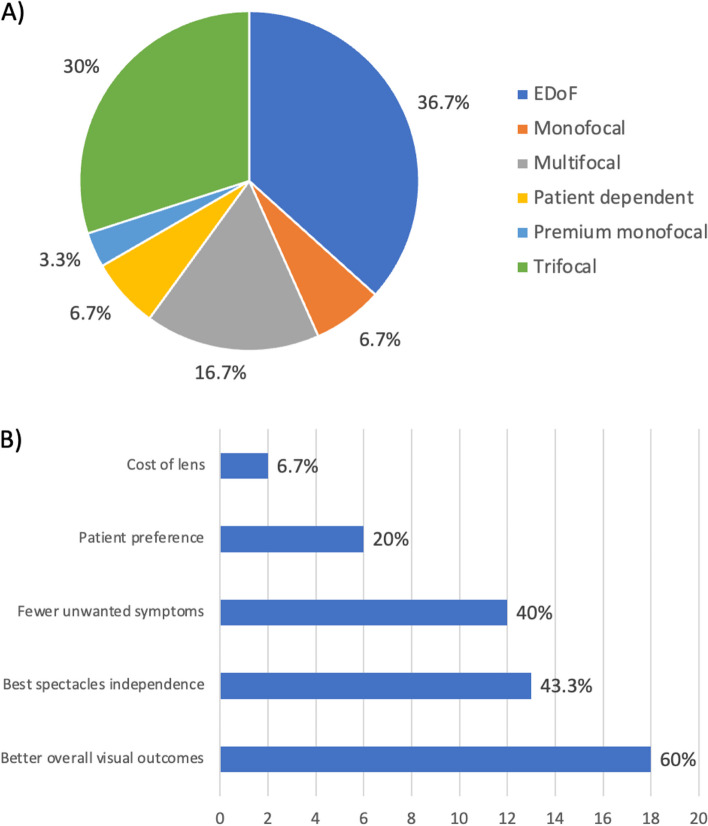
Results: Following an 81.6% response rate, thirty responses were analysed; median years of refractive surgery experience was 12.5. The most popular IOL choices for cataract surgery were EDoF lenses (30%), monofocals (20%), and trifocals (20%). The most cited reason for each was better overall visual outcomes (88.9%), fewer unwanted symptoms (66.7%) and best spectacle independence (66.7%), respectively. For RLE, EDoF remained most popular (36.7%), followed by trifocals (30%), and multifocals (16.7%) with the same reasons for choice cited above. Mini-monovision with EDoF lenses was well-regarded (83% recommend for most/select patients), unlike utilising IOL mix-and-match (60% did not recommend). 40% prefer toric IOLs for astigmatism of 1 dioptre (D) or higher, whilst 30% opt for them at < 1D.
Conclusions: Experienced UK refractive surgeons prefer newer IOLs with enhanced optics; ≥50% of respondents favoured either EDoF or trifocals for a 'typical' cataract or RLE patient. Notably, respondents have a low corneal astigmatism threshold for toric lenses. Mini-monovision with EDoF IOLs was well-regarded, whilst mix-and-match of different IOL types was less recommended.
期刊介绍:
BMC Ophthalmology is an open access, peer-reviewed journal that considers articles on all aspects of the prevention, diagnosis and management of eye disorders, as well as related molecular genetics, pathophysiology, and epidemiology.




 京公网安备 11010802042870号
京ICP备2023020795号-1
京公网安备 11010802042870号
京ICP备2023020795号-1

 分享
分享
 求助内容:
求助内容: 应助结果提醒方式:
 扫码关注我们
