Efficacy and safety of endoscopic nasobiliary drainage versus percutaneous transhepatic cholangial drainage in the treatment of advanced hilar cholangiocarcinoma: a systematic review and meta-analysis.
Huiling Zhou, Chunxia Liu, Xianhuan Yu, Mingye Su, Jingwen Yan, Xiangde Shi
{"title":"Efficacy and safety of endoscopic nasobiliary drainage versus percutaneous transhepatic cholangial drainage in the treatment of advanced hilar cholangiocarcinoma: a systematic review and meta-analysis.","authors":"Huiling Zhou, Chunxia Liu, Xianhuan Yu, Mingye Su, Jingwen Yan, Xiangde Shi","doi":"10.1186/s12876-024-03397-3","DOIUrl":null,"url":null,"abstract":"<p><strong>Objective: </strong>To evaluate and compare the efficacy and safety of Endoscopic Nasobiliary Drainage (ENBD) and Percutaneous Transhepatic Cholangiography Drainage (PTCD) in patients with advanced Hilar Cholangiocarcinoma (HCCA) through a meta-analysis of clinical studies.</p><p><strong>Methods: </strong>We searched Chinese and English databases, including China National Knowledge Infrastructure (CNKI), Wanfang database, PubMed, Embase, Scopus, and Web of Science, for relevant literatures on PTCD and ENBD for advanced HCCA clinical trials. Two investigators independently screened the literatures, and the quality of the included studies was evaluated using the Newcastle-Ottawa Scale (NOS). The primary endpoint was the success rate of biliary drainage operation, while secondary endpoints included Total Bilirubin (TBIL) change, acute pancreatitis, biliary tract infection, hemobilia, and other complications. R software was used for data analysis.</p><p><strong>Results: </strong>A comprehensive database search, based on predefined inclusion and exclusion criteria, yielded 26 articles for this study. Analysis revealed that PTCD had a significantly higher success rate than ENBD [OR (95% CI) = 2.63 (1.98, 3.49), Z=6.70, P<0.05]. PTCD was also more effective in reducing TBIL levels post-drainage [SMD (95%CI) =-0.13 (-0.23, -0.03), Z=-2.61, P<0.05]. While ENBD demonstrated a lower overall complication rate [OR (95%CI) = 0.60 (0.43, 0.84), Z=-2.99, P<0.05], it was associated with a significantly lower incidence of post-drainage biliary hemorrhage compared to PTCD [OR=3.02, 95%CI: (1.94-4.71), Z= 4.89, P<0.01].</p><p><strong>Conclusions: </strong>This meta-analysis compares the efficacy and safety of ENBD and PTCD for palliative treatment of advanced HCCA. While both are effective, PTCD showed superiority in achieving successful drainage, reducing TBIL, and lowering the incidence of acute pancreatitis and biliary infections. However, ENBD had a lower risk of post-drainage bleeding. Clinicians should weigh these risks and benefits when choosing between ENBD and PTCD for individual patients. Further research is needed to confirm these findings and explore long-term outcomes.</p>","PeriodicalId":9129,"journal":{"name":"BMC Gastroenterology","volume":"24 1","pages":"302"},"PeriodicalIF":2.5000,"publicationDate":"2024-09-06","publicationTypes":"Journal Article","fieldsOfStudy":null,"isOpenAccess":false,"openAccessPdf":"https://www.ncbi.nlm.nih.gov/pmc/articles/PMC11378551/pdf/","citationCount":"0","resultStr":null,"platform":"Semanticscholar","paperid":null,"PeriodicalName":"BMC Gastroenterology","FirstCategoryId":"3","ListUrlMain":"https://doi.org/10.1186/s12876-024-03397-3","RegionNum":3,"RegionCategory":"医学","ArticlePicture":[],"TitleCN":null,"AbstractTextCN":null,"PMCID":null,"EPubDate":"","PubModel":"","JCR":"Q2","JCRName":"GASTROENTEROLOGY & HEPATOLOGY","Score":null,"Total":0}
引用次数: 0
Abstract
Objective: To evaluate and compare the efficacy and safety of Endoscopic Nasobiliary Drainage (ENBD) and Percutaneous Transhepatic Cholangiography Drainage (PTCD) in patients with advanced Hilar Cholangiocarcinoma (HCCA) through a meta-analysis of clinical studies.
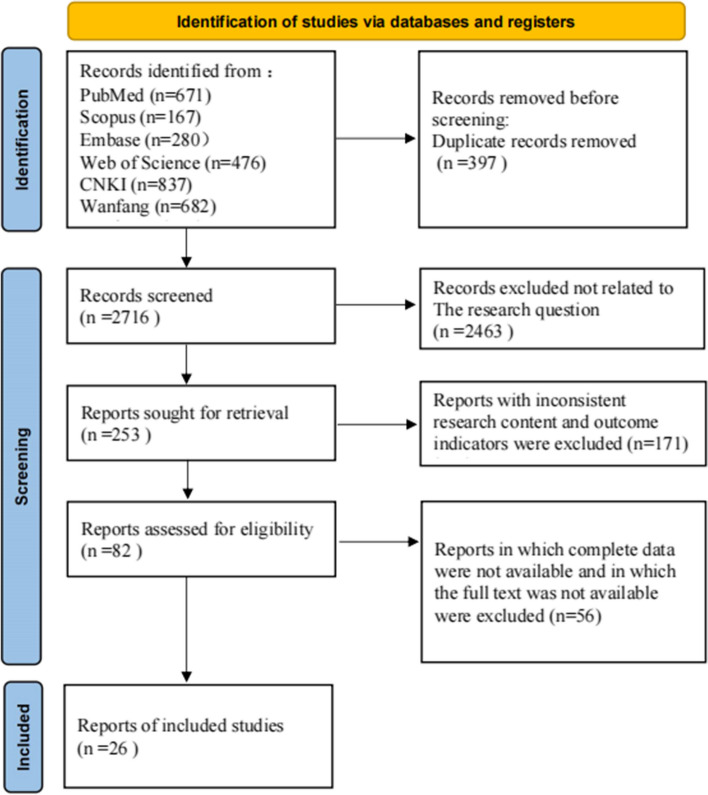
Methods: We searched Chinese and English databases, including China National Knowledge Infrastructure (CNKI), Wanfang database, PubMed, Embase, Scopus, and Web of Science, for relevant literatures on PTCD and ENBD for advanced HCCA clinical trials. Two investigators independently screened the literatures, and the quality of the included studies was evaluated using the Newcastle-Ottawa Scale (NOS). The primary endpoint was the success rate of biliary drainage operation, while secondary endpoints included Total Bilirubin (TBIL) change, acute pancreatitis, biliary tract infection, hemobilia, and other complications. R software was used for data analysis.
Results: A comprehensive database search, based on predefined inclusion and exclusion criteria, yielded 26 articles for this study. Analysis revealed that PTCD had a significantly higher success rate than ENBD [OR (95% CI) = 2.63 (1.98, 3.49), Z=6.70, P<0.05]. PTCD was also more effective in reducing TBIL levels post-drainage [SMD (95%CI) =-0.13 (-0.23, -0.03), Z=-2.61, P<0.05]. While ENBD demonstrated a lower overall complication rate [OR (95%CI) = 0.60 (0.43, 0.84), Z=-2.99, P<0.05], it was associated with a significantly lower incidence of post-drainage biliary hemorrhage compared to PTCD [OR=3.02, 95%CI: (1.94-4.71), Z= 4.89, P<0.01].
Conclusions: This meta-analysis compares the efficacy and safety of ENBD and PTCD for palliative treatment of advanced HCCA. While both are effective, PTCD showed superiority in achieving successful drainage, reducing TBIL, and lowering the incidence of acute pancreatitis and biliary infections. However, ENBD had a lower risk of post-drainage bleeding. Clinicians should weigh these risks and benefits when choosing between ENBD and PTCD for individual patients. Further research is needed to confirm these findings and explore long-term outcomes.
期刊介绍:
BMC Gastroenterology is an open access, peer-reviewed journal that considers articles on all aspects of the prevention, diagnosis and management of gastrointestinal and hepatobiliary disorders, as well as related molecular genetics, pathophysiology, and epidemiology.





 京公网安备 11010802042870号
京ICP备2023020795号-1
京公网安备 11010802042870号
京ICP备2023020795号-1

 分享
分享
 求助内容:
求助内容: 应助结果提醒方式:
 扫码关注我们
