Camilla Rigotti, Emanuela Zannin, Sofia Chiaraluce, Maria Luisa Ventura
{"title":"Lung function response to postnatal corticosteroids for the prevention and treatment of bronchopulmonary dysplasia","authors":"Camilla Rigotti, Emanuela Zannin, Sofia Chiaraluce, Maria Luisa Ventura","doi":"10.1038/s41390-024-03535-3","DOIUrl":null,"url":null,"abstract":"Steroid treatment is well-known for producing clinically significant improvements in respiratory support requirements. In this study, we utilized lung ultrasound and respiratory oscillometry to objectively assess this response and determine if the combination of these methods can serve as a valuable tool for comparing different treatment strategies. We conducted a retrospective observational study including preterm infants with a gestational age below 32 weeks and/or a birth weight below 1500 g. We measured lung ultrasound score (LUS) and respiratory system reactance (Xrs) by respiratory oscillometry before and after treatment with either systemic dexamethasone or inhaled budesonide. We analyzed 46 treatments (9 dexamethasone, 37 budesonide) administered to 40 infants (median (Q1, Q3) postnatal age = 30 (18, 49) days, postmenstrual age = 33.29 (30.14, 35.00) weeks). All treatments were associated with a notable reduction in respiratory support and a concurrent improvement in either Xrs, LUS, or both. On average, Xrs improved from 3.13 (1.09, 5.41) to 0.44 (–0.90, 1.59) z-score (p < 0.001) and LUS from 10 (7, 12) to 5 (3, 8) (p < 0.001). Xrs and LUS proved sensitive to lung function changes associated with corticosteroids; combining the two better described the response and its variability.","PeriodicalId":19829,"journal":{"name":"Pediatric Research","volume":"97 5","pages":"1605-1611"},"PeriodicalIF":3.1000,"publicationDate":"2024-09-06","publicationTypes":"Journal Article","fieldsOfStudy":null,"isOpenAccess":false,"openAccessPdf":"https://www.nature.com/articles/s41390-024-03535-3.pdf","citationCount":"0","resultStr":null,"platform":"Semanticscholar","paperid":null,"PeriodicalName":"Pediatric Research","FirstCategoryId":"3","ListUrlMain":"https://www.nature.com/articles/s41390-024-03535-3","RegionNum":3,"RegionCategory":"医学","ArticlePicture":[],"TitleCN":null,"AbstractTextCN":null,"PMCID":null,"EPubDate":"","PubModel":"","JCR":"Q1","JCRName":"PEDIATRICS","Score":null,"Total":0}
引用次数: 0
Abstract
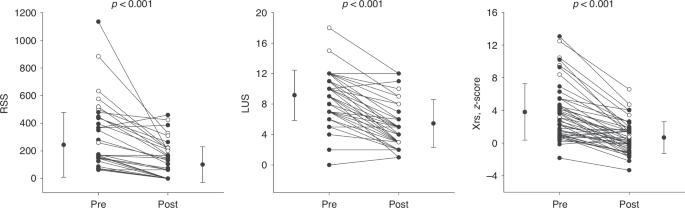
Steroid treatment is well-known for producing clinically significant improvements in respiratory support requirements. In this study, we utilized lung ultrasound and respiratory oscillometry to objectively assess this response and determine if the combination of these methods can serve as a valuable tool for comparing different treatment strategies. We conducted a retrospective observational study including preterm infants with a gestational age below 32 weeks and/or a birth weight below 1500 g. We measured lung ultrasound score (LUS) and respiratory system reactance (Xrs) by respiratory oscillometry before and after treatment with either systemic dexamethasone or inhaled budesonide. We analyzed 46 treatments (9 dexamethasone, 37 budesonide) administered to 40 infants (median (Q1, Q3) postnatal age = 30 (18, 49) days, postmenstrual age = 33.29 (30.14, 35.00) weeks). All treatments were associated with a notable reduction in respiratory support and a concurrent improvement in either Xrs, LUS, or both. On average, Xrs improved from 3.13 (1.09, 5.41) to 0.44 (–0.90, 1.59) z-score (p < 0.001) and LUS from 10 (7, 12) to 5 (3, 8) (p < 0.001). Xrs and LUS proved sensitive to lung function changes associated with corticosteroids; combining the two better described the response and its variability.
期刊介绍:
Pediatric Research publishes original papers, invited reviews, and commentaries on the etiologies of children''s diseases and
disorders of development, extending from molecular biology to epidemiology. Use of model organisms and in vitro techniques
relevant to developmental biology and medicine are acceptable, as are translational human studies



 京公网安备 11010802042870号
京ICP备2023020795号-1
京公网安备 11010802042870号
京ICP备2023020795号-1

 分享
分享
 求助内容:
求助内容: 应助结果提醒方式:
 扫码关注我们
