Sun Jo Kim , Cheol Woon Jung , Nguyen Hoang Anh , Young Cheol Yoon , Nguyen Phuoc Long , Soon-Sun Hong , Eun Ju Cho , Sung Won Kwon
{"title":"Metabolic phenotyping combined with transcriptomics metadata fortifies the diagnosis of early-stage Hepatocellular carcinoma","authors":"Sun Jo Kim , Cheol Woon Jung , Nguyen Hoang Anh , Young Cheol Yoon , Nguyen Phuoc Long , Soon-Sun Hong , Eun Ju Cho , Sung Won Kwon","doi":"10.1016/j.jare.2024.09.007","DOIUrl":null,"url":null,"abstract":"<div><h3>Introduction</h3><div>The low sensitivity of alpha-fetoprotein (AFP) renders it unsuitable as a stand-alone marker for early hepatocellular carcinoma (eHCC) surveillance. Therefore, additional blood-based biomarkers with enhanced sensitivities are required.</div></div><div><h3>Objectives</h3><div>In light of the metabolic changes that are distinctive to eHCC development, the current study presents a panel of serum metabolites that may serve as noninvasive diagnostic indicators for patients with eHCC.</div></div><div><h3>Methods</h3><div>Serum samples obtained from normal control (NC), cirrhosis, and eHCC patients were analyzed by four different metabolomic platforms. A <em>meta</em>-analysis of very early-stage HCC transcriptomic datasets retrieved from public sources supports the integrated interpretation with metabolic changes.</div></div><div><h3>Results</h3><div>A total of 94 metabolites were significantly correlated with a progressive disease status. Integrated analysis of the significant metabolites and differentially expressed genes from <em>meta</em>-analysis emphasized metabolic pathways including bile acid biosynthesis, phenylalanine and tyrosine metabolism, and butanoate metabolism. The 11 metabolites associated with these pathways were compiled into a metabolite panel for use as diagnostic signatures. With an accuracy of 81.8%, compared with 45.4% for a model trained solely on AFP, the model enhanced its ability to differentiate between the three groups by incorporating a metabolite panel and AFP. Upon examining the trained models using receiver operating characteristic curves, the AFP and metabolite panel combined model exhibited greater area under the curve values in comparisons between NC and eHCC (1.000 versus 0.810) and cirrhosis and eHCC (0.926 versus 0.556). The result was consistent in an independent validation cohort.</div></div><div><h3>Conclusion</h3><div>This study emphasizes the role of circulating metabolite markers in the diagnosis of eHCC.</div></div>","PeriodicalId":14952,"journal":{"name":"Journal of Advanced Research","volume":"74 ","pages":"Pages 153-163"},"PeriodicalIF":13.0000,"publicationDate":"2024-09-06","publicationTypes":"Journal Article","fieldsOfStudy":null,"isOpenAccess":false,"openAccessPdf":"","citationCount":"0","resultStr":null,"platform":"Semanticscholar","paperid":null,"PeriodicalName":"Journal of Advanced Research","FirstCategoryId":"103","ListUrlMain":"https://www.sciencedirect.com/science/article/pii/S2090123224003916","RegionNum":1,"RegionCategory":"综合性期刊","ArticlePicture":[],"TitleCN":null,"AbstractTextCN":null,"PMCID":null,"EPubDate":"","PubModel":"","JCR":"Q1","JCRName":"MULTIDISCIPLINARY SCIENCES","Score":null,"Total":0}
引用次数: 0
Abstract
Introduction
The low sensitivity of alpha-fetoprotein (AFP) renders it unsuitable as a stand-alone marker for early hepatocellular carcinoma (eHCC) surveillance. Therefore, additional blood-based biomarkers with enhanced sensitivities are required.
Objectives
In light of the metabolic changes that are distinctive to eHCC development, the current study presents a panel of serum metabolites that may serve as noninvasive diagnostic indicators for patients with eHCC.
Methods
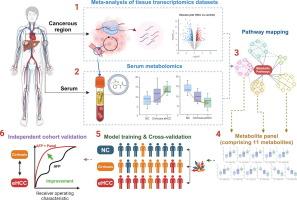
Serum samples obtained from normal control (NC), cirrhosis, and eHCC patients were analyzed by four different metabolomic platforms. A meta-analysis of very early-stage HCC transcriptomic datasets retrieved from public sources supports the integrated interpretation with metabolic changes.
Results
A total of 94 metabolites were significantly correlated with a progressive disease status. Integrated analysis of the significant metabolites and differentially expressed genes from meta-analysis emphasized metabolic pathways including bile acid biosynthesis, phenylalanine and tyrosine metabolism, and butanoate metabolism. The 11 metabolites associated with these pathways were compiled into a metabolite panel for use as diagnostic signatures. With an accuracy of 81.8%, compared with 45.4% for a model trained solely on AFP, the model enhanced its ability to differentiate between the three groups by incorporating a metabolite panel and AFP. Upon examining the trained models using receiver operating characteristic curves, the AFP and metabolite panel combined model exhibited greater area under the curve values in comparisons between NC and eHCC (1.000 versus 0.810) and cirrhosis and eHCC (0.926 versus 0.556). The result was consistent in an independent validation cohort.
Conclusion
This study emphasizes the role of circulating metabolite markers in the diagnosis of eHCC.
期刊介绍:
Journal of Advanced Research (J. Adv. Res.) is an applied/natural sciences, peer-reviewed journal that focuses on interdisciplinary research. The journal aims to contribute to applied research and knowledge worldwide through the publication of original and high-quality research articles in the fields of Medicine, Pharmaceutical Sciences, Dentistry, Physical Therapy, Veterinary Medicine, and Basic and Biological Sciences.
The following abstracting and indexing services cover the Journal of Advanced Research: PubMed/Medline, Essential Science Indicators, Web of Science, Scopus, PubMed Central, PubMed, Science Citation Index Expanded, Directory of Open Access Journals (DOAJ), and INSPEC.



 京公网安备 11010802042870号
京ICP备2023020795号-1
京公网安备 11010802042870号
京ICP备2023020795号-1

 分享
分享
 求助内容:
求助内容: 应助结果提醒方式:
 扫码关注我们
