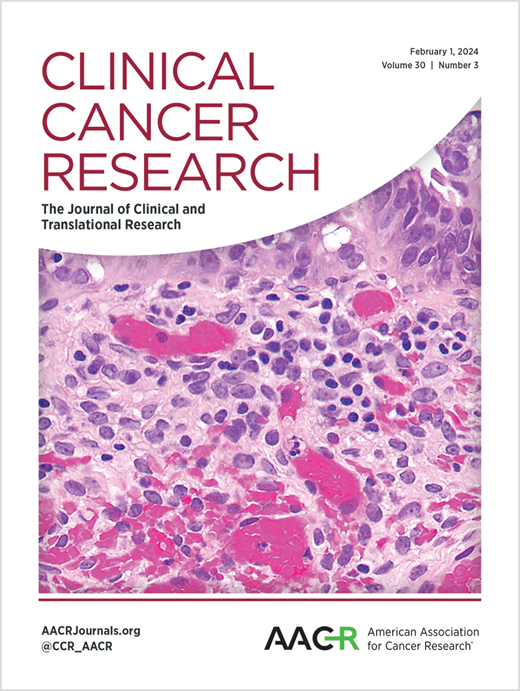
Tumor-Infiltrating Lymphocytes in Necrotic Tumors after Melanoma Neoadjuvant Anti-PD-1 Therapy Correlate with Pathologic Response and Recurrence-Free Survival.
Kevin L Ma, Tara C Mitchell, Meaghan Dougher, Cimarron E Sharon, Gabriella N Tortorello, David E Elder, Eric E Morgan, Phyllis A Gimotty, Alexander C Huang, Ravi K Amaravadi, Lynn M Schuchter, Ahron Flowers, John T Miura, Giorgos C Karakousis, Xiaowei Xu
{"title":"Tumor-Infiltrating Lymphocytes in Necrotic Tumors after Melanoma Neoadjuvant Anti-PD-1 Therapy Correlate with Pathologic Response and Recurrence-Free Survival.","authors":"Kevin L Ma, Tara C Mitchell, Meaghan Dougher, Cimarron E Sharon, Gabriella N Tortorello, David E Elder, Eric E Morgan, Phyllis A Gimotty, Alexander C Huang, Ravi K Amaravadi, Lynn M Schuchter, Ahron Flowers, John T Miura, Giorgos C Karakousis, Xiaowei Xu","doi":"10.1158/1078-0432.CCR-23-3775","DOIUrl":null,"url":null,"abstract":"<p><strong>Purpose: </strong>Neoadjuvant anti-PD-1 therapy in melanoma may increase tumor-infiltrating lymphocytes (TIL), and more TIL are associated with better treatment response. A major pathologic response (MPR) in melanoma after neoadjuvant anti-PD-1 therapy usually comprises tumor necrosis and fibrosis. The role of TIL in necrotic tumor necrosis (nTIL) has not been explored.</p><p><strong>Experimental design: </strong>We performed CD3 and CD8 IHC stains on 41 melanomas with geographic necrosis. Of the 41, 14 were immunotherapy-naïve, and 27 had been treated with one dose of neoadjuvant anti-PD-1 in two clinical trials. CD3+ and CD8+ nTIL were graded as absent/minimal or moderate/brisk. The percentage of necrotic areas in the tumor bed before and after treatment was quantified. The endpoints were MPR and 5-year recurrence-free survival (RFS).</p><p><strong>Results: </strong>In the immunotherapy-naïve cohort, 3/14 (21%) specimens had moderate/brisk CD3+, and 2/14 (14%) had moderate/brisk CD8+ nTIL. In the treated cohort, 16/27 (59%) specimens had moderate/brisk CD3+, and 15/27 (56%) had moderate/brisk CD8+ nTIL, higher than those of the naïve cohort (CD3, P = 0.046; CD8, P = 0.018). Tumor necrosis was significantly increased after anti-PD-1 therapy (P = 0.007). In the treated cohort, moderate/brisk CD3+ and CD8+ nTIL correlated with MPR (P = 0.042; P = 0.019, respectively). Treated patients with moderate/brisk CD3+ nTIL had higher 5-year RFS than those with absent/minimal nTIL (69% vs. 0%; P = 0.006). This persisted on multivariate analysis (HR, 0.16; 95% confidence interval, 0.03-0.84; P = 0.03), adjusted for pathologic response, which was borderline significant (HR, 0.26; 95% confidence interval, 0.07-1.01; P = 0.051).</p><p><strong>Conclusions: </strong>CD3+ and CD8+ nTIL are associated with pathologic response and 5-year RFS in patients with melanoma after neoadjuvant anti-PD-1 therapy.</p>","PeriodicalId":10279,"journal":{"name":"Clinical Cancer Research","volume":" ","pages":"4987-4994"},"PeriodicalIF":10.2000,"publicationDate":"2024-11-01","publicationTypes":"Journal Article","fieldsOfStudy":null,"isOpenAccess":false,"openAccessPdf":"https://www.ncbi.nlm.nih.gov/pmc/articles/PMC11539852/pdf/","citationCount":"0","resultStr":null,"platform":"Semanticscholar","paperid":null,"PeriodicalName":"Clinical Cancer Research","FirstCategoryId":"3","ListUrlMain":"https://doi.org/10.1158/1078-0432.CCR-23-3775","RegionNum":1,"RegionCategory":"医学","ArticlePicture":[],"TitleCN":null,"AbstractTextCN":null,"PMCID":null,"EPubDate":"","PubModel":"","JCR":"Q1","JCRName":"ONCOLOGY","Score":null,"Total":0}
引用次数: 0
Abstract
Purpose: Neoadjuvant anti-PD-1 therapy in melanoma may increase tumor-infiltrating lymphocytes (TIL), and more TIL are associated with better treatment response. A major pathologic response (MPR) in melanoma after neoadjuvant anti-PD-1 therapy usually comprises tumor necrosis and fibrosis. The role of TIL in necrotic tumor necrosis (nTIL) has not been explored.
Experimental design: We performed CD3 and CD8 IHC stains on 41 melanomas with geographic necrosis. Of the 41, 14 were immunotherapy-naïve, and 27 had been treated with one dose of neoadjuvant anti-PD-1 in two clinical trials. CD3+ and CD8+ nTIL were graded as absent/minimal or moderate/brisk. The percentage of necrotic areas in the tumor bed before and after treatment was quantified. The endpoints were MPR and 5-year recurrence-free survival (RFS).
Results: In the immunotherapy-naïve cohort, 3/14 (21%) specimens had moderate/brisk CD3+, and 2/14 (14%) had moderate/brisk CD8+ nTIL. In the treated cohort, 16/27 (59%) specimens had moderate/brisk CD3+, and 15/27 (56%) had moderate/brisk CD8+ nTIL, higher than those of the naïve cohort (CD3, P = 0.046; CD8, P = 0.018). Tumor necrosis was significantly increased after anti-PD-1 therapy (P = 0.007). In the treated cohort, moderate/brisk CD3+ and CD8+ nTIL correlated with MPR (P = 0.042; P = 0.019, respectively). Treated patients with moderate/brisk CD3+ nTIL had higher 5-year RFS than those with absent/minimal nTIL (69% vs. 0%; P = 0.006). This persisted on multivariate analysis (HR, 0.16; 95% confidence interval, 0.03-0.84; P = 0.03), adjusted for pathologic response, which was borderline significant (HR, 0.26; 95% confidence interval, 0.07-1.01; P = 0.051).
Conclusions: CD3+ and CD8+ nTIL are associated with pathologic response and 5-year RFS in patients with melanoma after neoadjuvant anti-PD-1 therapy.
期刊介绍:
Clinical Cancer Research is a journal focusing on groundbreaking research in cancer, specifically in the areas where the laboratory and the clinic intersect. Our primary interest lies in clinical trials that investigate novel treatments, accompanied by research on pharmacology, molecular alterations, and biomarkers that can predict response or resistance to these treatments. Furthermore, we prioritize laboratory and animal studies that explore new drugs and targeted agents with the potential to advance to clinical trials. We also encourage research on targetable mechanisms of cancer development, progression, and metastasis.



 京公网安备 11010802042870号
京ICP备2023020795号-1
京公网安备 11010802042870号
京ICP备2023020795号-1

 分享
分享
 求助内容:
求助内容: 应助结果提醒方式:
 扫码关注我们
