Novel insights into the association between genetically proxied inhibition of proprotein convertase subtilisin/kexin type 9 and risk of sarcopenia

IF 9.1 1区 医学 Q1 GERIATRICS & GERONTOLOGY Journal of Cachexia Sarcopenia and Muscle Pub Date : 2024-09-10 DOI:10.1002/jcsm.13575
Hongyan Jiang, Lulu Li, Xue Zhang, Jia He, Chuanhuai Chen, Ruimin Sun, Ying Chen, Lijuan Xia, Lei Wen, Yunxiang Chen, Junxiu Liu, Lijiang Zhang, Wanqiang Lv
{"title":"Novel insights into the association between genetically proxied inhibition of proprotein convertase subtilisin/kexin type 9 and risk of sarcopenia","authors":"Hongyan Jiang,&nbsp;Lulu Li,&nbsp;Xue Zhang,&nbsp;Jia He,&nbsp;Chuanhuai Chen,&nbsp;Ruimin Sun,&nbsp;Ying Chen,&nbsp;Lijuan Xia,&nbsp;Lei Wen,&nbsp;Yunxiang Chen,&nbsp;Junxiu Liu,&nbsp;Lijiang Zhang,&nbsp;Wanqiang Lv","doi":"10.1002/jcsm.13575","DOIUrl":null,"url":null,"abstract":"<div>\n \n \n <section>\n \n <h3> Background</h3>\n \n <p>The effects of lipid-lowering drugs [including statins, ezetimibe, and proprotein convertase subtilisin/kexin type 9 (PCSK9) inhibitors] on hyperlipidaemia have been established. Some may have treatment effects beyond their reported properties, offering potential opportunities for drug repurposing. Epidemiological studies have reported conflicting findings on the relationship between lipid-lowering medication use and sarcopenia risk.</p>\n </section>\n \n <section>\n \n <h3> Methods</h3>\n \n <p>We performed a two-sample Mendelian randomization (MR) study to investigate the causal association between the use of genetically proxied lipid-lowering drugs (including statins, ezetimibe, and PCSK9 inhibitors, which use low-density lipoprotein as a biomarker), and sarcopenia risk. The inverse-variance weighting method was used with pleiotropy-robust methods (MR–Egger regression and weighted median) and colocalization as sensitivity analyses.</p>\n </section>\n \n <section>\n \n <h3> Results</h3>\n \n <p>According to the positive control analysis, genetically proxied inhibition in lipid-lowering drug targets was associated with a lower risk of coronary heart disease [PCSK9 (OR, 0.67; 95% CI, 0.61 to 0.72; <i>P =</i> 7.7E-21); 3-hydroxy-3-methylglutaryl coenzyme A reductase (HMGCR; OR, 0.68; 95% CI, 0.57 to 0.82; <i>P =</i> 4.6E-05), and Niemann–Pick C1-like 1 (NPC1L1; OR, 0.53; 95% CI, 0.40 to 0.69; <i>P =</i> 3.3E-06)], consistent with drug mechanistic actions and previous trial evidence. Genetically proxied inhibition of PCSK9 (beta, −0.040; 95% CI, −0.068 to −0.012; <i>P =</i> 0.005) and circulating PCSK9 levels (beta, −0.019; 95% CI, −0.033 to −0.005; <i>P =</i> 0.006) were associated with reduced appendicular lean mass (ALM) with concordant estimates in terms of direction and magnitude. Validation analyses using a second instrument for PCSK9 yielded consistent results in terms of direction and magnitude [(PCSK9 to ALM; beta, −0.052; 95% CI, −0.074 to −0.032; <i>P =</i> 7.1E-7); (PCSK9 protein to ALM; beta, −0.060; 95% CI, −0.106 to −0.014; <i>P =</i> 0.010)]. Genetically proxied inhibition of PCSK9 gene expression in the liver may be associated with reduced ALM (beta, −0.013; 95% CI, −0.035 to 0.009; <i>P =</i> 0.25), consistent with the results of PCSK9 drug-target and PCSK9 protein MR analyses, but the magnitude was less precise. No robust association was found between HMGCR inhibition (beta, 0.048; 95% CI, −0.015 to 0.110; <i>P =</i> 0.14) or NPC1L1 (beta, 0.035; 95% CI, −0.074 to 0.144; <i>P =</i> 0.53) inhibition and ALM, and validation and sensitivity MR analyses showed consistent estimates.</p>\n </section>\n \n <section>\n \n <h3> Conclusions</h3>\n \n <p>This MR study suggested that PCSK9 is involved in sarcopenia pathogenesis and that its inhibition is associated with reduced ALM. These findings potentially pave the way for future studies that may allow personalized selection of lipid-lowering drugs for those at risk of sarcopenia.</p>\n </section>\n </div>","PeriodicalId":48911,"journal":{"name":"Journal of Cachexia Sarcopenia and Muscle","volume":"15 6","pages":"2417-2425"},"PeriodicalIF":9.1000,"publicationDate":"2024-09-10","publicationTypes":"Journal Article","fieldsOfStudy":null,"isOpenAccess":false,"openAccessPdf":"https://onlinelibrary.wiley.com/doi/epdf/10.1002/jcsm.13575","citationCount":"0","resultStr":null,"platform":"Semanticscholar","paperid":null,"PeriodicalName":"Journal of Cachexia Sarcopenia and Muscle","FirstCategoryId":"3","ListUrlMain":"https://onlinelibrary.wiley.com/doi/10.1002/jcsm.13575","RegionNum":1,"RegionCategory":"医学","ArticlePicture":[],"TitleCN":null,"AbstractTextCN":null,"PMCID":null,"EPubDate":"","PubModel":"","JCR":"Q1","JCRName":"GERIATRICS & GERONTOLOGY","Score":null,"Total":0}
引用次数: 0

Abstract

Background

The effects of lipid-lowering drugs [including statins, ezetimibe, and proprotein convertase subtilisin/kexin type 9 (PCSK9) inhibitors] on hyperlipidaemia have been established. Some may have treatment effects beyond their reported properties, offering potential opportunities for drug repurposing. Epidemiological studies have reported conflicting findings on the relationship between lipid-lowering medication use and sarcopenia risk.

Methods

We performed a two-sample Mendelian randomization (MR) study to investigate the causal association between the use of genetically proxied lipid-lowering drugs (including statins, ezetimibe, and PCSK9 inhibitors, which use low-density lipoprotein as a biomarker), and sarcopenia risk. The inverse-variance weighting method was used with pleiotropy-robust methods (MR–Egger regression and weighted median) and colocalization as sensitivity analyses.

Results

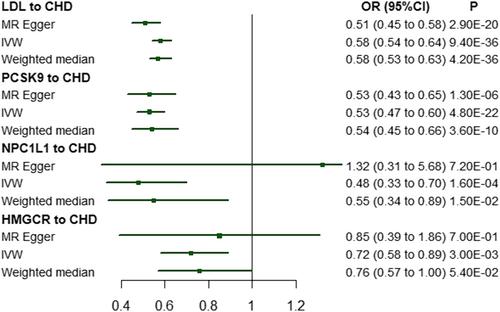
According to the positive control analysis, genetically proxied inhibition in lipid-lowering drug targets was associated with a lower risk of coronary heart disease [PCSK9 (OR, 0.67; 95% CI, 0.61 to 0.72; P = 7.7E-21); 3-hydroxy-3-methylglutaryl coenzyme A reductase (HMGCR; OR, 0.68; 95% CI, 0.57 to 0.82; P = 4.6E-05), and Niemann–Pick C1-like 1 (NPC1L1; OR, 0.53; 95% CI, 0.40 to 0.69; P = 3.3E-06)], consistent with drug mechanistic actions and previous trial evidence. Genetically proxied inhibition of PCSK9 (beta, −0.040; 95% CI, −0.068 to −0.012; P = 0.005) and circulating PCSK9 levels (beta, −0.019; 95% CI, −0.033 to −0.005; P = 0.006) were associated with reduced appendicular lean mass (ALM) with concordant estimates in terms of direction and magnitude. Validation analyses using a second instrument for PCSK9 yielded consistent results in terms of direction and magnitude [(PCSK9 to ALM; beta, −0.052; 95% CI, −0.074 to −0.032; P = 7.1E-7); (PCSK9 protein to ALM; beta, −0.060; 95% CI, −0.106 to −0.014; P = 0.010)]. Genetically proxied inhibition of PCSK9 gene expression in the liver may be associated with reduced ALM (beta, −0.013; 95% CI, −0.035 to 0.009; P = 0.25), consistent with the results of PCSK9 drug-target and PCSK9 protein MR analyses, but the magnitude was less precise. No robust association was found between HMGCR inhibition (beta, 0.048; 95% CI, −0.015 to 0.110; P = 0.14) or NPC1L1 (beta, 0.035; 95% CI, −0.074 to 0.144; P = 0.53) inhibition and ALM, and validation and sensitivity MR analyses showed consistent estimates.

Conclusions

This MR study suggested that PCSK9 is involved in sarcopenia pathogenesis and that its inhibition is associated with reduced ALM. These findings potentially pave the way for future studies that may allow personalized selection of lipid-lowering drugs for those at risk of sarcopenia.
Abstract Image

查看原文
分享 分享
微信好友 朋友圈 QQ好友 复制链接
本刊更多论文
从基因角度看9型枯草蛋白酶/kexin抑制与肌肉疏松症风险之间关系的新见解
降脂药物[包括他汀类药物、依折麦布和9型(PCSK9)酶抑制剂]对高脂血症的影响已经确立。其中一些药物的治疗效果可能超出了其报告的特性,这为药物的再利用提供了潜在的机会。关于降脂药物的使用与肌肉疏松症风险之间的关系,流行病学研究报告的结果相互矛盾。
本文章由计算机程序翻译,如有差异,请以英文原文为准。
求助全文
约1分钟内获得全文 去求助
来源期刊
Journal of Cachexia Sarcopenia and Muscle
Journal of Cachexia Sarcopenia and Muscle MEDICINE, GENERAL & INTERNAL-
CiteScore
13.30
自引率
12.40%
发文量
234
审稿时长
16 weeks
期刊介绍: The Journal of Cachexia, Sarcopenia and Muscle is a peer-reviewed international journal dedicated to publishing materials related to cachexia and sarcopenia, as well as body composition and its physiological and pathophysiological changes across the lifespan and in response to various illnesses from all fields of life sciences. The journal aims to provide a reliable resource for professionals interested in related research or involved in the clinical care of affected patients, such as those suffering from AIDS, cancer, chronic heart failure, chronic lung disease, liver cirrhosis, chronic kidney failure, rheumatoid arthritis, or sepsis.
期刊最新文献
Correction to ‘Determination of Ultrasound Reference Values for Diagnosing Low Muscle Mass in Older Chinese Adults’ Cancer Cachexia Prevalence Is Underestimated in Medical Records of Patients in a Regional Tertiary Hospital Comment on ‘Muscle-Specific Strength Better Predicts Physical Performance Decline Than Conventional Metrics: The I-Lan Longitudinal Aging Study’ by Chien et al.—The Authors Reply Physical Fitness and Physical Function in Patients With Fabry Disease: A Cross-Sectional Multicentre Study Menopause, Female Sex Hormones, Skeletal Muscle Mass and Muscle Protein Turnover in Humans
×
引用
GB/T 7714-2015
复制
MLA
复制
APA
复制
导出至
BibTeX EndNote RefMan NoteFirst NoteExpress
×
×
提示
您的信息不完整,为了账户安全,请先补充。
现在去补充
×
提示
您因"违规操作"
具体请查看互助需知
我知道了
×
提示
现在去查看 取消
×
提示
确定
0
微信
客服QQ
Book学术公众号 扫码关注我们
反馈
×
意见反馈
请填写您的意见或建议
请填写您的手机或邮箱
已复制链接
已复制链接
快去分享给好友吧!
我知道了
×
扫码分享
扫码分享
Book学术官方微信
Book学术文献互助
Book学术文献互助群
群 号:604180095
Book学术
文献互助 智能选刊 最新文献 互助须知 联系我们:info@booksci.cn
Book学术提供免费学术资源搜索服务,方便国内外学者检索中英文文献。致力于提供最便捷和优质的服务体验。
Copyright © 2023 Book学术 All rights reserved.
ghs 京公网安备 11010802042870号 京ICP备2023020795号-1





