Saiqi Yang, Wei Liu, Yining Zhang, Xiaohui Jia, Jingyan Sun, Chenxi Zhang and Mingguang Liu
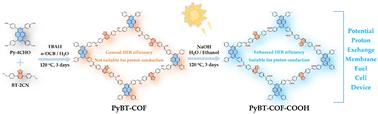
{"title":"A post-modified donor–acceptor covalent organic framework for enhanced photocatalytic H2 production and high proton transport†","authors":"Saiqi Yang, Wei Liu, Yining Zhang, Xiaohui Jia, Jingyan Sun, Chenxi Zhang and Mingguang Liu","doi":"10.1039/D4TA04952G","DOIUrl":null,"url":null,"abstract":"<p >The production of fuel and membranes for proton exchange membrane fuel cells (PEMFCs) typically involves disparate materials, highlighting the need for a bifunctional material capable of integrating hydrogen supply and proton conduction. Herein, we modified a donor–acceptor covalent organic framework (PyBT-COF) by converting its cyano groups into carboxyl groups, resulting in PyBT-COF-COOH. The modification significantly enhances the photocatalytic hydrogen production activity, achieving a rate of 8.15 mmol g<small><sup>−1</sup></small> h<small><sup>−1</sup></small> with Pt as the cocatalyst, over 2.8 times higher than that of the original PyBT-COF. It also demonstrates an impressive quantum efficiency of 5.10% at 420 nm due to the improved hydrophilicity and carrier separation. Additionally, the rich proton carriers and exchange binding sites within PyBT-COF-COOH also give it a notable proton conductivity of 4.91 × 10<small><sup>−3</sup></small> S cm<small><sup>−1</sup></small> at 353 K and 98% RH. Upon visible light irradiation, the proton conductivity of PyBT-COF-COOH can be further increased to three times compared to that under normal conditions (1.5 × 10<small><sup>−2</sup></small> S cm<small><sup>−1</sup></small> at 353 K and 98% RH). This study suggests an inspiration for developing and utilizing such bifunctional COF materials in terms of solar energy conversion.</p>","PeriodicalId":82,"journal":{"name":"Journal of Materials Chemistry A","volume":" 41","pages":" 28161-28169"},"PeriodicalIF":9.5000,"publicationDate":"2024-09-12","publicationTypes":"Journal Article","fieldsOfStudy":null,"isOpenAccess":false,"openAccessPdf":"","citationCount":"0","resultStr":null,"platform":"Semanticscholar","paperid":null,"PeriodicalName":"Journal of Materials Chemistry A","FirstCategoryId":"88","ListUrlMain":"https://pubs.rsc.org/en/content/articlelanding/2024/ta/d4ta04952g","RegionNum":2,"RegionCategory":"材料科学","ArticlePicture":[],"TitleCN":null,"AbstractTextCN":null,"PMCID":null,"EPubDate":"","PubModel":"","JCR":"Q1","JCRName":"CHEMISTRY, PHYSICAL","Score":null,"Total":0}
引用次数: 0
Abstract
The production of fuel and membranes for proton exchange membrane fuel cells (PEMFCs) typically involves disparate materials, highlighting the need for a bifunctional material capable of integrating hydrogen supply and proton conduction. Herein, we modified a donor–acceptor covalent organic framework (PyBT-COF) by converting its cyano groups into carboxyl groups, resulting in PyBT-COF-COOH. The modification significantly enhances the photocatalytic hydrogen production activity, achieving a rate of 8.15 mmol g−1 h−1 with Pt as the cocatalyst, over 2.8 times higher than that of the original PyBT-COF. It also demonstrates an impressive quantum efficiency of 5.10% at 420 nm due to the improved hydrophilicity and carrier separation. Additionally, the rich proton carriers and exchange binding sites within PyBT-COF-COOH also give it a notable proton conductivity of 4.91 × 10⁻³ S cm−1 at 353 K and 98% RH. Upon visible light irradiation, the proton conductivity of PyBT-COF-COOH can be further increased to three times compared to that under normal conditions (1.5 × 10⁻² S cm−1 at 353 K and 98% RH). This study suggests an inspiration for developing and utilizing such bifunctional COF materials in terms of solar energy conversion.
期刊介绍:
The Journal of Materials Chemistry A, B & C covers a wide range of high-quality studies in the field of materials chemistry, with each section focusing on specific applications of the materials studied. Journal of Materials Chemistry A emphasizes applications in energy and sustainability, including topics such as artificial photosynthesis, batteries, and fuel cells. Journal of Materials Chemistry B focuses on applications in biology and medicine, while Journal of Materials Chemistry C covers applications in optical, magnetic, and electronic devices. Example topic areas within the scope of Journal of Materials Chemistry A include catalysis, green/sustainable materials, sensors, and water treatment, among others.



 京公网安备 11010802042870号
京ICP备2023020795号-1
京公网安备 11010802042870号
京ICP备2023020795号-1

 分享
分享
 求助内容:
求助内容: 应助结果提醒方式:
 扫码关注我们
