Acrylic acid modified indapamide-based polymer as an effective inhibitor against carbon steel corrosion in CO2-saturated NaCl with variable H2S levels: An electrochemical, weight loss and machine learning study
Kabiru Haruna , Tawfik A. Saleh , Abdulmajid Lawal
{"title":"Acrylic acid modified indapamide-based polymer as an effective inhibitor against carbon steel corrosion in CO2-saturated NaCl with variable H2S levels: An electrochemical, weight loss and machine learning study","authors":"Kabiru Haruna , Tawfik A. Saleh , Abdulmajid Lawal","doi":"10.1016/j.surfin.2024.105065","DOIUrl":null,"url":null,"abstract":"<div><p>In this work, the performance of an acrylic acid-indapamide based polymer, poly(AAI), was investigated as a corrosion inhibitor in mitigating C1018 carbon steel in a 3.5 % NaCl solution saturated with CO<sub>2</sub> in the presence of different H<sub>2</sub>S concentrations simulating an oilfield sweet and sour corrosive environment. The effectiveness of the inhibitor was evaluated using weight loss and electrochemical techniques supported by SEM, EDS, and AFM surface techniques. At a concentration of 80 ppm, the polymer showed an inhibition effect of over 94 %. The effect of H<sub>2</sub>S concentration on the inhibitor's effectiveness was also investigated. The inhibitor was effective under all conditions tested. The adsorption of poly(AAI) was consistent with the Langmuir adsorption model and poly(AAI) acted mainly as a cathodic-type inhibitor. EIS, SEM/EDS, and AFM studies of the steel surface morphology showed that poly(AAI) forms a protective layer on the steel surface. The corrosive elements were successfully prevented from accessing the steel surface by the protective layer. Machine learning was also performed to predict the %IE of poly(AAI) using four distinct machine learning models: decision tree regression (DTR), artificial neural networks (ANN), linear regression (LR), and Gaussian process regressor (GPR). A 10 k-fold cross-validation in addition to the mean absolute error, mean squared error, root mean square error, mean absolute percentage error, and determination coefficient procedure was used to assess the models' performance accuracy. Overall, the LR performs the best in terms of performance hierarchy robustness, followed by GPR, ANN, and =DTR. Consequently, the LR model was found to be a more reliable choice for estimating the %IE of poly(AAI), providing potentially more accurate information about material performance in practical applications.</p></div>","PeriodicalId":22081,"journal":{"name":"Surfaces and Interfaces","volume":"53 ","pages":"Article 105065"},"PeriodicalIF":6.3000,"publicationDate":"2024-10-01","publicationTypes":"Journal Article","fieldsOfStudy":null,"isOpenAccess":false,"openAccessPdf":"","citationCount":"0","resultStr":null,"platform":"Semanticscholar","paperid":null,"PeriodicalName":"Surfaces and Interfaces","FirstCategoryId":"88","ListUrlMain":"https://www.sciencedirect.com/science/article/pii/S2468023024012215","RegionNum":2,"RegionCategory":"材料科学","ArticlePicture":[],"TitleCN":null,"AbstractTextCN":null,"PMCID":null,"EPubDate":"2024/9/5 0:00:00","PubModel":"Epub","JCR":"Q2","JCRName":"CHEMISTRY, PHYSICAL","Score":null,"Total":0}
引用次数: 0
Abstract
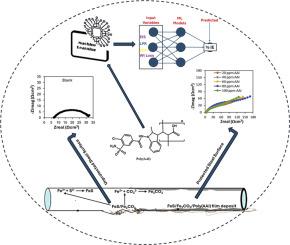
In this work, the performance of an acrylic acid-indapamide based polymer, poly(AAI), was investigated as a corrosion inhibitor in mitigating C1018 carbon steel in a 3.5 % NaCl solution saturated with CO2 in the presence of different H2S concentrations simulating an oilfield sweet and sour corrosive environment. The effectiveness of the inhibitor was evaluated using weight loss and electrochemical techniques supported by SEM, EDS, and AFM surface techniques. At a concentration of 80 ppm, the polymer showed an inhibition effect of over 94 %. The effect of H2S concentration on the inhibitor's effectiveness was also investigated. The inhibitor was effective under all conditions tested. The adsorption of poly(AAI) was consistent with the Langmuir adsorption model and poly(AAI) acted mainly as a cathodic-type inhibitor. EIS, SEM/EDS, and AFM studies of the steel surface morphology showed that poly(AAI) forms a protective layer on the steel surface. The corrosive elements were successfully prevented from accessing the steel surface by the protective layer. Machine learning was also performed to predict the %IE of poly(AAI) using four distinct machine learning models: decision tree regression (DTR), artificial neural networks (ANN), linear regression (LR), and Gaussian process regressor (GPR). A 10 k-fold cross-validation in addition to the mean absolute error, mean squared error, root mean square error, mean absolute percentage error, and determination coefficient procedure was used to assess the models' performance accuracy. Overall, the LR performs the best in terms of performance hierarchy robustness, followed by GPR, ANN, and =DTR. Consequently, the LR model was found to be a more reliable choice for estimating the %IE of poly(AAI), providing potentially more accurate information about material performance in practical applications.
期刊介绍:
The aim of the journal is to provide a respectful outlet for ''sound science'' papers in all research areas on surfaces and interfaces. We define sound science papers as papers that describe new and well-executed research, but that do not necessarily provide brand new insights or are merely a description of research results.
Surfaces and Interfaces publishes research papers in all fields of surface science which may not always find the right home on first submission to our Elsevier sister journals (Applied Surface, Surface and Coatings Technology, Thin Solid Films)



 京公网安备 11010802042870号
京ICP备2023020795号-1
京公网安备 11010802042870号
京ICP备2023020795号-1

 分享
分享
 求助内容:
求助内容: 应助结果提醒方式:
 扫码关注我们
