Miguel Justo-Tirado, Irene Pérez-Herráez, Jorge Escorihuela, Raúl Arenal, Elena Zaballos-García and Julia Pérez-Prieto
{"title":"Harnessing sustainable nanoclusters for sensitive optical detection of tetracyclines and the underlying mechanism†","authors":"Miguel Justo-Tirado, Irene Pérez-Herráez, Jorge Escorihuela, Raúl Arenal, Elena Zaballos-García and Julia Pérez-Prieto","doi":"10.1039/D4NA00637B","DOIUrl":null,"url":null,"abstract":"<p >Simple and rapid sensing methods for the detection of antibiotics in drinks and foods are highly desirable due to the presence of these drugs in food products, as a consequence of extensive abuse of antibiotics in livestock production. In this study, we report a facile synthesis strategy of gold nanoclusters (AuNCs) passivated with <em>N</em>-acetyl-<small>L</small>-cysteine (AuNC@NAC). This nanocluster exhibits a fluorescence emission peak at 700 nm, which gradually decreases at increasing concentrations of antibiotics, such as tetracyclines. The limit of detection (LOD) was determined to be 0.8 ppm with a linear range of 0.1–140 μM (0.04–62 ppm). This method showcased exceptional selectivity in the detection of tetracyclines compared to anions, metallic cations and amino acids. The underlying mechanism has been elucidated, and the fluorescence quenching was found to be a combination of dynamic and static quenching mechanisms, with photoinduced electron transfer (PET) identified as the primary process for dynamic quenching.</p>","PeriodicalId":18806,"journal":{"name":"Nanoscale Advances","volume":" 22","pages":" 5718-5726"},"PeriodicalIF":4.6000,"publicationDate":"2024-09-06","publicationTypes":"Journal Article","fieldsOfStudy":null,"isOpenAccess":false,"openAccessPdf":"https://pubs.rsc.org/en/content/articlepdf/2024/na/d4na00637b?page=search","citationCount":"0","resultStr":null,"platform":"Semanticscholar","paperid":null,"PeriodicalName":"Nanoscale Advances","FirstCategoryId":"88","ListUrlMain":"https://pubs.rsc.org/en/content/articlelanding/2024/na/d4na00637b","RegionNum":3,"RegionCategory":"材料科学","ArticlePicture":[],"TitleCN":null,"AbstractTextCN":null,"PMCID":null,"EPubDate":"","PubModel":"","JCR":"Q2","JCRName":"CHEMISTRY, MULTIDISCIPLINARY","Score":null,"Total":0}
引用次数: 0
Abstract
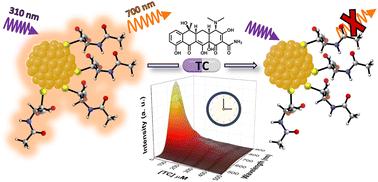
Simple and rapid sensing methods for the detection of antibiotics in drinks and foods are highly desirable due to the presence of these drugs in food products, as a consequence of extensive abuse of antibiotics in livestock production. In this study, we report a facile synthesis strategy of gold nanoclusters (AuNCs) passivated with N-acetyl-L-cysteine (AuNC@NAC). This nanocluster exhibits a fluorescence emission peak at 700 nm, which gradually decreases at increasing concentrations of antibiotics, such as tetracyclines. The limit of detection (LOD) was determined to be 0.8 ppm with a linear range of 0.1–140 μM (0.04–62 ppm). This method showcased exceptional selectivity in the detection of tetracyclines compared to anions, metallic cations and amino acids. The underlying mechanism has been elucidated, and the fluorescence quenching was found to be a combination of dynamic and static quenching mechanisms, with photoinduced electron transfer (PET) identified as the primary process for dynamic quenching.



 京公网安备 11010802042870号
京ICP备2023020795号-1
京公网安备 11010802042870号
京ICP备2023020795号-1

 分享
分享
 求助内容:
求助内容: 应助结果提醒方式:
 扫码关注我们
