David Evans, José Martín-Roca, Nathan J. Harmer, Chantal Valeriani and Mark A. Miller
{"title":"Re-entrant percolation in active Brownian hard disks†","authors":"David Evans, José Martín-Roca, Nathan J. Harmer, Chantal Valeriani and Mark A. Miller","doi":"10.1039/D4SM00975D","DOIUrl":null,"url":null,"abstract":"<p >Non-equilibrium clustering and percolation are investigated in an archetypal model of two-dimensional active matter using dynamic simulations of self-propelled Brownian repulsive particles. We concentrate on the single-phase region up to moderate levels of activity, before motility-induced phase separation (MIPS) sets in. Weak activity promotes cluster formation and lowers the percolation threshold. However, driving the system further out of equilibrium partly reverses this effect, resulting in a minimum in the critical density for the formation of system-spanning clusters and introducing re-entrant percolation as a function of activity in the pre-MIPS regime. This non-monotonic behaviour arises from competition between activity-induced effective attraction (which eventually leads to MIPS) and activity-driven cluster breakup. Using an adapted iterative Boltzmann inversion method, we derive effective potentials to map weakly active cases onto a passive (equilibrium) model with conservative attraction, which can be characterised by Monte Carlo simulations. While the active and passive systems have practically identical radial distribution functions, we find decisive differences in higher-order structural correlations, to which the percolation threshold is highly sensitive. For sufficiently strong activity, no passive pairwise potential can reproduce the radial distribution function of the active system.</p>","PeriodicalId":103,"journal":{"name":"Soft Matter","volume":" 37","pages":" 7484-7492"},"PeriodicalIF":2.8000,"publicationDate":"2024-09-05","publicationTypes":"Journal Article","fieldsOfStudy":null,"isOpenAccess":false,"openAccessPdf":"https://pubs.rsc.org/en/content/articlepdf/2024/sm/d4sm00975d?page=search","citationCount":"0","resultStr":null,"platform":"Semanticscholar","paperid":null,"PeriodicalName":"Soft Matter","FirstCategoryId":"92","ListUrlMain":"https://pubs.rsc.org/en/content/articlelanding/2024/sm/d4sm00975d","RegionNum":3,"RegionCategory":"化学","ArticlePicture":[],"TitleCN":null,"AbstractTextCN":null,"PMCID":null,"EPubDate":"","PubModel":"","JCR":"Q3","JCRName":"CHEMISTRY, PHYSICAL","Score":null,"Total":0}
引用次数: 0
Abstract
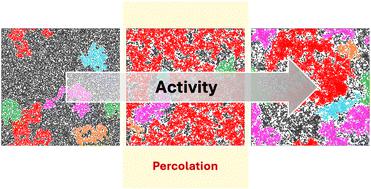
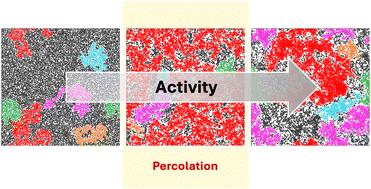
Non-equilibrium clustering and percolation are investigated in an archetypal model of two-dimensional active matter using dynamic simulations of self-propelled Brownian repulsive particles. We concentrate on the single-phase region up to moderate levels of activity, before motility-induced phase separation (MIPS) sets in. Weak activity promotes cluster formation and lowers the percolation threshold. However, driving the system further out of equilibrium partly reverses this effect, resulting in a minimum in the critical density for the formation of system-spanning clusters and introducing re-entrant percolation as a function of activity in the pre-MIPS regime. This non-monotonic behaviour arises from competition between activity-induced effective attraction (which eventually leads to MIPS) and activity-driven cluster breakup. Using an adapted iterative Boltzmann inversion method, we derive effective potentials to map weakly active cases onto a passive (equilibrium) model with conservative attraction, which can be characterised by Monte Carlo simulations. While the active and passive systems have practically identical radial distribution functions, we find decisive differences in higher-order structural correlations, to which the percolation threshold is highly sensitive. For sufficiently strong activity, no passive pairwise potential can reproduce the radial distribution function of the active system.
期刊介绍:
Soft Matter is an international journal published by the Royal Society of Chemistry using Engineering-Materials Science: A Synthesis as its research focus. It publishes original research articles, review articles, and synthesis articles related to this field, reporting the latest discoveries in the relevant theoretical, practical, and applied disciplines in a timely manner, and aims to promote the rapid exchange of scientific information in this subject area. The journal is an open access journal. The journal is an open access journal and has not been placed on the alert list in the last three years.



 京公网安备 11010802042870号
京ICP备2023020795号-1
京公网安备 11010802042870号
京ICP备2023020795号-1

 分享
分享
 求助内容:
求助内容: 应助结果提醒方式:
 扫码关注我们
