Yue Pan, Chunhua Zhao, Ruirui Wang, Mingjie Zhu, Wenchang Zhuang and Qintang Li
{"title":"Self-assembly of the imidazolium surfactant in aprotic ionic liquids. The anion effect of aprotic ionic liquids†","authors":"Yue Pan, Chunhua Zhao, Ruirui Wang, Mingjie Zhu, Wenchang Zhuang and Qintang Li","doi":"10.1039/D4SM00699B","DOIUrl":null,"url":null,"abstract":"<p >The structure of ionic liquids (ILs) has an influence on their physiochemical properties, determining their performance as self-assembly media. In this study, we focus on the anion effect of aprotic ionic liquids (AILs). The aggregation behaviours of the cationic surfactant 1-hexadecyl-3-methylimidazolium bromide (C<small><sub>16</sub></small>mimBr) have been investigated in the imidazolium AILs with the 1-ethyl-3-methyl imidazolium cation and different anions, including nitrate, ethylsulfate, bis(trifluoromethylsulfonyl) imide and tetrafluoroborate. Surface adsorption parameters of C<small><sub>16</sub></small>mimBr were determined using surface tension measurements, and the critical micellization concentration values in AILs vary for their different cohesive energy. The micellar and lamellar lyotropic liquid crystal phases emerge with the increase of C<small><sub>16</sub></small>mimBr concentrations. The structure and properties of aggregates were determined using small angle X-ray scattering, polarized optical microscopy, rheology and differential scanning calorimetry. The anion effects of AILs on the phase behaviours and structure and properties of aggregates were analysed and discussed. The lamellar lyotropic liquid crystals have shown good conductivity, as confirmed by electrochemical impedance spectroscopy characterization. Our results enhance the understanding of the structure effect of ILs as self-assembly media and contribute to the design of tailorable solvents.</p>","PeriodicalId":103,"journal":{"name":"Soft Matter","volume":" 37","pages":" 7420-7428"},"PeriodicalIF":2.8000,"publicationDate":"2024-09-03","publicationTypes":"Journal Article","fieldsOfStudy":null,"isOpenAccess":false,"openAccessPdf":"","citationCount":"0","resultStr":null,"platform":"Semanticscholar","paperid":null,"PeriodicalName":"Soft Matter","FirstCategoryId":"92","ListUrlMain":"https://pubs.rsc.org/en/content/articlelanding/2024/sm/d4sm00699b","RegionNum":3,"RegionCategory":"化学","ArticlePicture":[],"TitleCN":null,"AbstractTextCN":null,"PMCID":null,"EPubDate":"","PubModel":"","JCR":"Q3","JCRName":"CHEMISTRY, PHYSICAL","Score":null,"Total":0}
引用次数: 0
Abstract
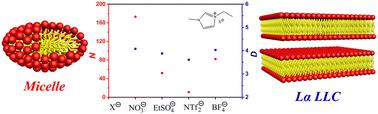
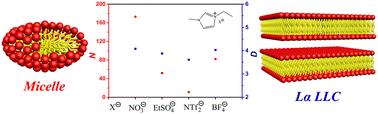
The structure of ionic liquids (ILs) has an influence on their physiochemical properties, determining their performance as self-assembly media. In this study, we focus on the anion effect of aprotic ionic liquids (AILs). The aggregation behaviours of the cationic surfactant 1-hexadecyl-3-methylimidazolium bromide (C16mimBr) have been investigated in the imidazolium AILs with the 1-ethyl-3-methyl imidazolium cation and different anions, including nitrate, ethylsulfate, bis(trifluoromethylsulfonyl) imide and tetrafluoroborate. Surface adsorption parameters of C16mimBr were determined using surface tension measurements, and the critical micellization concentration values in AILs vary for their different cohesive energy. The micellar and lamellar lyotropic liquid crystal phases emerge with the increase of C16mimBr concentrations. The structure and properties of aggregates were determined using small angle X-ray scattering, polarized optical microscopy, rheology and differential scanning calorimetry. The anion effects of AILs on the phase behaviours and structure and properties of aggregates were analysed and discussed. The lamellar lyotropic liquid crystals have shown good conductivity, as confirmed by electrochemical impedance spectroscopy characterization. Our results enhance the understanding of the structure effect of ILs as self-assembly media and contribute to the design of tailorable solvents.
期刊介绍:
Soft Matter is an international journal published by the Royal Society of Chemistry using Engineering-Materials Science: A Synthesis as its research focus. It publishes original research articles, review articles, and synthesis articles related to this field, reporting the latest discoveries in the relevant theoretical, practical, and applied disciplines in a timely manner, and aims to promote the rapid exchange of scientific information in this subject area. The journal is an open access journal. The journal is an open access journal and has not been placed on the alert list in the last three years.



 京公网安备 11010802042870号
京ICP备2023020795号-1
京公网安备 11010802042870号
京ICP备2023020795号-1

 分享
分享
 求助内容:
求助内容: 应助结果提醒方式:
 扫码关注我们
