Xiangshen Meng, Xiaowei Li, Jian Li, Yueqiang Lin, Xiaodong Liu and Zhenghong He
{"title":"A macroscopic magneto-optical response resulting from local effects in ferronematic liquid crystals†","authors":"Xiangshen Meng, Xiaowei Li, Jian Li, Yueqiang Lin, Xiaodong Liu and Zhenghong He","doi":"10.1039/D4SM00577E","DOIUrl":null,"url":null,"abstract":"<p >This study investigates the magneto-optical response of liquid crystals (LCs) with planar anchoring in the presence of γ-Fe<small><sub>2</sub></small>O<small><sub>3</sub></small> magnetic nanoparticles (MNPs). This research demonstrates the formation of novel magnetic composite chains of LCs wrapped around γ-Fe<small><sub>2</sub></small>O<small><sub>3</sub></small> MNP chains within the LC matrix under an applied magnetic field. These composite chains exhibit a distinct magneto-optical response, characterized by changes in birefringence and dichroism as the magnetic field direction is altered. Based on experimental findings, a two-subsystem model and an effective volume fraction of composite chains are proposed to describe the magneto-optical behavior of the γ-Fe<small><sub>2</sub></small>O<small><sub>3</sub></small> MNP-doped LCs. The first subsystem comprises the LC matrix, which retains its inherent anisotropic optical properties and does not respond to the applied magnetic field. The second subsystem consists of the magnetic composite chains, which exhibit a distinct magneto-optical response due to their rotational alignment with the magnetic field. The difference in absorbance, 2<em>α</em><small><sub>d</sub></small><em>d</em>, which corresponds to dichroism, decreases with increasing magnetic field angle <em>Θ</em>, indicating a corresponding change in dichroism. This interplay between the two subsystems leads to the macroscopic magneto-optical response observed in the γ-Fe<small><sub>2</sub></small>O<small><sub>3</sub></small> MNP-doped LCs. Due to the stability of the composite chains, the magneto-optical response is stable and can be reversed.</p>","PeriodicalId":103,"journal":{"name":"Soft Matter","volume":" 42","pages":" 8363-8372"},"PeriodicalIF":2.8000,"publicationDate":"2024-08-30","publicationTypes":"Journal Article","fieldsOfStudy":null,"isOpenAccess":false,"openAccessPdf":"","citationCount":"0","resultStr":null,"platform":"Semanticscholar","paperid":null,"PeriodicalName":"Soft Matter","FirstCategoryId":"92","ListUrlMain":"https://pubs.rsc.org/en/content/articlelanding/2024/sm/d4sm00577e","RegionNum":3,"RegionCategory":"化学","ArticlePicture":[],"TitleCN":null,"AbstractTextCN":null,"PMCID":null,"EPubDate":"","PubModel":"","JCR":"Q3","JCRName":"CHEMISTRY, PHYSICAL","Score":null,"Total":0}
引用次数: 0
Abstract
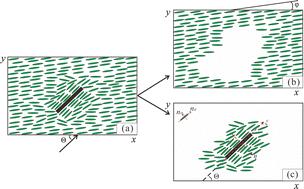
This study investigates the magneto-optical response of liquid crystals (LCs) with planar anchoring in the presence of γ-Fe2O3 magnetic nanoparticles (MNPs). This research demonstrates the formation of novel magnetic composite chains of LCs wrapped around γ-Fe2O3 MNP chains within the LC matrix under an applied magnetic field. These composite chains exhibit a distinct magneto-optical response, characterized by changes in birefringence and dichroism as the magnetic field direction is altered. Based on experimental findings, a two-subsystem model and an effective volume fraction of composite chains are proposed to describe the magneto-optical behavior of the γ-Fe2O3 MNP-doped LCs. The first subsystem comprises the LC matrix, which retains its inherent anisotropic optical properties and does not respond to the applied magnetic field. The second subsystem consists of the magnetic composite chains, which exhibit a distinct magneto-optical response due to their rotational alignment with the magnetic field. The difference in absorbance, 2αdd, which corresponds to dichroism, decreases with increasing magnetic field angle Θ, indicating a corresponding change in dichroism. This interplay between the two subsystems leads to the macroscopic magneto-optical response observed in the γ-Fe2O3 MNP-doped LCs. Due to the stability of the composite chains, the magneto-optical response is stable and can be reversed.
期刊介绍:
Soft Matter is an international journal published by the Royal Society of Chemistry using Engineering-Materials Science: A Synthesis as its research focus. It publishes original research articles, review articles, and synthesis articles related to this field, reporting the latest discoveries in the relevant theoretical, practical, and applied disciplines in a timely manner, and aims to promote the rapid exchange of scientific information in this subject area. The journal is an open access journal. The journal is an open access journal and has not been placed on the alert list in the last three years.



 京公网安备 11010802042870号
京ICP备2023020795号-1
京公网安备 11010802042870号
京ICP备2023020795号-1

 分享
分享
 求助内容:
求助内容: 应助结果提醒方式:
 扫码关注我们
