Esther Cendra-Duarte, Josefa Canals, Nerea Becerra-Tomás, Cristina Jardí, Francisco Martín-Luján, Victoria Arija
{"title":"Maternal dietary patterns and offspring behavioral problems","authors":"Esther Cendra-Duarte, Josefa Canals, Nerea Becerra-Tomás, Cristina Jardí, Francisco Martín-Luján, Victoria Arija","doi":"10.1038/s41390-024-03462-3","DOIUrl":null,"url":null,"abstract":"Mental health problems often begin in early childhood and could predict psychiatric and behavioral outcomes. Prenatal factors such as maternal nutrition have an impact on neurodevelopment. This study aims to investigate the association between maternal dietary patterns and emotional and behavioral problems in 4-year-old children. Within a cohort of 205 mother-child pairs, three maternal dietary patterns were identified: ‘Sweet and Superfluous’, ‘Fish and Vegetables’ and ‘Meat and Cereals’. Child behavior was evaluated by means of the Child Behavior Checklist 1.5-5 (CBCL 1.5-5), the Teacher’s Report Form 1.5-5 (TRF 1.5-5), and the Behavior Rating Inventory of Executive Function – Preschool Version (BRIEF-P). Multivariable analysis determined associations between maternal dietary patterns and their children’s behavior. Maternal adherence to the ‘Sweet and Superfluous’ pattern was positively associated with externalizing and depressive problems in children. The ‘Meat and Cereals’ pattern was linked to a higher risk for attention, hyperactivity and depressive problems as somatic complaints. Conversely, the ‘Fish and Vegetables’ pattern was associated with a reduced risk of hyperactivity problems. All these associations were more pronounced in girls than in boys. Maternal diet during pregnancy is associated with the emotional and behavioral development of children at 4 years of age.","PeriodicalId":19829,"journal":{"name":"Pediatric Research","volume":"97 6","pages":"1882-1891"},"PeriodicalIF":3.1000,"publicationDate":"2024-09-13","publicationTypes":"Journal Article","fieldsOfStudy":null,"isOpenAccess":false,"openAccessPdf":"","citationCount":"0","resultStr":null,"platform":"Semanticscholar","paperid":null,"PeriodicalName":"Pediatric Research","FirstCategoryId":"3","ListUrlMain":"https://www.nature.com/articles/s41390-024-03462-3","RegionNum":3,"RegionCategory":"医学","ArticlePicture":[],"TitleCN":null,"AbstractTextCN":null,"PMCID":null,"EPubDate":"","PubModel":"","JCR":"Q1","JCRName":"PEDIATRICS","Score":null,"Total":0}
引用次数: 0
Abstract
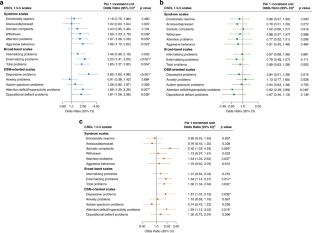
Mental health problems often begin in early childhood and could predict psychiatric and behavioral outcomes. Prenatal factors such as maternal nutrition have an impact on neurodevelopment. This study aims to investigate the association between maternal dietary patterns and emotional and behavioral problems in 4-year-old children. Within a cohort of 205 mother-child pairs, three maternal dietary patterns were identified: ‘Sweet and Superfluous’, ‘Fish and Vegetables’ and ‘Meat and Cereals’. Child behavior was evaluated by means of the Child Behavior Checklist 1.5-5 (CBCL 1.5-5), the Teacher’s Report Form 1.5-5 (TRF 1.5-5), and the Behavior Rating Inventory of Executive Function – Preschool Version (BRIEF-P). Multivariable analysis determined associations between maternal dietary patterns and their children’s behavior. Maternal adherence to the ‘Sweet and Superfluous’ pattern was positively associated with externalizing and depressive problems in children. The ‘Meat and Cereals’ pattern was linked to a higher risk for attention, hyperactivity and depressive problems as somatic complaints. Conversely, the ‘Fish and Vegetables’ pattern was associated with a reduced risk of hyperactivity problems. All these associations were more pronounced in girls than in boys. Maternal diet during pregnancy is associated with the emotional and behavioral development of children at 4 years of age.
期刊介绍:
Pediatric Research publishes original papers, invited reviews, and commentaries on the etiologies of children''s diseases and
disorders of development, extending from molecular biology to epidemiology. Use of model organisms and in vitro techniques
relevant to developmental biology and medicine are acceptable, as are translational human studies




 京公网安备 11010802042870号
京ICP备2023020795号-1
京公网安备 11010802042870号
京ICP备2023020795号-1

 分享
分享
 求助内容:
求助内容: 应助结果提醒方式:
 扫码关注我们
