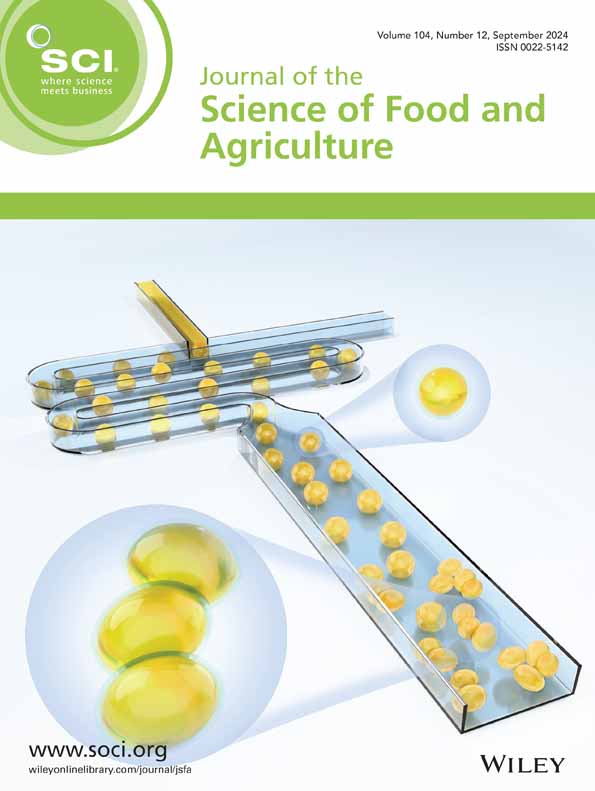
The Pickering emulsion delivery technique is widely acknowledged for its efficacy in serving as a carrier that can encapsulate functional components effectively. Previous studies have shown significant differences in the stability of Pickering emulsions composed of different oil phases and in the bioaccessibility of the encapsulated functional ingredients. This study therefore investigated the effects of different carrier oils in the betulin self-stabilized water-in-oil (W/O) Pickering emulsion on the stability of the emulsion and bioaccessibility of betulin.
Results
The results showed that the oil type was one of the main factors affecting the stability of the emulsion. Palm oil and coconut oil provided better storage stability and centrifugal stability due to the high saturated fatty acid content. The bioavailability of betulin correlated significantly with the composition and characteristics of fatty acids in carrier oils. Carrier oils rich in low-saturation long-chain fatty acids tended to release more free fatty acids (FFAs), thus forming larger and more mixed micelles with stronger swelling and dissolution ability, resulting in a relatively high bioaccessibility of betulin. In contrast, the bioaccessibility of betulin in the emulsion prepared by coconut oil (with high saturated fatty acid content) was relatively low (1.17%).
期刊介绍:
The Journal of the Science of Food and Agriculture publishes peer-reviewed original research, reviews, mini-reviews, perspectives and spotlights in these areas, with particular emphasis on interdisciplinary studies at the agriculture/ food interface.
Published for SCI by John Wiley & Sons Ltd.
SCI (Society of Chemical Industry) is a unique international forum where science meets business on independent, impartial ground. Anyone can join and current Members include consumers, business people, environmentalists, industrialists, farmers, and researchers. The Society offers a chance to share information between sectors as diverse as food and agriculture, pharmaceuticals, biotechnology, materials, chemicals, environmental science and safety. As well as organising educational events, SCI awards a number of prestigious honours and scholarships each year, publishes peer-reviewed journals, and provides Members with news from their sectors in the respected magazine, Chemistry & Industry .
Originally established in London in 1881 and in New York in 1894, SCI is a registered charity with Members in over 70 countries.



 京公网安备 11010802042870号
京ICP备2023020795号-1
京公网安备 11010802042870号
京ICP备2023020795号-1

 分享
分享
 求助内容:
求助内容: 应助结果提醒方式:
 扫码关注我们
