B. G. K. Steiger, N. T. Bui, B. M. Babalola and L. D. Wilson
{"title":"Sustainable agro-waste pellets as granular slow-release fertilizer carrier systems for ammonium sulfate†","authors":"B. G. K. Steiger, N. T. Bui, B. M. Babalola and L. D. Wilson","doi":"10.1039/D4SU00141A","DOIUrl":null,"url":null,"abstract":"<p >In this study, several granular biocomposite carrier systems were prepared that contain biomaterials (chitosan, torrefied wheat straw and avian eggshells) as additive components at variable composition. The biocomposites were loaded with ammonium sulfate (AS) by two methods: (1) <em>in situ</em> addition of AS during pellet preparation, and (2) an adsorption method of AS after pellet preparation. Characterisation was carried out <em>via</em> spectroscopy (XRD, FT-IR) and complementary methods (TGA, acid stability). The pellet system (C1) by method (1) contained <em>ca.</em> 22 mg per g NH<small><sub>4</sub></small><small><sup>+</sup></small>, whereas pellet systems by method (2) contained up to <em>ca.</em> 40 mg per g NH<small><sub>4</sub></small><small><sup>+</sup></small>. The mol-ratio of NH<small><sub>4</sub></small><small><sup>+</sup></small> : SO<small><sub>4</sub></small><small><sup>2−</sup></small> varied from 2.18 (C1) to 2.72 (CW72), 2.97 (CW20), 2.64 (CW21) and 3.20 (CW22). Release studies in water showed that C1 pellets released almost 100% NH<small><sub>4</sub></small><small><sup>+</sup></small> within 3 h, while release varied from <em>ca.</em> 60% (CW72), <em>ca.</em> 40% (C20), 20% (C21) to 10% (CW22). By comparison, the systems prepared through method (2) showed a marginal increase of the release profiles up to 96 h. Granular AS carrier systems prepared by method (2) displayed greater mechanical stability and AS content <em>versus</em> the systems prepared by method (1). We demonstrated the ability to tailor the physico-chemical properties of such biocomposite carriers and highlight their promising potential as slow-release fertilizer systems.</p>","PeriodicalId":74745,"journal":{"name":"RSC sustainability","volume":" 10","pages":" 2979-2988"},"PeriodicalIF":4.9000,"publicationDate":"2024-08-27","publicationTypes":"Journal Article","fieldsOfStudy":null,"isOpenAccess":false,"openAccessPdf":"https://pubs.rsc.org/en/content/articlepdf/2024/su/d4su00141a?page=search","citationCount":"0","resultStr":null,"platform":"Semanticscholar","paperid":null,"PeriodicalName":"RSC sustainability","FirstCategoryId":"1085","ListUrlMain":"https://pubs.rsc.org/en/content/articlelanding/2024/su/d4su00141a","RegionNum":0,"RegionCategory":null,"ArticlePicture":[],"TitleCN":null,"AbstractTextCN":null,"PMCID":null,"EPubDate":"","PubModel":"","JCR":"","JCRName":"","Score":null,"Total":0}
引用次数: 0
Abstract
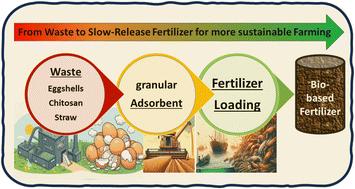
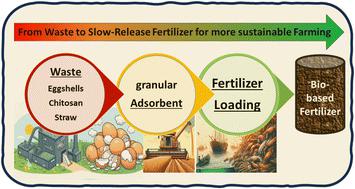
In this study, several granular biocomposite carrier systems were prepared that contain biomaterials (chitosan, torrefied wheat straw and avian eggshells) as additive components at variable composition. The biocomposites were loaded with ammonium sulfate (AS) by two methods: (1) in situ addition of AS during pellet preparation, and (2) an adsorption method of AS after pellet preparation. Characterisation was carried out via spectroscopy (XRD, FT-IR) and complementary methods (TGA, acid stability). The pellet system (C1) by method (1) contained ca. 22 mg per g NH4+, whereas pellet systems by method (2) contained up to ca. 40 mg per g NH4+. The mol-ratio of NH4+ : SO42− varied from 2.18 (C1) to 2.72 (CW72), 2.97 (CW20), 2.64 (CW21) and 3.20 (CW22). Release studies in water showed that C1 pellets released almost 100% NH4+ within 3 h, while release varied from ca. 60% (CW72), ca. 40% (C20), 20% (C21) to 10% (CW22). By comparison, the systems prepared through method (2) showed a marginal increase of the release profiles up to 96 h. Granular AS carrier systems prepared by method (2) displayed greater mechanical stability and AS content versus the systems prepared by method (1). We demonstrated the ability to tailor the physico-chemical properties of such biocomposite carriers and highlight their promising potential as slow-release fertilizer systems.




 京公网安备 11010802042870号
京ICP备2023020795号-1
京公网安备 11010802042870号
京ICP备2023020795号-1

 分享
分享

 求助内容:
求助内容: 应助结果提醒方式:
 扫码关注我们
