Zhuzuan Chen , Shengzhi Li , Guangzhao Zhang , Yu Yang , Yong Qian
{"title":"Renewable lignocellulose based binders for advanced battery systems†","authors":"Zhuzuan Chen , Shengzhi Li , Guangzhao Zhang , Yu Yang , Yong Qian","doi":"10.1039/d4gc02226b","DOIUrl":null,"url":null,"abstract":"<div><div>As a crucial component of batteries, the binder connects the granular active material and the conductive additive into a whole electrode and attaches to the surface of the current collector through a variety of interactions to maintain the electron/ion transport and the integrity of the electrode during the charge–discharge cycles. However, conventional binders are mostly synthetic polymers with single structures and properties and are not renewable, thus the development of multifunctional green renewable binders derived from biomass materials is attracting increasing attention. The distribution and function of lignocellulose in plants are similar to those of binders in electrodes. They strengthen the structure of the plants <em>via</em> hydrogen bonding, π–π conjugation, hydrophobicity, <em>etc.</em>, and maintain the diffusion and transport of molecules, aligning with the criteria for the next generation of battery binders. In the context of the significant impact of binders on the performance of advanced battery systems, recent progress in research on lignocellulose derivative-based binders in various batteries is summarized. The research potential and challenges of lignocellulose and its derivatives as binder materials are discussed, with the hope of shedding light on the rational construction of robust and stable lignocellulose-based binders for high-energy-density batteries.</div></div>","PeriodicalId":78,"journal":{"name":"Green Chemistry","volume":"26 19","pages":"Pages 9993-10005"},"PeriodicalIF":9.2000,"publicationDate":"2024-09-30","publicationTypes":"Journal Article","fieldsOfStudy":null,"isOpenAccess":false,"openAccessPdf":"","citationCount":"0","resultStr":null,"platform":"Semanticscholar","paperid":null,"PeriodicalName":"Green Chemistry","FirstCategoryId":"92","ListUrlMain":"https://www.sciencedirect.com/org/science/article/pii/S1463926224007696","RegionNum":1,"RegionCategory":"化学","ArticlePicture":[],"TitleCN":null,"AbstractTextCN":null,"PMCID":null,"EPubDate":"","PubModel":"","JCR":"Q1","JCRName":"CHEMISTRY, MULTIDISCIPLINARY","Score":null,"Total":0}
引用次数: 0
Abstract
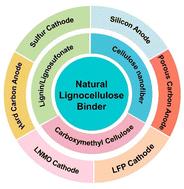
As a crucial component of batteries, the binder connects the granular active material and the conductive additive into a whole electrode and attaches to the surface of the current collector through a variety of interactions to maintain the electron/ion transport and the integrity of the electrode during the charge–discharge cycles. However, conventional binders are mostly synthetic polymers with single structures and properties and are not renewable, thus the development of multifunctional green renewable binders derived from biomass materials is attracting increasing attention. The distribution and function of lignocellulose in plants are similar to those of binders in electrodes. They strengthen the structure of the plants via hydrogen bonding, π–π conjugation, hydrophobicity, etc., and maintain the diffusion and transport of molecules, aligning with the criteria for the next generation of battery binders. In the context of the significant impact of binders on the performance of advanced battery systems, recent progress in research on lignocellulose derivative-based binders in various batteries is summarized. The research potential and challenges of lignocellulose and its derivatives as binder materials are discussed, with the hope of shedding light on the rational construction of robust and stable lignocellulose-based binders for high-energy-density batteries.
期刊介绍:
Green Chemistry is a journal that provides a unique forum for the publication of innovative research on the development of alternative green and sustainable technologies. The scope of Green Chemistry is based on the definition proposed by Anastas and Warner (Green Chemistry: Theory and Practice, P T Anastas and J C Warner, Oxford University Press, Oxford, 1998), which defines green chemistry as the utilisation of a set of principles that reduces or eliminates the use or generation of hazardous substances in the design, manufacture and application of chemical products. Green Chemistry aims to reduce the environmental impact of the chemical enterprise by developing a technology base that is inherently non-toxic to living things and the environment. The journal welcomes submissions on all aspects of research relating to this endeavor and publishes original and significant cutting-edge research that is likely to be of wide general appeal. For a work to be published, it must present a significant advance in green chemistry, including a comparison with existing methods and a demonstration of advantages over those methods.



 京公网安备 11010802042870号
京ICP备2023020795号-1
京公网安备 11010802042870号
京ICP备2023020795号-1

 分享
分享
 求助内容:
求助内容: 应助结果提醒方式:
 扫码关注我们
