Jetske Graafsma, Ewoudt M. W. van de Garde, Hieronymus J. Derijks, Rien H. L. Hoge, Joanna E. Klopotowska, Fatma Karapinar-Carkit, Patricia M. L. A. van den Bemt, for the Dutch CDSS-efficiency study group
{"title":"Efficiency of computerized clinical decision support systems involving anticoagulants: A flashmob study in Dutch hospital pharmacies","authors":"Jetske Graafsma, Ewoudt M. W. van de Garde, Hieronymus J. Derijks, Rien H. L. Hoge, Joanna E. Klopotowska, Fatma Karapinar-Carkit, Patricia M. L. A. van den Bemt, for the Dutch CDSS-efficiency study group","doi":"10.1111/bcp.16236","DOIUrl":null,"url":null,"abstract":"<div>\n \n <section>\n \n <h3> Aims</h3>\n \n <p>Computerized decision support systems (CDSSs) aim to prevent adverse drug events. However, these systems generate an overload of alerts that are not always clinically relevant. Anticoagulants are frequently involved in these alerts. The aim of this study was to investigate the efficiency of CDSS alerts on anticoagulants in Dutch hospital pharmacies.</p>\n </section>\n \n <section>\n \n <h3> Methods</h3>\n \n <p>A multicentre, single-day, cross-sectional study was conducted using a flashmob design in Dutch hospital pharmacies, which have CDSSs that operate on both a national medication surveillance database and on self-developed clinical rules. Hospital pharmacists and pharmacy technicians collected data on the number and type of alerts and time needed for assessing these alerts. The primary outcome was the CDSS efficiency on anticoagulants, defined as the percentage of alerts on anticoagulants that led to an intervention. Secondary outcomes where among other CDSSs efficiency related to any medications and the time expenditure. Descriptive data-analysis was used.</p>\n </section>\n \n <section>\n \n <h3> Results</h3>\n \n <p>Of the 69 hospital pharmacies invited, 42 (61%) participated. The efficiency of CDSS alerts on anticoagulants was 4.0% (interquartile range [IQR] 14.0%) for the national medication surveillance database alerts and 14.3% (IQR 40.0%) for alerts from clinical rules. For any medication, the efficiency was lower: 1.8% (IQR 7.5%) and 13.4% (IQR 21.5%) respectively. The median time for assessing the relevance of all alerts was 2 (IQR 1:21) h/day for pharmacists and 6 (IQR 5:01) h/day for pharmacy technicians.</p>\n </section>\n \n <section>\n \n <h3> Conclusion</h3>\n \n <p>CDSS efficiency is generally low, both for anticoagulants and any medication, while the time investment is high. Optimization of CDSSs is needed.</p>\n </section>\n </div>","PeriodicalId":9251,"journal":{"name":"British journal of clinical pharmacology","volume":"91 1","pages":"157-165"},"PeriodicalIF":3.0000,"publicationDate":"2024-09-10","publicationTypes":"Journal Article","fieldsOfStudy":null,"isOpenAccess":false,"openAccessPdf":"https://onlinelibrary.wiley.com/doi/epdf/10.1111/bcp.16236","citationCount":"0","resultStr":null,"platform":"Semanticscholar","paperid":null,"PeriodicalName":"British journal of clinical pharmacology","FirstCategoryId":"3","ListUrlMain":"https://bpspubs.onlinelibrary.wiley.com/doi/10.1111/bcp.16236","RegionNum":3,"RegionCategory":"医学","ArticlePicture":[],"TitleCN":null,"AbstractTextCN":null,"PMCID":null,"EPubDate":"","PubModel":"","JCR":"Q2","JCRName":"PHARMACOLOGY & PHARMACY","Score":null,"Total":0}
引用次数: 0
Abstract
Aims
Computerized decision support systems (CDSSs) aim to prevent adverse drug events. However, these systems generate an overload of alerts that are not always clinically relevant. Anticoagulants are frequently involved in these alerts. The aim of this study was to investigate the efficiency of CDSS alerts on anticoagulants in Dutch hospital pharmacies.
Methods
A multicentre, single-day, cross-sectional study was conducted using a flashmob design in Dutch hospital pharmacies, which have CDSSs that operate on both a national medication surveillance database and on self-developed clinical rules. Hospital pharmacists and pharmacy technicians collected data on the number and type of alerts and time needed for assessing these alerts. The primary outcome was the CDSS efficiency on anticoagulants, defined as the percentage of alerts on anticoagulants that led to an intervention. Secondary outcomes where among other CDSSs efficiency related to any medications and the time expenditure. Descriptive data-analysis was used.
Results
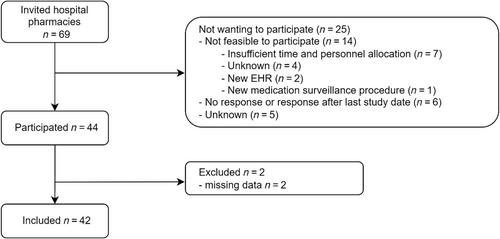
Of the 69 hospital pharmacies invited, 42 (61%) participated. The efficiency of CDSS alerts on anticoagulants was 4.0% (interquartile range [IQR] 14.0%) for the national medication surveillance database alerts and 14.3% (IQR 40.0%) for alerts from clinical rules. For any medication, the efficiency was lower: 1.8% (IQR 7.5%) and 13.4% (IQR 21.5%) respectively. The median time for assessing the relevance of all alerts was 2 (IQR 1:21) h/day for pharmacists and 6 (IQR 5:01) h/day for pharmacy technicians.
Conclusion
CDSS efficiency is generally low, both for anticoagulants and any medication, while the time investment is high. Optimization of CDSSs is needed.
期刊介绍:
Published on behalf of the British Pharmacological Society, the British Journal of Clinical Pharmacology features papers and reports on all aspects of drug action in humans: review articles, mini review articles, original papers, commentaries, editorials and letters. The Journal enjoys a wide readership, bridging the gap between the medical profession, clinical research and the pharmaceutical industry. It also publishes research on new methods, new drugs and new approaches to treatment. The Journal is recognised as one of the leading publications in its field. It is online only, publishes open access research through its OnlineOpen programme and is published monthly.