Telomere length and DNA methylation epitype both provide independent prognostic information in CLL patients; data from the UK CLL4, ARCTIC and ADMIRE clinical trials
Louise Carr, Kevin Norris, Helen Parker, Anna Nilsson-Takeuchi, Dean Bryant, Harindra Amarasinghe, Latha Kadalayil, Monica Else, Andrew Pettitt, Peter Hillmen, Anna Schuh, Renata Walewska, Duncan M. Baird, David G. Oscier, Christopher C. Oakes, Jane Gibson, Chris Pepper, Jonathan C. Strefford
{"title":"Telomere length and DNA methylation epitype both provide independent prognostic information in CLL patients; data from the UK CLL4, ARCTIC and ADMIRE clinical trials","authors":"Louise Carr, Kevin Norris, Helen Parker, Anna Nilsson-Takeuchi, Dean Bryant, Harindra Amarasinghe, Latha Kadalayil, Monica Else, Andrew Pettitt, Peter Hillmen, Anna Schuh, Renata Walewska, Duncan M. Baird, David G. Oscier, Christopher C. Oakes, Jane Gibson, Chris Pepper, Jonathan C. Strefford","doi":"10.1111/bjh.19765","DOIUrl":null,"url":null,"abstract":"<p>Patients with chronic lymphocytic leukaemia (CLL) exhibit varied clinical paths; some have indolent courses, while others experience aggressive disease.<span><sup>1</sup></span> Despite numerous molecular and cellular biomarkers being discovered, only <i>TP53</i> aberrations (<i>TP53ab</i>: <i>TP53</i> deletion and/or mutations) and unmutated IGHV status (U-CLL) are used for treatment stratification.<span><sup>2, 3</sup></span> Other biomarkers have not been adopted due to a lack of independent prognostic or predictive value. Validating new biomarkers in large phase II/III trials with extensive molecular characterization and long-term follow-up is crucial. This study aims to validate the clinical relevance of two CLL biomarkers, methylation-based epitype (DME) and telomere length (TL), using large trial cohorts.</p><p>CLL patients can be classified into three DME subgroups: naïve-like (n-CLL), intermediate (i-CLL) and memory-like CLL (m-CLL), based on similarities with normal B-cell maturation states.<span><sup>4, 5</sup></span> These subgroups correlate with IGHV mutational status and clinical outcomes, reflecting the influence of cell of origin signatures on disease behaviour.<span><sup>4</sup></span> TL in CLL cells, which correlates with DME, also has clinical utility.<span><sup>6, 7</sup></span> TL, measured by quartile cut-offs and fusogenic range, is associated with reduced progression-free (PFS) and overall survival (OS) in patients treated with (immuno)chemotherapy.<span><sup>8-10</sup></span> Notably, 59% of n-CLL and 85% of m-CLL patients exhibit short and long telomeres respectively.<span><sup>9</sup></span> This study aims to distinguish the clinical correlation of DME and TL in prospective trials, quantifying their individual association with survival to enhance the risk-adapted stratification of CLL patients.</p><p>Our study focused on 519 patients from three UK clinical trials based on the availability of DNA for biomarker profiling: UK LRF CLL4 (NCT00004218, <i>n</i> = 304), UKCRN ARCTIC (‘ARC’, ID7136, <i>n</i> = 107) and UKCRN ADMIRE (‘ADM’, ID6897, <i>n</i> = 108; Table S1). Due to similarities in inclusion criteria and follow-up data, ARC and ADM trials were combined for survival analysis.<span><sup>9</sup></span> We used pre-existing DME data and supplemented published TL data with new data from 60 patients selected based on DNA availability and pre-existing DME data (Table S2), using the MMQ-PCR assay with established TL cut-offs (TL-Short <2.92 kb, TL-Intermediate 2.92–3.57 kb, TL-Long >3.57 kb).<span><sup>9, 11, 12</sup></span> The analysed cohorts were representative of the wider clinical trials for an extensive biomarker panel (Tables S3 and S4). Informed consent was obtained from all patients, adhering to the Declaration of Helsinki and regional ethics committee approvals. For data inquiries, contact Jonathan C Strefford at <span>[email protected]</span>.</p><p>Initially, we confirmed the association between DME and TL, consistent with previous findings: 73% of m-CLL and 50% of n-CLL patients exhibited TL-L and TL-S respectively (<i>p</i> < 0.001; Figure 1A,B). We also showed that n-CLL and TL-S were linked with other poor-risk features, including U-CLL, biallelic <i>ATM</i> lesions and <i>TP53ab</i> (Figure 1C,D). Next, we verified the association of each clinico-biological feature, including DME and TL, with PFS and OS in the CLL4 and ARC/ADM trials using univariate and multivariate analyses.<span><sup>9, 11</sup></span> In univariate analysis, we found significant associations for TL and DME with OS and PFS in both trials (Figure 2Ai, ii). Specifically, TL-S had the worst PFS and OS in CLL4 (median 1.95 and 4.95 years respectively), compared to TL-I and TL-L (Tables S5 and S6). n-CLL had the highest hazard ratios (HR) for both PFS and OS in ARC/ADM (Tables S7 and S8). In CLL4, n-CLL had the shortest median PFS and OS among the DME subgroups, but <i>TP53ab</i> had a greater HR (Tables S5 and S6). Importantly, stratification of i-CLL patients in only the ARC/ADM cohort showed significantly longer PFS in TL-L patients (median PFS: 6.12 years) compared to those in the TL-S (median PFS: 3.8 years) or TL-I groups (median PFS: 4.35 years; PFS <i>p</i> < 0.01, Figure 2Bi, ii).</p><p>We compared the predictive performances of three biomarkers (DME, TL and <i>TP53ab</i>) for PFS and OS in both cohorts. Predictive performance was assessed using likelihood ratios (LR+/LR−). Due to limited <i>TP53</i> data, cohorts were restricted to 250 and 176 patients for CLL4 and ARC/ADM respectively. TL and DME emerged as the strongest predictors of PFS events in the CLL4 (LR+/LR−: 7.30) and ARC/ADM (LR+/LR-: 5.42) cohorts respectively (Table S9). For OS, DME showed the highest predictive potential in ARC/ADM (LR+/LR−: 3.69), followed by <i>TP53ab</i> (LR+/LR−: 3.30), while TL had a lower predictive potential (LR+/LR-: 1.87; Table S10).</p><p>Given our analysis suggesting that both DME and TL predict outcomes, we constructed a multivariate Cox regression model to assess their independent associations with PFS and OS. Eight significant predictors from univariate analysis were included in the initial model, followed by stepwise backwards elimination to reach the final model. For CLL4, the final models included 246 subjects, 221 PFS events and 205 OS events. The ARC/ADM PFS model was based on 138 subjects and 86 events, while the OS model included 176 subjects and 45 events. Both DME and TL provided independent prognostic information. TL-S independently predicted poorer PFS (CLL4 HR:2.14, 95% CI:1.39–3.3, <i>p</i> < 0.001; ARC/ADM HR:2.18, 95% CI:1.17–4.05, <i>p</i> < 0.01) and inferior OS in CLL4 (CLL4 HR:2.4, 95% CI:1.51–3.81, <i>p</i> < 0.001; ARC/ADM HR:2.26, 95% CI:1.09–4.67, <i>p</i> = 0.08). DME remained significant in all models except for PFS in ARC/ADM. <i>TP53ab</i> showed the highest increase in risk of progression (CLL4 HR:3.38, 95% CI:2.13–5.37, <i>p</i> < 0.001; ARC/ADM HR:4.94, 95% CI:2.58–9.48, <i>p</i> < 0.001; Figure 2C, Tables S11–S14). TL-S and n-CLL epitype were strongly associated with early patient death. Limited data availability prevented analysis of the clinical importance of IGLV3-21R110 in our cohort.<span><sup>13, 14</sup></span></p><p>In summary, our analysis is the first direct comparison of the prognostic impact of TL and DME in a large cohort of CLL patients enrolled in a prospective clinical trial, with extensive follow-up and molecular characterization, and confirmation in an independent cohort (ARC/ADM). Our study aimed to determine whether TL or DME is more clinically useful for managing CLL patients. Both biomarkers provided valuable information on adverse clinical events, including progression and death, suggesting they capture different biological aspects driving an aggressive phenotype. Future studies with larger cohorts and inclusion of patients in targeted agent trials are needed. Our findings highlight the additional prognostic value of TL and DME compared to established genomic lesions in predicting PFS and OS post-(immuno)-chemotherapy, suggesting they may help identify IGHV-mutated patients who might benefit more from targeted agents.</p><p>LC, KN, HP, ANT, HA, DMB and CCO performed the experimental work; LC, LK, ME, DB and JG conducted the statistical and bioinformatics analyses; ME, AP, PH, AS, RW and DGO contributed patient samples and data; LK, JG, JCS and CP initiated and designed the study; LK, HP, JG, CP and JCS wrote the paper; and all authors critically reviewed the final paper.</p><p>The authors have no sources of funding to disclose.</p><p>DMB and CP have received funding from TeloNostiX.</p><p>Data supporting the findings of this study are available from the corresponding author on reasonable request.</p><p>Approval was provided by Somerset Research Ethics committee (REC number 06/Q2202/30).</p><p>All patients signed an informed consent form.</p><p>These data are from three prospectively registered studies; UK LRF CLL4 (NCT00004218), UKCRN ARCTIC (‘ARC’, ID7136) and UKCRN ADMIRE (‘ADM’, ID6897).</p>","PeriodicalId":135,"journal":{"name":"British Journal of Haematology","volume":"205 5","pages":"2072-2076"},"PeriodicalIF":3.6000,"publicationDate":"2024-09-10","publicationTypes":"Journal Article","fieldsOfStudy":null,"isOpenAccess":false,"openAccessPdf":"https://onlinelibrary.wiley.com/doi/epdf/10.1111/bjh.19765","citationCount":"0","resultStr":null,"platform":"Semanticscholar","paperid":null,"PeriodicalName":"British Journal of Haematology","FirstCategoryId":"3","ListUrlMain":"https://onlinelibrary.wiley.com/doi/10.1111/bjh.19765","RegionNum":2,"RegionCategory":"医学","ArticlePicture":[],"TitleCN":null,"AbstractTextCN":null,"PMCID":null,"EPubDate":"","PubModel":"","JCR":"Q1","JCRName":"HEMATOLOGY","Score":null,"Total":0}
引用次数: 0
Abstract
Patients with chronic lymphocytic leukaemia (CLL) exhibit varied clinical paths; some have indolent courses, while others experience aggressive disease.1 Despite numerous molecular and cellular biomarkers being discovered, only TP53 aberrations (TP53ab: TP53 deletion and/or mutations) and unmutated IGHV status (U-CLL) are used for treatment stratification.2, 3 Other biomarkers have not been adopted due to a lack of independent prognostic or predictive value. Validating new biomarkers in large phase II/III trials with extensive molecular characterization and long-term follow-up is crucial. This study aims to validate the clinical relevance of two CLL biomarkers, methylation-based epitype (DME) and telomere length (TL), using large trial cohorts.
CLL patients can be classified into three DME subgroups: naïve-like (n-CLL), intermediate (i-CLL) and memory-like CLL (m-CLL), based on similarities with normal B-cell maturation states.4, 5 These subgroups correlate with IGHV mutational status and clinical outcomes, reflecting the influence of cell of origin signatures on disease behaviour.4 TL in CLL cells, which correlates with DME, also has clinical utility.6, 7 TL, measured by quartile cut-offs and fusogenic range, is associated with reduced progression-free (PFS) and overall survival (OS) in patients treated with (immuno)chemotherapy.8-10 Notably, 59% of n-CLL and 85% of m-CLL patients exhibit short and long telomeres respectively.9 This study aims to distinguish the clinical correlation of DME and TL in prospective trials, quantifying their individual association with survival to enhance the risk-adapted stratification of CLL patients.
Our study focused on 519 patients from three UK clinical trials based on the availability of DNA for biomarker profiling: UK LRF CLL4 (NCT00004218, n = 304), UKCRN ARCTIC (‘ARC’, ID7136, n = 107) and UKCRN ADMIRE (‘ADM’, ID6897, n = 108; Table S1). Due to similarities in inclusion criteria and follow-up data, ARC and ADM trials were combined for survival analysis.9 We used pre-existing DME data and supplemented published TL data with new data from 60 patients selected based on DNA availability and pre-existing DME data (Table S2), using the MMQ-PCR assay with established TL cut-offs (TL-Short <2.92 kb, TL-Intermediate 2.92–3.57 kb, TL-Long >3.57 kb).9, 11, 12 The analysed cohorts were representative of the wider clinical trials for an extensive biomarker panel (Tables S3 and S4). Informed consent was obtained from all patients, adhering to the Declaration of Helsinki and regional ethics committee approvals. For data inquiries, contact Jonathan C Strefford at [email protected].
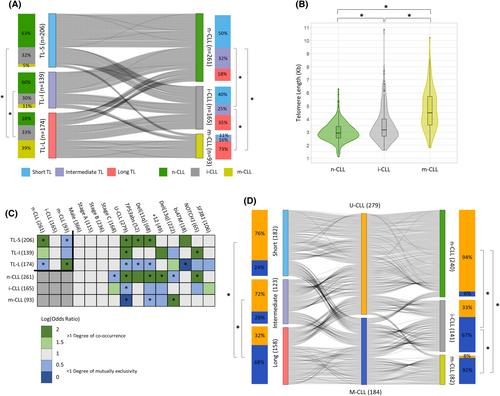
Initially, we confirmed the association between DME and TL, consistent with previous findings: 73% of m-CLL and 50% of n-CLL patients exhibited TL-L and TL-S respectively (p < 0.001; Figure 1A,B). We also showed that n-CLL and TL-S were linked with other poor-risk features, including U-CLL, biallelic ATM lesions and TP53ab (Figure 1C,D). Next, we verified the association of each clinico-biological feature, including DME and TL, with PFS and OS in the CLL4 and ARC/ADM trials using univariate and multivariate analyses.9, 11 In univariate analysis, we found significant associations for TL and DME with OS and PFS in both trials (Figure 2Ai, ii). Specifically, TL-S had the worst PFS and OS in CLL4 (median 1.95 and 4.95 years respectively), compared to TL-I and TL-L (Tables S5 and S6). n-CLL had the highest hazard ratios (HR) for both PFS and OS in ARC/ADM (Tables S7 and S8). In CLL4, n-CLL had the shortest median PFS and OS among the DME subgroups, but TP53ab had a greater HR (Tables S5 and S6). Importantly, stratification of i-CLL patients in only the ARC/ADM cohort showed significantly longer PFS in TL-L patients (median PFS: 6.12 years) compared to those in the TL-S (median PFS: 3.8 years) or TL-I groups (median PFS: 4.35 years; PFS p < 0.01, Figure 2Bi, ii).
We compared the predictive performances of three biomarkers (DME, TL and TP53ab) for PFS and OS in both cohorts. Predictive performance was assessed using likelihood ratios (LR+/LR−). Due to limited TP53 data, cohorts were restricted to 250 and 176 patients for CLL4 and ARC/ADM respectively. TL and DME emerged as the strongest predictors of PFS events in the CLL4 (LR+/LR−: 7.30) and ARC/ADM (LR+/LR-: 5.42) cohorts respectively (Table S9). For OS, DME showed the highest predictive potential in ARC/ADM (LR+/LR−: 3.69), followed by TP53ab (LR+/LR−: 3.30), while TL had a lower predictive potential (LR+/LR-: 1.87; Table S10).
Given our analysis suggesting that both DME and TL predict outcomes, we constructed a multivariate Cox regression model to assess their independent associations with PFS and OS. Eight significant predictors from univariate analysis were included in the initial model, followed by stepwise backwards elimination to reach the final model. For CLL4, the final models included 246 subjects, 221 PFS events and 205 OS events. The ARC/ADM PFS model was based on 138 subjects and 86 events, while the OS model included 176 subjects and 45 events. Both DME and TL provided independent prognostic information. TL-S independently predicted poorer PFS (CLL4 HR:2.14, 95% CI:1.39–3.3, p < 0.001; ARC/ADM HR:2.18, 95% CI:1.17–4.05, p < 0.01) and inferior OS in CLL4 (CLL4 HR:2.4, 95% CI:1.51–3.81, p < 0.001; ARC/ADM HR:2.26, 95% CI:1.09–4.67, p = 0.08). DME remained significant in all models except for PFS in ARC/ADM. TP53ab showed the highest increase in risk of progression (CLL4 HR:3.38, 95% CI:2.13–5.37, p < 0.001; ARC/ADM HR:4.94, 95% CI:2.58–9.48, p < 0.001; Figure 2C, Tables S11–S14). TL-S and n-CLL epitype were strongly associated with early patient death. Limited data availability prevented analysis of the clinical importance of IGLV3-21R110 in our cohort.13, 14
In summary, our analysis is the first direct comparison of the prognostic impact of TL and DME in a large cohort of CLL patients enrolled in a prospective clinical trial, with extensive follow-up and molecular characterization, and confirmation in an independent cohort (ARC/ADM). Our study aimed to determine whether TL or DME is more clinically useful for managing CLL patients. Both biomarkers provided valuable information on adverse clinical events, including progression and death, suggesting they capture different biological aspects driving an aggressive phenotype. Future studies with larger cohorts and inclusion of patients in targeted agent trials are needed. Our findings highlight the additional prognostic value of TL and DME compared to established genomic lesions in predicting PFS and OS post-(immuno)-chemotherapy, suggesting they may help identify IGHV-mutated patients who might benefit more from targeted agents.
LC, KN, HP, ANT, HA, DMB and CCO performed the experimental work; LC, LK, ME, DB and JG conducted the statistical and bioinformatics analyses; ME, AP, PH, AS, RW and DGO contributed patient samples and data; LK, JG, JCS and CP initiated and designed the study; LK, HP, JG, CP and JCS wrote the paper; and all authors critically reviewed the final paper.
The authors have no sources of funding to disclose.
DMB and CP have received funding from TeloNostiX.
Data supporting the findings of this study are available from the corresponding author on reasonable request.
Approval was provided by Somerset Research Ethics committee (REC number 06/Q2202/30).
All patients signed an informed consent form.
These data are from three prospectively registered studies; UK LRF CLL4 (NCT00004218), UKCRN ARCTIC (‘ARC’, ID7136) and UKCRN ADMIRE (‘ADM’, ID6897).
期刊介绍:
The British Journal of Haematology publishes original research papers in clinical, laboratory and experimental haematology. The Journal also features annotations, reviews, short reports, images in haematology and Letters to the Editor.




 京公网安备 11010802042870号
京ICP备2023020795号-1
京公网安备 11010802042870号
京ICP备2023020795号-1

 分享
分享
 求助内容:
求助内容: 应助结果提醒方式:
 扫码关注我们
