Haiting Zou , Miaomiao Pan , Ping Wang , Feng Chen , Xuefei Wang , Huogen Yu
{"title":"2D/2D Mo2CTx/g-C3N4 with a strong coupling interface via one-step NH4Cl-assisted calcination for enhanced photocatalytic hydrogen production†","authors":"Haiting Zou , Miaomiao Pan , Ping Wang , Feng Chen , Xuefei Wang , Huogen Yu","doi":"10.1039/d4cy00882k","DOIUrl":null,"url":null,"abstract":"<div><div>Mo<sub>2</sub>CT<sub>x</sub> is regarded as a potential cocatalyst to substitute noble metals in photocatalytic hydrogen production owing to its good electrical conductivity and a large number of active sites. However, Mo<sub>2</sub>CT<sub>x</sub>-based photocatalysts by the conventional physical mixing method always display a weak coupling interface between Mo<sub>2</sub>CT<sub>x</sub> and photocatalysts due to the large block-layered structure of Mo<sub>2</sub>CT<sub>x</sub>, which results in slow photogenerated-electron transfer of photocatalysts, thereby leading to unsatisfactory hydrogen production efficiency. Considering that <em>in situ</em> construction and the 2D/2D structure can increase the contact area and enhance the coupling interface interaction, in this study, a strategy of constructing a 2D/2D Mo<sub>2</sub>CT<sub>x</sub>/g-C<sub>3</sub>N<sub>4</sub> photocatalyst from pre-etched Mo<sub>2</sub>CT<sub>x</sub> and guanidine hydrochloride (CH<sub>6</sub>ClN<sub>3</sub>) through a one-step NH<sub>4</sub>Cl-assisted calcination method is realized by the gas-expansion exfoliation of Mo<sub>2</sub>CT<sub>x</sub> and <em>in situ</em> generation of thin g-C<sub>3</sub>N<sub>4</sub> nanosheets. Experimental results unveiled that the 2D/2D Mo<sub>2</sub>CT<sub>x</sub>/g-C<sub>3</sub>N<sub>4</sub> composite photocatalyst exhibits an exceptional H<sub>2</sub>-evolution activity (125 μmol h<sup>−1</sup> g<sup>−1</sup>, AQE = 3.88%), which is almost 25 and 18 times greater than that of pure g-C<sub>3</sub>N<sub>4</sub> and physically mixed Mo<sub>2</sub>CT<sub>x</sub>–g-C<sub>3</sub>N<sub>4</sub>, respectively. The enhanced photocatalytic H<sub>2</sub>-production efficiency is attributed to the robust coupling interface between Mo<sub>2</sub>CT<sub>x</sub> and g-C<sub>3</sub>N<sub>4</sub> in 2D/2D Mo<sub>2</sub>CT<sub>x</sub>/g-C<sub>3</sub>N<sub>4</sub>, which promotes the fast photogenerated electron transfer from g-C<sub>3</sub>N<sub>4</sub> to Mo<sub>2</sub>CT<sub>x</sub> and achieves an optimized Gibbs free energy. This study offers a novel perspective on preparing high-efficiency 2D/2D MXene-based photocatalysts.</div></div>","PeriodicalId":66,"journal":{"name":"Catalysis Science & Technology","volume":"14 19","pages":"Pages 5731-5738"},"PeriodicalIF":4.2000,"publicationDate":"2024-09-30","publicationTypes":"Journal Article","fieldsOfStudy":null,"isOpenAccess":false,"openAccessPdf":"","citationCount":"0","resultStr":null,"platform":"Semanticscholar","paperid":null,"PeriodicalName":"Catalysis Science & Technology","FirstCategoryId":"92","ListUrlMain":"https://www.sciencedirect.com/org/science/article/pii/S2044475324004829","RegionNum":3,"RegionCategory":"化学","ArticlePicture":[],"TitleCN":null,"AbstractTextCN":null,"PMCID":null,"EPubDate":"2024/8/12 0:00:00","PubModel":"Epub","JCR":"Q2","JCRName":"CHEMISTRY, PHYSICAL","Score":null,"Total":0}
引用次数: 0
Abstract
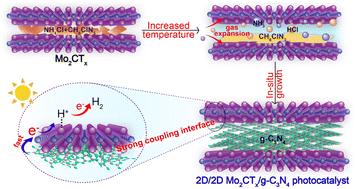
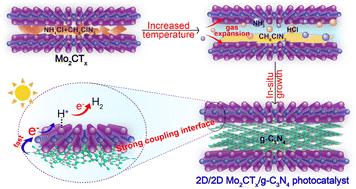
Mo2CTx is regarded as a potential cocatalyst to substitute noble metals in photocatalytic hydrogen production owing to its good electrical conductivity and a large number of active sites. However, Mo2CTx-based photocatalysts by the conventional physical mixing method always display a weak coupling interface between Mo2CTx and photocatalysts due to the large block-layered structure of Mo2CTx, which results in slow photogenerated-electron transfer of photocatalysts, thereby leading to unsatisfactory hydrogen production efficiency. Considering that in situ construction and the 2D/2D structure can increase the contact area and enhance the coupling interface interaction, in this study, a strategy of constructing a 2D/2D Mo2CTx/g-C3N4 photocatalyst from pre-etched Mo2CTx and guanidine hydrochloride (CH6ClN3) through a one-step NH4Cl-assisted calcination method is realized by the gas-expansion exfoliation of Mo2CTx and in situ generation of thin g-C3N4 nanosheets. Experimental results unveiled that the 2D/2D Mo2CTx/g-C3N4 composite photocatalyst exhibits an exceptional H2-evolution activity (125 μmol h−1 g−1, AQE = 3.88%), which is almost 25 and 18 times greater than that of pure g-C3N4 and physically mixed Mo2CTx–g-C3N4, respectively. The enhanced photocatalytic H2-production efficiency is attributed to the robust coupling interface between Mo2CTx and g-C3N4 in 2D/2D Mo2CTx/g-C3N4, which promotes the fast photogenerated electron transfer from g-C3N4 to Mo2CTx and achieves an optimized Gibbs free energy. This study offers a novel perspective on preparing high-efficiency 2D/2D MXene-based photocatalysts.
期刊介绍:
A multidisciplinary journal focusing on cutting edge research across all fundamental science and technological aspects of catalysis.
Editor-in-chief: Bert Weckhuysen
Impact factor: 5.0
Time to first decision (peer reviewed only): 31 days



 京公网安备 11010802042870号
京ICP备2023020795号-1
京公网安备 11010802042870号
京ICP备2023020795号-1

 分享
分享
 求助内容:
求助内容: 应助结果提醒方式:
 扫码关注我们
