Yanan Pan, Qi Yang, Xiaoying Liu, Fan Qiu, Junjie Chen, Mengdie Yang, Yang Fan, Haiou Song and Shupeng Zhang
{"title":"Multi-metal (Fe, Cu, and Zn) coordinated hollow porous dodecahedron nanocage catalyst for oxygen reduction in Zn–air batteries†","authors":"Yanan Pan, Qi Yang, Xiaoying Liu, Fan Qiu, Junjie Chen, Mengdie Yang, Yang Fan, Haiou Song and Shupeng Zhang","doi":"10.1039/D4YA00295D","DOIUrl":null,"url":null,"abstract":"<p >The coupling of multiple low-cost metals and porous nanocarbon materials aimed at replacing precious metals to enhance electrocatalytic oxygen reduction is a critical challenge in some crucial research areas. In the present study, a hollow dodecahedron nanocage catalyst (Fe<small><sub>3</sub></small>O<small><sub>4</sub></small>/CuNCs/ZnN<small><sub><em>x</em></sub></small>-PHNC) was constructed by supporting copper nanoclusters, Fe<small><sub>3</sub></small>O<small><sub>4</sub></small> nanoparticles, and Zn–N<small><sub><em>x</em></sub></small> after sintering and annealing through the coordination of ZIF-8 and by doping copper and iron ions. We observed that the synergy of the multi-metals in the magnetically separable heterojunction catalyst induced electron transfer and inhibited hydrogen peroxide formation, thus improving its catalytic performance for the oxygen-reduction reaction. The catalyst demonstrated a half-wave potential as high as 0.832 V and a Tafel slope of 54 mV decade<small><sup>−1</sup></small>, superior to many non-precious metal catalysts reported in the literature. The assembled Zn–air battery (ZAB) exhibited a maximum power density of 162 mW cm<small><sup>−2</sup></small> and ultrahigh stability of >500 h at 5 mA cm<small><sup>−2</sup></small> current density. The ZAB's excellent performance indicates its high development and practical application prospects.</p>","PeriodicalId":72913,"journal":{"name":"Energy advances","volume":" 10","pages":" 2648-2657"},"PeriodicalIF":4.3000,"publicationDate":"2024-09-05","publicationTypes":"Journal Article","fieldsOfStudy":null,"isOpenAccess":false,"openAccessPdf":"https://pubs.rsc.org/en/content/articlepdf/2024/ya/d4ya00295d?page=search","citationCount":"0","resultStr":null,"platform":"Semanticscholar","paperid":null,"PeriodicalName":"Energy advances","FirstCategoryId":"1085","ListUrlMain":"https://pubs.rsc.org/en/content/articlelanding/2024/ya/d4ya00295d","RegionNum":0,"RegionCategory":null,"ArticlePicture":[],"TitleCN":null,"AbstractTextCN":null,"PMCID":null,"EPubDate":"","PubModel":"","JCR":"Q2","JCRName":"CHEMISTRY, PHYSICAL","Score":null,"Total":0}
引用次数: 0
Abstract
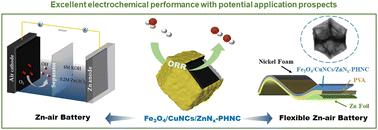
The coupling of multiple low-cost metals and porous nanocarbon materials aimed at replacing precious metals to enhance electrocatalytic oxygen reduction is a critical challenge in some crucial research areas. In the present study, a hollow dodecahedron nanocage catalyst (Fe3O4/CuNCs/ZnNx-PHNC) was constructed by supporting copper nanoclusters, Fe3O4 nanoparticles, and Zn–Nx after sintering and annealing through the coordination of ZIF-8 and by doping copper and iron ions. We observed that the synergy of the multi-metals in the magnetically separable heterojunction catalyst induced electron transfer and inhibited hydrogen peroxide formation, thus improving its catalytic performance for the oxygen-reduction reaction. The catalyst demonstrated a half-wave potential as high as 0.832 V and a Tafel slope of 54 mV decade−1, superior to many non-precious metal catalysts reported in the literature. The assembled Zn–air battery (ZAB) exhibited a maximum power density of 162 mW cm−2 and ultrahigh stability of >500 h at 5 mA cm−2 current density. The ZAB's excellent performance indicates its high development and practical application prospects.



 京公网安备 11010802042870号
京ICP备2023020795号-1
京公网安备 11010802042870号
京ICP备2023020795号-1

 分享
分享

 求助内容:
求助内容: 应助结果提醒方式:
 扫码关注我们
