Emergency delivery in case of suspected placenta accreta spectrum: Can it be predicted?

IF 3.1 2区 医学 Q1 OBSTETRICS & GYNECOLOGY Acta Obstetricia et Gynecologica Scandinavica Pub Date : 2024-09-11 DOI:10.1111/aogs.14931
Petra Hanulikova, Egle Savukyne, Karin A. Fox, Lukas Sobisek, Mina Mhallem, Heleen J. van Beekhuizen, Vedran Stefanovic, Thorsten Braun, Alexander Paping, Charline Bertholdt, Olivier Morel, IS-PAS
{"title":"Emergency delivery in case of suspected placenta accreta spectrum: Can it be predicted?","authors":"Petra Hanulikova,&nbsp;Egle Savukyne,&nbsp;Karin A. Fox,&nbsp;Lukas Sobisek,&nbsp;Mina Mhallem,&nbsp;Heleen J. van Beekhuizen,&nbsp;Vedran Stefanovic,&nbsp;Thorsten Braun,&nbsp;Alexander Paping,&nbsp;Charline Bertholdt,&nbsp;Olivier Morel,&nbsp;IS-PAS","doi":"10.1111/aogs.14931","DOIUrl":null,"url":null,"abstract":"<div>\n \n \n <section>\n \n <h3> Introduction</h3>\n \n <p>The main goal of placenta accreta spectrum (PAS) screening is to enable delivery in an expert center in the presence of an experienced team at an appropriate time. Our study aimed to identify independent risk factors for emergency deliveries within the IS-PAS 2.0 database cohort and establish a multivariate predictive model.</p>\n </section>\n \n <section>\n \n <h3> Material and Methods</h3>\n \n <p>A retrospective analysis of prospectively collected PAS cases from the IS-PAS database between January 2020 and June 2022 by 23 international expert centers was performed. All PAS cases (singleton and multiple pregnancies) managed according to local protocols were included. Individuals with emergent delivery were identified and compared to those with scheduled delivery. A multivariate analysis was conducted to identify the possible risk factors for emergency delivery and was used to establish a predictive model. Maternal outcomes were compared.</p>\n </section>\n \n <section>\n \n <h3> Results</h3>\n \n <p>Overall, 315 women were included in the study. Of these, 182 participants (89 with emergent and 93 with scheduled delivery) were included in the final analysis after exclusion of those with unsuspected PAS antenatally or who lacked information about the urgency of delivery. Gestational age at delivery was higher in the scheduled group (34.7 vs. 32.9, <i>p</i> &lt; 0.001). Antenatal bleeding (OR 2.9, <i>p</i> = 0.02) and a placenta located over a uterine scar (OR 0.38, <i>p</i> = 0.001) were the independent predictive factors for emergent delivery (AUC 0.68). Ultrasound (US) markers: loss of clear zone (<i>p</i> = 0.001), placental lacunae (<i>p</i> = 0.01), placental bulge (<i>p</i> = 0.02), and presence of bridging vessels (<i>p</i> = 0.02) were more frequently documented in the scheduled group. None of these markers improved the predictive values of the model. Higher PAS grades were identified in the scheduled group (<i>p</i> = 0.01). There were no significant differences in maternal outcomes.</p>\n </section>\n \n <section>\n \n <h3> Conclusions</h3>\n \n <p>Antenatal bleeding and the placental location away from the uterine scar remained the most significant predictors for emergent delivery among patients with PAS, even when combining more predictive risk factors, including US markers. Based on these results, patients who bleed antenatally may benefit from transfer to an expert center, as we found no differences in maternal outcomes between groups delivered in expert centers. Earlier-scheduled delivery is not supported due to the low predictive value of our model.</p>\n </section>\n </div>","PeriodicalId":6990,"journal":{"name":"Acta Obstetricia et Gynecologica Scandinavica","volume":"104 S1","pages":"29-37"},"PeriodicalIF":3.1000,"publicationDate":"2024-09-11","publicationTypes":"Journal Article","fieldsOfStudy":null,"isOpenAccess":false,"openAccessPdf":"https://onlinelibrary.wiley.com/doi/epdf/10.1111/aogs.14931","citationCount":"0","resultStr":null,"platform":"Semanticscholar","paperid":null,"PeriodicalName":"Acta Obstetricia et Gynecologica Scandinavica","FirstCategoryId":"3","ListUrlMain":"https://obgyn.onlinelibrary.wiley.com/doi/10.1111/aogs.14931","RegionNum":2,"RegionCategory":"医学","ArticlePicture":[],"TitleCN":null,"AbstractTextCN":null,"PMCID":null,"EPubDate":"","PubModel":"","JCR":"Q1","JCRName":"OBSTETRICS & GYNECOLOGY","Score":null,"Total":0}
引用次数: 0

Abstract

Introduction

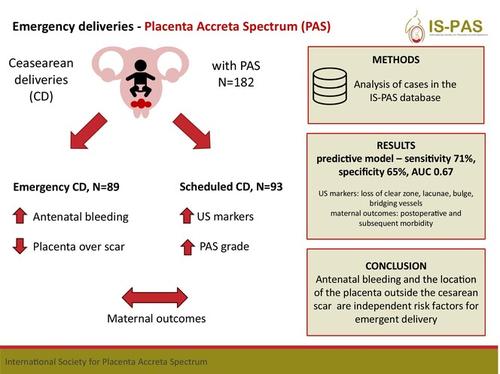
The main goal of placenta accreta spectrum (PAS) screening is to enable delivery in an expert center in the presence of an experienced team at an appropriate time. Our study aimed to identify independent risk factors for emergency deliveries within the IS-PAS 2.0 database cohort and establish a multivariate predictive model.

Material and Methods

A retrospective analysis of prospectively collected PAS cases from the IS-PAS database between January 2020 and June 2022 by 23 international expert centers was performed. All PAS cases (singleton and multiple pregnancies) managed according to local protocols were included. Individuals with emergent delivery were identified and compared to those with scheduled delivery. A multivariate analysis was conducted to identify the possible risk factors for emergency delivery and was used to establish a predictive model. Maternal outcomes were compared.

Results

Overall, 315 women were included in the study. Of these, 182 participants (89 with emergent and 93 with scheduled delivery) were included in the final analysis after exclusion of those with unsuspected PAS antenatally or who lacked information about the urgency of delivery. Gestational age at delivery was higher in the scheduled group (34.7 vs. 32.9, p < 0.001). Antenatal bleeding (OR 2.9, p = 0.02) and a placenta located over a uterine scar (OR 0.38, p = 0.001) were the independent predictive factors for emergent delivery (AUC 0.68). Ultrasound (US) markers: loss of clear zone (p = 0.001), placental lacunae (p = 0.01), placental bulge (p = 0.02), and presence of bridging vessels (p = 0.02) were more frequently documented in the scheduled group. None of these markers improved the predictive values of the model. Higher PAS grades were identified in the scheduled group (p = 0.01). There were no significant differences in maternal outcomes.

Conclusions

Antenatal bleeding and the placental location away from the uterine scar remained the most significant predictors for emergent delivery among patients with PAS, even when combining more predictive risk factors, including US markers. Based on these results, patients who bleed antenatally may benefit from transfer to an expert center, as we found no differences in maternal outcomes between groups delivered in expert centers. Earlier-scheduled delivery is not supported due to the low predictive value of our model.

Abstract Image

Abstract Image

Abstract Image

Abstract Image

查看原文
分享 分享
微信好友 朋友圈 QQ好友 复制链接
本刊更多论文
疑似胎盘早剥的紧急分娩:能否预测?
胎盘早剥筛查(PAS)的主要目的是在专家中心由经验丰富的团队在适当的时间进行分娩。我们的研究旨在确定 IS-PAS 2.0 数据库队列中紧急分娩的独立风险因素,并建立一个多变量预测模型。
本文章由计算机程序翻译,如有差异,请以英文原文为准。
求助全文
约1分钟内获得全文 去求助
来源期刊
CiteScore
8.00
自引率
4.70%
发文量
180
审稿时长
3-6 weeks
期刊介绍: Published monthly, Acta Obstetricia et Gynecologica Scandinavica is an international journal dedicated to providing the very latest information on the results of both clinical, basic and translational research work related to all aspects of women’s health from around the globe. The journal regularly publishes commentaries, reviews, and original articles on a wide variety of topics including: gynecology, pregnancy, birth, female urology, gynecologic oncology, fertility and reproductive biology.
期刊最新文献
Pregnancies in women with rare diseases: Selected maternal and perinatal outcomes. Predictive value of alcohol use questionnaires for adverse pregnancy outcomes: Evidence from a Finnish birth cohort. Beyond complication rates: Surgical instrumentation, clinical decision-making, and long-term outcomes in uterine evacuation. Real-world evaluation of a population-based vaginal self-sampling program for cervical cancer prevention in Region Skåne, Sweden. Is colorectal resection necessary to improve pain and fertility outcomes in patients with deep endometriosis?
×
引用
GB/T 7714-2015
复制
MLA
复制
APA
复制
导出至
BibTeX EndNote RefMan NoteFirst NoteExpress
×
×
提示
您的信息不完整,为了账户安全,请先补充。
现在去补充
×
提示
您因"违规操作"
具体请查看互助需知
我知道了
×
提示
现在去查看 取消
×
提示
确定
0
微信
客服QQ
Book学术公众号 扫码关注我们
反馈
×
意见反馈
请填写您的意见或建议
请填写您的手机或邮箱
已复制链接
已复制链接
快去分享给好友吧!
我知道了
×
扫码分享
扫码分享
Book学术官方微信
Book学术官方微信
Book学术文献互助
Book学术文献互助群
群 号:604180095
Book学术
文献互助 智能选刊 最新文献 互助须知 联系我们:info@booksci.cn
Book学术提供免费学术资源搜索服务,方便国内外学者检索中英文文献。致力于提供最便捷和优质的服务体验。
Copyright © 2023 Book学术 All rights reserved.
ghs 京公网安备 11010802042870号 京ICP备2023020795号-1